Filled PTFE compounds are used because they preserve PTFE’s chemical resistance and low friction while correcting its main mechanical weaknesses. Raw PTFE can creep under continuous load, wear during friction, and change dimensionally over time. Adding fillers such as glass fiber, graphite, carbon, mica, or powdered metals improves wear resistance, load-bearing capability, creep resistance, and, where needed, thermal or electrical conductivity.
The central advantage of filled PTFE is balance: it delivers PTFE’s chemical inertness and low-friction behavior with the dimensional stability and durability required for heavy-duty laboratory components.
Why Raw PTFE Is Insufficient for Heavy-Duty Use
Continuous load causes creep
Raw PTFE tends to deform gradually when subjected to sustained compression, bolt loading, pressure, or elevated temperatures. This behavior, known as cold flow or creep, can change the dimensions of a machined component and eventually reduce seal integrity.
In laboratory valves, flanges, pump components, and mechanical supports, that deformation can lead to leakage, loss of alignment, or reduced operating life.
Friction accelerates wear
PTFE has a very low coefficient of friction, but low friction does not automatically mean high wear resistance. Under continuous sliding, oscillation, or contact pressure, unfilled PTFE can wear more quickly than a filled grade designed for that service.
This matters for bearings, bushings, wear rings, dynamic seals, and pump components, where material surfaces repeatedly interact.
Thermal and electrical properties are limited
Raw PTFE has relatively low thermal and electrical conductivity. That can be useful for insulation, but it can limit heat dissipation or prevent a component from meeting a required conductivity specification.
Fillers allow the compound to be tailored for more demanding thermal or electrical conditions.
How Fillers Improve PTFE Performance
Reinforcement reduces deformation
Fillers restrict movement within the PTFE matrix and improve resistance to deformation under load. Filled grades generally provide substantially better creep resistance than unfilled PTFE, including at elevated temperatures.
Carbon and graphite combinations are particularly effective for reducing deformation, while high levels of bronze can also provide strong load resistance.
Wear resistance increases
Glass fiber, carbon, graphite, and certain mineral or metallic fillers help the material withstand continuous friction and contact pressure. The result is a longer-wearing surface for components exposed to movement or repeated mechanical stress.
The specific filler affects whether the compound is optimized for abrasive wear, sliding wear, compressive loading, or dimensional stability.
Hardness and compressive stability improve
Filled compounds are generally harder than raw PTFE. Typical Shore D hardness can increase from approximately 50–55 for unfilled PTFE to roughly 55–70 for filled compounds, depending on the filler and concentration.
Greater hardness helps components resist indentation, distortion, and damage during assembly or operation.
Thermal and electrical behavior can be customized
Graphite, carbon black, and powdered metals can alter the compound’s thermal or electrical conductivity. This makes it possible to select a grade based not only on chemical compatibility and friction, but also on heat transfer or static-dissipation requirements.
The result is a material better suited to a specific laboratory component rather than a general-purpose PTFE part.
Why Filled PTFE Suits Custom-Machined Components
It maintains dimensional stability
Custom-machined parts must retain their designed geometry after machining and during service. Improved creep resistance and lower thermal expansion help filled PTFE components maintain closer dimensional control under pressure, temperature changes, and continuous loading.
This is important for close-fitting valve seats, bushings, bearing surfaces, seals, and wear rings.
It supports dynamic applications
Static chemical resistance is not enough for parts that move. Pump diaphragms, mechanical stirrer bearings, impellers, and dynamic seals must tolerate repeated motion, friction, and mechanical stress.
Filled PTFE compounds provide the durability needed for these dynamic conditions while retaining PTFE’s resistance to many aggressive chemicals.
It extends service life
A component that wears or deforms rapidly can cause leakage, downtime, frequent replacement, or damage to mating parts. Filled PTFE helps preserve functional dimensions and surface performance for longer periods.
That makes it particularly valuable when laboratory equipment operates continuously, under pressure, or through repeated thermal cycles.
Why Chemical Resistance Still Matters
The PTFE matrix retains its core advantages
Filling PTFE does not eliminate the underlying benefits of the fluoropolymer. Filled grades generally retain strong chemical resistance, low surface energy, and low-friction behavior.
This combination is important in laboratory environments where mechanical components may also contact corrosive chemicals, solvents, or reactive process fluids.
Mechanical performance is added selectively
The filler is chosen according to the primary operating requirement. Glass fiber may be selected for reinforcement, graphite or carbon for wear and creep resistance, and metal powders for particular load or conductivity requirements.
Material selection therefore becomes a design decision involving the fluid, temperature, load, motion, pressure, and electrical requirements.
Understanding the Trade-offs
Strength does not improve in every direction
Fillers often improve hardness, wear resistance, and compressive stability, but increasing filler content can reduce tensile strength and elongation. Unfilled PTFE may have tensile strength around 20.6–29.9 MPa and elongation of 250–400%, while heavily filled grades can be less ductile.
A filled compound is therefore not automatically superior for every application; it is optimized for specific mechanical demands.
Filled PTFE can be anisotropic
Non-spherical filler particles can create directional anisotropy, meaning properties may differ along the molding direction and across it. This is relevant when the component experiences highly directional loads or when machining orientation affects performance.
Manufacturing history and part geometry should be considered during material selection.
Purity and chemical inertness may change
Virgin PTFE provides the highest level of chemical purity. Fillers introduce additional materials that may affect extractables, contamination limits, or compatibility with a particular chemical environment.
For highly sensitive analytical or pharmaceutical applications, the filler composition must be reviewed rather than selected solely for mechanical performance.
Filler choice can create secondary effects
Some fillers may increase hardness or wear resistance while affecting mating surfaces, friction behavior, electrical properties, or thermal expansion. A grade that performs well as a bearing material may not be ideal for a high-purity seal or an electrically insulating component.
The correct comparison is between application-specific grades, not simply “filled” versus “unfilled” PTFE.
Making the Right Choice for Your Goal
Filled PTFE is most appropriate when the component must combine chemical resistance with sustained mechanical performance.
- If your primary focus is wear resistance: Select a filled grade containing graphite, carbon, glass fiber, or another wear-focused reinforcement for sliding seals, bushings, bearings, and wear rings.
- If your primary focus is creep resistance: Use a compound designed for compressive and continuous-load stability, particularly for valve seats, gaskets, flanges, and pressure seals.
- If your primary focus is dimensional stability: Choose a reinforced grade with lower deformation and thermal expansion for precision-machined laboratory components.
- If your primary focus is thermal or electrical performance: Evaluate carbon, graphite, carbon black, or metallic fillers according to the required conductivity and the surrounding chemical conditions.
- If your primary focus is maximum purity and chemical inertness: Use raw PTFE when loads, friction, and dimensional stability are modest and filler contamination is unacceptable.
Filled PTFE is chosen when the application needs PTFE’s chemical and friction advantages without accepting raw PTFE’s susceptibility to creep, wear, and dimensional change.
Summary Table:
| Property | Raw PTFE | Filled PTFE |
|---|---|---|
| Creep resistance | Poor | Improved significantly |
| Wear resistance | Low | High (with fillers) |
| Dimensional stability | Poor | Good |
| Hardness (Shore D) | 50–55 | 55–70 |
| Chemical resistance | Excellent | Good (inherent) |
| Tensile strength | 20.6–29.9 MPa | Variable, often lower |
| Elongation | 250–400% | Reduced |
| Thermal/electrical conductivity | Low | Can be tailored |
Enhance your lab's heavy-duty components with precision-machined filled PTFE parts from KINTEK. Our custom CNC machining expertise covers everything from wear-resistant bearings to creep-resistant seals, ensuring reliability under the toughest conditions. Contact us today for a tailored solution that optimizes performance and longevity. Get in touch now!
Related Products
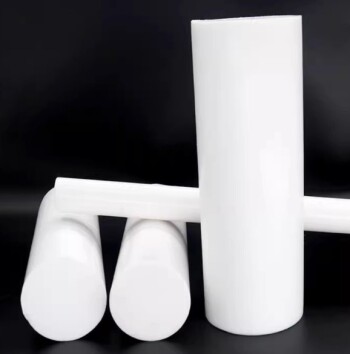
- Custom Graphite Filled PTFE Rods for Advanced Industrial Applications
- Customizable PTFE Rods for Advanced Industrial Applications
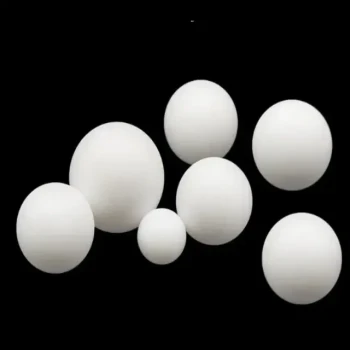
- Custom PTFE Teflon Balls for Advanced Industrial Applications
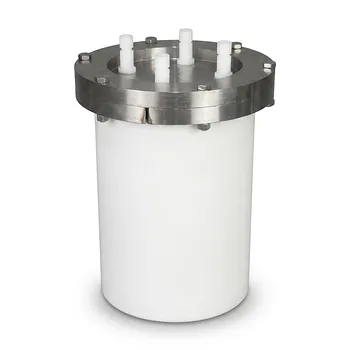
- PTFE Hydrofluoric Acid Dilutor and Corrosion Resistant Reaction Vessel with Flange Sealing White PTFE Raw Material Storage Barrel
- Custom PTFE Parts Manufacturer for Teflon Containers and Components
People Also Ask
- What property does graphite filler provide to PTFE? Achieve Superior Self-Lubrication and Low Friction
- How does graphite-filled PTFE perform? A Guide to Superior Self-Lubricating Components
- What are the advantages of Polytetrafluoroethylene (PTFE) with Graphite Fill? Enhance Wear and Friction Performance
- How do graphite fillers enhance PTFE? Achieve Superior Self-Lubrication and Wear Resistance
- How is graphite filler typically used in PTFE? Enhance Wear Resistance & Self-Lubrication