Precision PTFE and PFA Miniature Valves for High-Purity Fluid Control
Fluid control hardware can determine the reliability of an entire laboratory or process system. A valve that swells, corrodes, leaks, sheds contaminants, traps residual liquid, or cannot be integrated with the required tubing creates operational risk far beyond the component itself. This is especially important in workflows involving strong acids, bases, oxidizers, organic solvents, ultra-pure reagents, trace-metal analysis, semiconductor chemicals, and moisture- or contamination-sensitive media.
KINTEK laboratory miniature valves are designed around the strengths of high-performance fluoropolymers. PTFE and PFA offer broad chemical resistance, low extractables, excellent dielectric properties, and dependable performance across demanding thermal and chemical conditions. By applying these materials to compact shutoff, routing, dispensing, and transfer components, KINTEK helps laboratories and industrial users build cleaner, more reliable fluid paths from source container to process vessel, instrument, reaction cell, or waste collection point.
Materials Selected for Demanding Chemical Environments
PTFE, commonly known as polytetrafluoroethylene, is widely used where conventional metal, rubber, or standard plastic valves are unsuitable. Its highly fluorinated molecular structure provides exceptional resistance to a broad range of corrosive reagents and minimizes interaction with handled fluids. PTFE also has a low coefficient of friction, which supports smooth sealing and actuation when the valve geometry is properly engineered. Its insulating behavior is valuable in electrochemical, electrophoresis, and electrically sensitive laboratory arrangements.
PFA combines many of the chemical-resistance and purity advantages of PTFE with melt-processable characteristics that make it particularly useful in high-purity tubing systems, weldable assemblies, and applications requiring clear visual confirmation of liquid flow. Transparent or translucent PFA tubing can help operators identify bubbles, flow interruptions, color changes, residue, or incomplete purging without opening the system. In semiconductor, sensor, and advanced chemical-delivery environments, this visibility can support faster troubleshooting and more consistent process control.
Material selection should always be matched to the actual chemical, concentration, temperature, pressure, operating cycle, and purity requirement. KINTEK can help specify PTFE or PFA configurations according to the intended service conditions, including valve bodies, sealing features, tubing interfaces, and custom assemblies. This is particularly useful when a standard catalog valve does not account for unusual media, confined installation space, frequent operation, or a non-standard connection requirement.
Compact Valve Configurations for Essential Fluid Operations
Laboratory miniature valves are not limited to simple on/off control. Different flow paths support different workflows, and selecting the right configuration improves both usability and system safety.
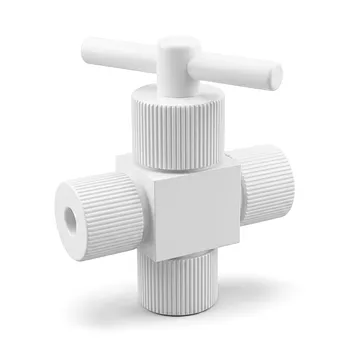
2-way valves are typically used to start or stop flow through a single line. They are suitable for isolating reagent feeds, controlling transfers between a container and a receiving vessel, closing a rinse line, or creating a compact service point in a fluid manifold. A well-matched 2-way PTFE or PFA valve gives users direct control over liquid movement while maintaining compatibility with harsh chemicals and high-purity liquids.
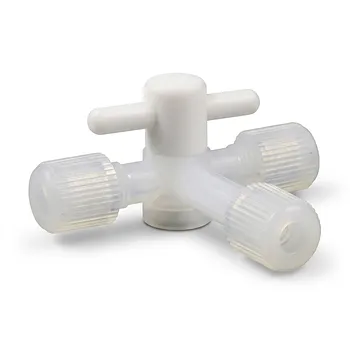
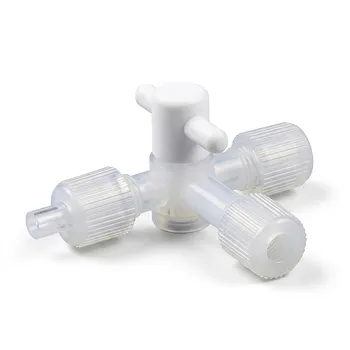
3-way valves provide a practical solution when one line must be switched between two destinations or when a process requires selective feeding, venting, sampling, bypassing, or draining. For example, a 3-way valve may support transfer to a process vessel during normal operation and redirect fluid to a drain or collection bottle during cleaning. It can also be used in analytical workflows where a line needs to alternate between reagent, rinse solution, blank, or sample pathways. Consolidating this routing into one compact valve can reduce the number of fittings and joints in the system.
4-way valves are useful for more complex routing requirements. They can support multi-line distribution, selection between several fluid paths, staged cleaning sequences, or compact manifold designs where several transfers must be controlled in limited space. The correct flow pattern depends on the process logic, so KINTEK can evaluate port placement and internal routing requirements for custom designs.
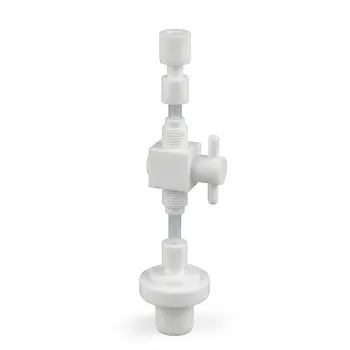
Flare-stop and reducing valves are suited to fluoropolymer tubing systems where secure, compact connections are important. They can help users transition between line sizes, create shutoff points close to equipment, and organize high-purity chemical pathways without relying on unsuitable metallic components. When paired with appropriate PFA or PTFE tubing, these valves form a chemically resistant transfer system tailored to the line diameter and installation layout.
Reliable Dispensing From Chemical Drums and Storage Containers
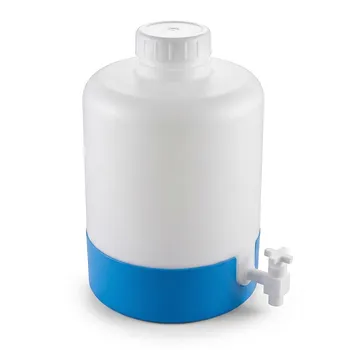
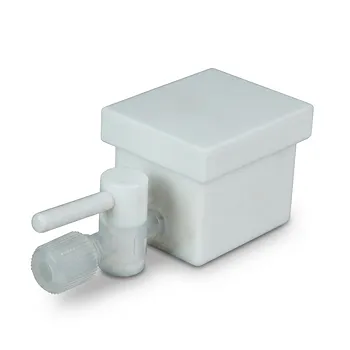
PTFE faucets and drum valves provide controlled dispensing from chemical storage drums, reagent tanks, bottles, and custom containers. Manual pouring from large containers is inefficient and can expose personnel, work surfaces, and the chemical itself to unnecessary risk. A chemically compatible drum valve gives operators a dedicated outlet for measured transfer, process feeding, container emptying, and routine dispensing.
For aggressive reagents, a fluoropolymer faucet can offer a practical alternative to standard metal or commodity-plastic taps that may corrode, discolor, bind, or contaminate the fluid. The valve can be integrated into a storage and transfer arrangement that suits the container geometry, outlet location, desired flow direction, and downstream tubing or receiving equipment. In laboratory environments, this supports cleaner bench operations and reduces the need to repeatedly open or handle bulk chemical containers.
High-purity PTFE drum valves are also valuable where trace contamination must be minimized. In trace analysis, sample preparation, and high-purity chemical handling, even small amounts of metallic leaching or incompatible material contact can compromise a blank, shift an analytical result, or require costly repeat work. A properly designed PTFE/PFA fluid path helps users reduce unnecessary contact with contamination-prone components.
Low-Contamination Design for Trace Analysis and Sensitive Processes
Many laboratory systems must protect the chemical compatibility of the line while also protecting the analytical integrity of the sample. Trace metal analysis, environmental testing, geochemistry, pharmaceutical research, semiconductor processing, and high-purity chemical preparation can all require materials that contribute minimal background contamination.
KINTEK fluoropolymer valve solutions are intended for applications in which low background and high material purity are central design goals. PTFE and PFA are favored for their resistance to many chemicals and their suitability for demanding sample-handling environments. The final performance of any system depends on factors such as material grade, cleaning protocol, assembly practice, reagent purity, dead volume, residence time, and the complete wetted flow path. For this reason, valve selection should be considered alongside tubing, fittings, tanks, reaction vessels, filters, and sample-contact components rather than as an isolated purchasing decision.
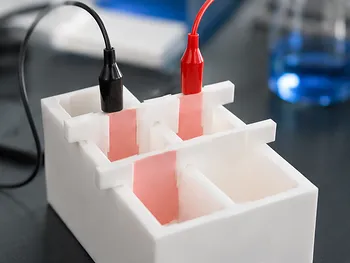
Integrated PTFE reaction cells with septa and valves demonstrate this systems-based approach. In an electrophoresis, electrochemical, derivatization, digestion, or custom analytical setup, the reaction vessel may need controlled reagent addition, sample injection, gas handling, isolation, or draining. Incorporating suitable valves and ports into the PTFE structure can reduce external connections, simplify the fluid path, and adapt the apparatus to the exact sequence of the experiment. PTFE's insulating properties can also be beneficial in applications where electrical isolation is part of the apparatus design.
Principles That Support Controlled Fluid Transfer
A miniature valve controls flow by changing the available passage through its internal geometry. In a shutoff position, the sealing arrangement blocks the intended fluid path. In an open position, the valve creates a route for liquid or gas transfer. In multi-way designs, the operator selects or redirects the relationship between inlet and outlet ports. While this principle is straightforward, reliable performance depends on the details: dimensional accuracy, sealing-surface finish, seat geometry, operating mechanism, port alignment, assembly quality, and compatibility between the valve material and the handled media.
For high-purity systems, internal geometry matters as much as external dimensions. Excessive dead volume can retain prior fluids, complicate cleaning, and increase carryover risk. Poorly planned flow transitions can make rinsing less effective or introduce bubble-trapping zones. An application-specific design can help reduce unnecessary liquid retention and support more predictable flushing, especially where reagents are expensive or process changeover is frequent.
Connection strategy is equally important. A reliable valve should interface correctly with the selected tubing, fittings, vessels, and mounting arrangement. PFA tubing assemblies may be designed for weldable, flare, or other suitable fluoropolymer connection methods based on the process need. PTFE valve components can be configured for chemical transfer lines, drum outlets, custom vessels, and specialized lab apparatus. The best choice depends on pressure, temperature, maintenance access, installation orientation, line size, and whether the system must be disassembled for cleaning or remain permanently integrated.
Advantages of Fluoropolymer Miniature Valves
Selecting PTFE and PFA valve components can provide meaningful operational benefits across laboratory and industrial fluid systems:
- Broad chemical resistance: PTFE and PFA are suited to many corrosive acids, alkalis, solvents, and process chemicals that can damage conventional valve materials.
- High-purity fluid contact: Fluoropolymer wetted surfaces help support low-contamination handling for analytical, semiconductor, and sensitive chemical applications.
- Thermal stability: These materials can serve in demanding temperature environments when the complete valve design is specified for the actual operating conditions.
- Corrosion-free fluid path options: Fluoropolymer construction can reduce dependence on metal wetted components in corrosion-sensitive systems.
- Compact installation: Miniature formats help users add control points to crowded laboratory benches, instrument enclosures, manifolds, reaction assemblies, and process skids.
- Flexible routing: 2-way, 3-way, and 4-way designs support isolation, diversion, selection, draining, venting, and multi-line transfer functions.
- Visible flow capability: PFA transparent tubing can make it easier to inspect fluid movement and identify bubbles or residue in the line.
- Custom integration: Valve dimensions, ports, connections, body geometry, mounting features, and complete PTFE/PFA assemblies can be designed around the actual process.
These advantages are most valuable when the valve is specified as part of a complete working system. A chemically resistant valve alone cannot compensate for incompatible tubing, poorly selected fittings, improper installation, unsuitable operating pressure, or inadequate cleaning procedures. KINTEK's fluoropolymer-focused product capability makes it possible to coordinate the valve with the surrounding components for a more coherent solution.
Applications Across Laboratories and Industry
KINTEK laboratory miniature valves can be applied wherever precision fluid handling and chemical compatibility are required. Typical applications include chemical reagent dispensing, acid and alkali transfer, laboratory wash and rinse stations, sample-preparation systems, instrument fluid lines, analytical reagent feeds, trace-metal workflows, corrosion-resistant storage tanks, semiconductor wet-process lines, sensor manufacturing, and customized chemical processing equipment.
In semiconductor and electronics-related production, high-purity PFA valves and transparent weldable tubing are suitable candidates for chemical-delivery systems where clean materials, chemical resistance, and line visibility are essential. In analytical laboratories, PTFE valves can support transfer of aggressive digestion reagents, acids, blanks, standards, and wash solutions. In chemical storage areas, PTFE faucets can provide a dedicated dispensing point for drums and containers. In research settings, custom PTFE reaction cells with integrated valves can help transform a conceptual experiment into a repeatable apparatus.
The category is also relevant to OEM equipment builders and engineering teams. A standard valve may be sufficient for a simple transfer line, but purpose-built equipment often needs a specific mounting footprint, port orientation, interface dimension, flow arrangement, or material combination. KINTEK can support projects ranging from individual replacement parts to high-volume, repeatable custom components for laboratory instruments, chemical-handling equipment, and specialized research devices.
Custom CNC-Machined Valve and Assembly Solutions
Not every fluid-control problem fits a standard catalog component. A valve might need a different inlet or outlet size, a non-standard thread, an integrated mounting flange, a unique internal passage, a compact handle arrangement, a connection to a custom tank, or incorporation into a larger reaction or transfer assembly. These requirements are common in laboratories that build their own apparatus, upgrade existing systems, or work with process conditions outside typical commercial standards.
KINTEK specializes in PTFE and PFA laboratory products and supports custom CNC machining for fluoropolymer components. This capability enables practical customization of miniature valves, faucets, manifolds, reaction cells, storage vessels, tubing interfaces, and related laboratory supplies. Custom work can focus on the critical details of the real application: chemical medium, temperature, pressure or vacuum requirement, desired flow path, tube outer diameter, connection standard, operating method, structural dimensions, and purity expectations.
A custom solution may also reduce the number of adapters in a system. Fewer unnecessary interfaces can simplify installation and maintenance while helping users create a cleaner fluid path. For specialized experiments or OEM equipment, integrating several functions into a single machined PTFE component can improve consistency from unit to unit and make the final assembly easier to operate.
Select the Right Valve With Application Details
For an effective recommendation or custom quotation, it is helpful to define the service conditions before finalizing the design. Important information includes the chemical name and concentration, expected operating temperature, pressure or vacuum range, desired line size, valve configuration, required inlet and outlet connections, flow direction, installation orientation, quantity, and whether the component will be used in a high-purity or trace-analysis environment. For custom systems, a drawing, sketch, sample part, or photograph of the existing setup can accelerate the engineering discussion.
KINTEK can assist with selecting a suitable PTFE or PFA miniature valve configuration and developing custom fluoropolymer parts or integrated assemblies for your process. Whether you need a corrosion-resistant drum faucet, a compact 3-way routing valve, a high-purity PFA valve with transparent tubing, a reducing flare-stop design, or a dedicated PTFE reaction-cell solution, our team can translate application requirements into manufacturable hardware.
Contact KINTEK through our inquiry form to share your chemical media, connection dimensions, operating conditions, drawings, and target quantity. We will help you specify a high-performance PTFE/PFA valve or custom laboratory fluid-control solution built for your workflow.