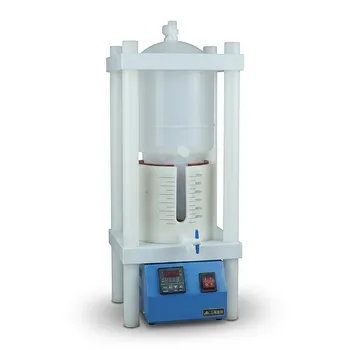
Engineered PTFE/PFA Apparatus and Technical Service for Critical Laboratory Workflows
Custom fluoroplastic laboratory apparatus is essential when standard glassware, metal hardware, or off-the-shelf polymer components cannot meet the chemical, purity, temperature, or dimensional requirements of a laboratory process. High-purity acid preparation, trace elemental analysis, semiconductor materials testing, corrosive reagent transfer, digestion, filtration, and electrochemical research all place exceptional demands on equipment surfaces and fluid-contact components. In these workflows, a small source of metallic contamination, an incompatible seal, a poorly controlled heating zone, or an impractical vessel geometry can compromise analytical results, shorten equipment life, and create unnecessary operational risk.
KINTEK is exclusively focused on high-performance fluoropolymer laboratory solutions. We manufacture and customize apparatus using PTFE and PFA, materials valued for their broad chemical resistance, low extractables, non-wetting surfaces, high-temperature capability, and suitability for high-purity applications. Our capability extends beyond individual labware items. We help laboratories develop complete functional assemblies, including vessels, lids, adapters, tubing interfaces, fittings, valves, holders, frames, heating-related components, collection sections, storage tanks, cleaning tanks, and specialized reaction or sample-preparation apparatus.
The category also covers technical service for high-purity acid purification systems, with particular attention to repair and maintenance of heating mantles and control boxes. These systems are central to laboratories that produce purified acids for ICP-MS, ICP-OES, AAS, ion analysis, semiconductor-related work, geochemistry, environmental monitoring, and other trace-analysis methods. Consistent heating, stable temperature control, intact insulation, reliable electrical connections, and appropriate fluoropolymer-compatible contact materials are all necessary to keep acid purification workflows operating safely and consistently.
Why Custom Fluoroplastic Apparatus Matters
Many laboratories begin with standard components, then encounter limits as their methods become more demanding. A commercial vessel may not fit a specific digestion rack. A conventional transfer assembly may contain metal parts that are unsuitable for trace-metal analysis. An ordinary heating solution may not match the shape, volume, or thermal behavior of a specialized PTFE or PFA vessel. Existing equipment may also have been modified repeatedly over time, leaving an arrangement that is difficult to clean, difficult to service, or unreliable under routine use.
A custom PTFE/PFA solution addresses these issues at the source. Instead of forcing a critical method around available hardware, the apparatus can be designed around the real workflow: the reagent concentration, operating temperature, sample volume, available bench space, connection standards, cleaning protocol, operator handling requirements, and analytical purity target. This approach can improve repeatability while reducing the number of transitions, adapters, and manually improvised steps in the process.
Fluoroplastics are especially valuable for corrosive chemical environments. PTFE is well known for its outstanding resistance to a wide range of acids, bases, solvents, and oxidizing reagents. PFA provides similar chemical resistance with the additional benefit of melt-processability and optical clarity in many formats, making it useful for tubing, bottles, fittings, and components where visual observation or more complex fabrication is advantageous. Material selection should always be matched to the actual temperature, pressure, chemical exposure, mechanical loads, and purity requirements of the application. KINTEK evaluates these practical factors when recommending a custom design.
High-Purity Acid Purification System Heating Mantle and Control Box Service
High-purity acids are not simply reagents; they are foundational process materials for many analytical laboratories. When acids are used to digest samples, prepare blanks, rinse sample-contact components, or generate calibration solutions, their background contamination can directly affect detection limits and data confidence. Acid purification systems use controlled evaporation and condensation processes to produce cleaner reagent fractions. Because the system works with corrosive media and elevated temperatures, dependable heating and control are essential.
The heating mantle is responsible for delivering heat to the purification vessel in a controlled and sufficiently uniform manner. Its function is not only to raise temperature, but to support a repeatable evaporation rate without introducing excessive thermal stress, unstable boiling behavior, or localized overheating. The control box provides the electrical and operational interface for this process, typically governing power delivery, temperature-related settings, alarm functions, and other operational parameters depending on the system configuration.
Over time, heating mantles and control boxes can be affected by normal wear, chemical exposure, cable fatigue, insulation degradation, sensor or controller issues, relay failure, connector damage, contamination, or mismatched operating conditions. Symptoms may include inconsistent heating, slow heat-up, temperature fluctuation, failure to maintain a setpoint, intermittent power, visible mantle damage, abnormal alarms, or reduced acid purification throughput. Continued operation with an unreliable heating or control system can affect process consistency and may increase downtime when the laboratory needs purified acid most urgently.
KINTEK provides professional maintenance, repair support, and on-site technical service for high-purity acid purification heating mantles and control boxes. Our service is intended to help laboratories assess the actual condition of the equipment, identify practical repair paths, and restore dependable operation where appropriate. For aging systems or specialized configurations, we can also evaluate replacement and upgrade options that better align with current workflow requirements.
A thorough service approach begins with understanding the system rather than treating every issue as a generic electrical fault. The model and configuration of the purification setup, vessel size and material, acid type, normal process temperature, historical symptoms, power conditions, available site utilities, and existing safety practices all influence the appropriate solution. This contextual assessment helps distinguish between problems in the heating element, controller, sensor, wiring, connectors, vessel fit, mechanical support, or the wider operating process.
For laboratories located in China, our Nanjing-based technical team can provide domestic on-site support according to project requirements. On-site service is particularly useful when a system needs to be inspected within its installed environment, when replacement components must be matched to an existing apparatus, or when operators need a practical review of system condition and operating considerations. For customers outside the region, KINTEK can discuss remote technical evaluation, detailed dimensional confirmation, spare-part planning, and custom replacement solutions based on the available equipment information.
Custom Design Capability from Component to Complete Apparatus
Every laboratory has constraints that a catalog product cannot always accommodate. Space may be limited. A reactor or purification vessel may have a non-standard external profile. The system may need to connect to existing PFA tubing, a specific cap thread, a ventilation line, a pump, or a legacy fixture. The apparatus may require a special angle for pouring, controlled draining, improved access for cleaning, or a secure support arrangement for routine handling. In high-purity environments, even the choice and placement of each wetted component can matter.
KINTEK's end-to-end PTFE/PFA custom CNC machining capability enables us to build solutions for these situations. We can manufacture non-standard machined parts and bespoke laboratory setups based on drawings, samples, dimensions, process descriptions, or performance objectives. Customers may come to us with a complete technical drawing, a hand sketch, a photograph of an existing component, or simply a clear description of the problem they need to solve. Our engineering process helps translate that input into a manufacturable fluoropolymer solution.
Typical custom apparatus opportunities include:
- PTFE or PFA reaction vessels, digestion vessels, crucibles, dishes, beakers, cylinders, and containers in non-standard dimensions
- High-purity acid purification system accessories, vessel supports, heating-related components, condensate collection sections, adapters, and replacement parts
- PFA tubing assemblies, fluoropolymer fittings, valves, connectors, manifolds, and fluid-transfer interfaces
- Trace-analysis sample preparation tools designed to reduce the use of metal-contact parts
- PTFE/PFA cleaning tanks, storage tanks, wash stations, racks, holders, and transport fixtures
- Specialized electrochemical cells, electrode holders, reaction assemblies, and chemical-resistant enclosures
- Custom lids, threaded closures, sealing surfaces, ports, drain features, and viewing-compatible PFA components
- Machined PTFE parts for instrument integration, laboratory automation, research prototypes, and repeatable production setups
This flexibility is useful at every stage of laboratory development. Research groups can obtain one-off apparatus for method development. Pilot facilities can refine an assembly before scaling a process. Analytical laboratories can replace obsolete or damaged fluoropolymer components without redesigning their entire workflow. Equipment manufacturers can source consistent custom parts for integration into their own systems. Larger organizations can also use KINTEK for stable high-volume production when a proven custom design needs to be reproduced at scale.
Material Benefits of PTFE and PFA
PTFE and PFA are not interchangeable with every engineering plastic, and their value is clearest in environments where chemical performance and purity are non-negotiable. Both materials offer excellent resistance to many aggressive laboratory reagents. Their low surface energy helps reduce adhesion and facilitates cleaning, which can be beneficial when handling sticky, reactive, or contamination-sensitive materials. Their electrical insulating properties also support applications involving insulated fixtures and selected electrochemical or heating-related assemblies.
PTFE is often selected for machined components because it is highly chemically inert and performs well across a broad range of laboratory conditions. It is a common choice for vessels, lids, seals, adapters, supports, and custom parts where corrosion resistance is a primary concern. PFA is frequently selected where chemically resistant tubing, translucent or clear components, welded structures, or complex fluid pathways are needed. The best choice depends on the intended function. A durable apparatus is not produced simply by choosing a fluoropolymer; it results from matching the correct material, wall thickness, geometry, sealing approach, and fabrication method to the actual operating environment.
For high-purity work, material quality and construction details deserve the same attention as chemical compatibility. Surface condition, fluid path complexity, dead volumes, joints, threads, vent features, drainage geometry, and cleanability can all influence performance. KINTEK considers these factors when creating custom apparatus for trace analysis and acid handling. Our goal is to provide hardware that is practical to operate, straightforward to maintain, and aligned with the contamination-control expectations of the application.
Design Principles for Reliable Laboratory Equipment
Reliable fluoroplastic apparatus should support the method, not introduce variability into it. For this reason, custom design begins with functional questions. What reagent will be used? What concentration and temperature range are expected? Is the process open, sealed, vented, pressurized, or under vacuum? What sample volume and throughput are required? Does the assembly need to integrate with an existing instrument, fume hood, hotplate, heating mantle, pump, or transfer line? How will users load, empty, clean, inspect, and store the apparatus?
These questions determine key engineering decisions. A vessel intended for repeated heating may need a different geometry and support arrangement from a room-temperature storage container. A fluid-transfer manifold may need controlled port locations and a minimized internal hold-up volume. A custom lid may require purpose-built ports for tubing, sensors, condensation pathways, or gas connections. A part that is routinely disassembled may benefit from a design that simplifies alignment and avoids unnecessary small components. A high-purity system may require thoughtful reduction of possible contamination sources throughout the entire wetted path.
Thermal design is equally important for acid purification and heated reaction applications. Heating should be appropriate for the vessel's material, dimensions, fill level, and intended process range. Uniformity, responsiveness, insulation condition, mechanical fit, and control stability can influence operating consistency. KINTEK can help customers evaluate a repair or custom replacement from the perspective of the complete assembly, including compatibility with the vessel and the operating workflow, rather than considering the heating mantle as an isolated accessory.
Safety remains a critical design consideration. Fluoropolymer equipment used with corrosive chemicals should be operated within defined process conditions and in accordance with laboratory safety procedures. Appropriate ventilation, personal protective equipment, electrical protection, spill-control measures, and chemical-handling practices remain essential. Custom apparatus can improve ergonomics and reduce avoidable handling complexity, but it must be specified with the real operating context in mind. Clear communication about acids, temperature, pressure, and process conditions enables a more appropriate solution.
Advantages of Working with KINTEK
KINTEK offers a focused combination of fluoropolymer specialization, laboratory application understanding, and custom manufacturing capability. Instead of treating PTFE/PFA as a small part of a broad industrial catalog, we work exclusively with high-performance fluoropolymers for laboratory and chemical-processing needs. This specialization helps us address the details that matter in corrosive, purity-sensitive, and non-standard applications.
Our customers benefit from several practical advantages:
- Broad fluoropolymer product knowledge: We support everyday labware, high-purity trace-analysis tools, cleaning and storage tanks, fluid-transfer components, sample-preparation products, consumables, and advanced reaction apparatus.
- Custom CNC machining capability: Complex PTFE parts, bespoke fixtures, special adapters, and non-standard laboratory assemblies can be developed for specific functional requirements.
- Application-oriented support: We consider the chemistry, process, equipment interface, maintenance needs, and operator workflow behind the requested component.
- Repair and service expertise: For high-purity acid purification heating mantles and control boxes, we provide practical diagnostics, maintenance support, replacement planning, and on-site technical service options.
- Scalable production: We can support single prototypes, replacement parts, low-volume specialty projects, and higher-volume orders after the design is confirmed.
- Quality-focused material selection: PTFE and PFA options are selected according to chemical compatibility, thermal conditions, purity targets, transparency needs, fabrication requirements, and intended service life.
For customers, this means fewer compromises between laboratory performance and equipment practicality. A custom apparatus can be made to fit an existing workflow instead of demanding that operators create temporary workarounds. Repair support can help extend the useful life of critical acid purification equipment when a targeted service or replacement is more appropriate than purchasing a completely new system. Where a current design has become a bottleneck, a bespoke PTFE/PFA solution can help improve handling, cleaning, integration, and repeatability.
Start Your Custom Apparatus or Service Project
To help us recommend the right solution, provide as much application information as is readily available. Useful details include photos of the current equipment, drawings or hand sketches, key dimensions, desired quantities, chemical media, expected temperature range, pressure or vacuum conditions, connection sizes, existing tubing or fitting specifications, and any problems you are experiencing. For acid purification heating mantle or control box service, it is helpful to include the system configuration, fault symptoms, operating history, model details, and images of the relevant components.
You do not need a finished engineering package before contacting KINTEK. Our team can work from an initial concept and help define the details required for manufacturing or service planning. We can assess whether a repair is practical, identify suitable fluoropolymer-compatible replacement options, or develop a fully custom component or apparatus for your laboratory. For complex needs, our technical approach combines functional evaluation with manufacturability, so the final solution is designed for real use rather than only for a drawing.
Contact KINTEK to discuss your custom fluoroplastic laboratory apparatus, high-purity acid purification system repair, or PTFE/PFA CNC machining requirement. Share your application, existing equipment details, and target performance requirements, and our specialists will help develop a professional solution tailored to your workflow.