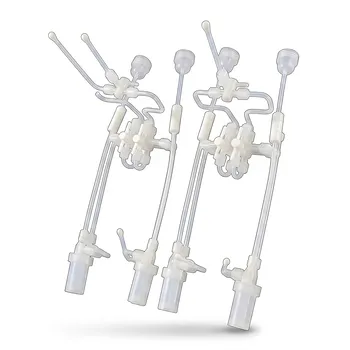
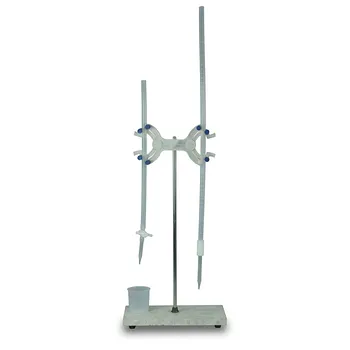
Custom CNC machined PTFE and PFA parts help laboratories and process teams handle aggressive chemicals, high-purity fluids, and application-specific mechanical interfaces with confidence. KINTEK produces bespoke fluoropolymer components for analytical chemistry, semiconductor processing, environmental testing, pharmaceuticals, chemical research, and fluid-handling systems. Our category includes machined fittings, valves, manifolds, burettes, vessels, tube holders, seals, reaction components, evaporation assemblies, and complex non-standard laboratory setups. Examples include high-purity PFA nitrogen blowdown evaporator systems with configurable manifolds and integrated PFA valves, plus PFA acid and base burettes with PTFE valves for precise handling of corrosive media, including hydrofluoric acid applications.
Toggle Categories
Get Instant Support
Choose your preferred way to connect with our team
Response Time
Within 8 hours on working days, 24 hours on holidays
Custom CNC Machined PTFE/PFA Parts
Precision PTFE and PFA Components Built Around Your Process
When standard labware or off-the-shelf fluid-handling hardware cannot meet the requirements of a process, a custom fluoropolymer component can provide the practical answer. KINTEK designs and manufactures CNC machined PTFE and PFA parts for users who need chemical compatibility, high material purity, reliable dimensional control, and a geometry tailored to the way their equipment actually operates. Whether the requirement is a single prototype, a replacement part for an existing system, a purpose-built analytical assembly, or a repeat production order, our fluoropolymer machining capability supports projects from concept through manufacture.
PTFE and PFA are selected because many conventional engineering materials struggle in the environments where fluoropolymers excel. Strong acids, alkalis, oxidizers, corrosive solvents, trace-analysis workflows, and high-purity wet processes can all impose severe demands on wetted materials. The correct part must do more than fit mechanically: it should resist the process media, avoid unnecessary contamination risk, maintain dependable flow paths, and remain practical to clean, assemble, inspect, and replace. Custom machining makes it possible to address these requirements together rather than forcing a critical process into the limitations of a catalog component.
A Practical Material Choice for Corrosive and High-Purity Work
PTFE is widely valued for its broad chemical resistance, naturally low surface energy, electrical insulation properties, and ability to perform across a wide temperature range. It is often an excellent material for components that contact aggressive reagents, including many acids, bases, and solvents. Its low-friction surface can also be advantageous for seals, sliding elements, valve components, liners, guides, and parts designed to release residues during cleaning.
PFA combines fluoropolymer chemical resistance with melt-processable characteristics and a smooth, nonporous surface well suited to high-purity fluid handling. It is frequently specified for components where clear or translucent material, smooth internal flow paths, purity-conscious wet chemistry, or fabricated fluid assemblies are important. PFA can be particularly useful in trace analysis, semiconductor-related wet processing, sample preparation, and corrosive reagent delivery systems where material selection must support both process compatibility and handling quality.
Material selection is not a one-line decision. The best choice depends on the reagent, temperature, pressure or vacuum condition, exposure duration, part geometry, cleaning procedure, mechanical loading, and purity target. For example, a static spacer and a repeatedly actuated valve seat experience very different service conditions even when both contact the same chemical. A component installed in a heated digestion setup may have different design priorities from a low-pressure gravity-feed burette or a multi-port sample concentration manifold. KINTEK evaluates the intended use so that PTFE, PFA, or an appropriate combination of fluoropolymer materials can be specified on a functional basis.
What Custom CNC Machining Makes Possible
Computer numerical control machining converts a defined design into repeatable tool paths for milling, turning, drilling, turn-mill operations, and multi-axis machining. This is especially valuable for fluoropolymer components because manual fabrication can make consistency difficult when a part has detailed features, multiple interfaces, or a requirement for repeatable batches. CNC-controlled production helps translate a drawing, sample, or engineering concept into parts with controlled geometry and a production approach suitable for both development and ongoing supply.
CNC milling is used to remove material accurately from a workpiece and is well suited to flat faces, pockets, slots, channels, mounting features, external profiles, and complex manifold layouts. It supports the production of laboratory brackets, holders, blocks, custom racks, valve bodies, adapter plates, and enclosures with features arranged to match the surrounding equipment.
CNC turning is effective for cylindrical and hollow components. It can be used to produce bodies, bushings, sleeves, caps, rings, nozzles, threaded forms, tube interfaces, and other rotationally symmetric shapes. A turned PFA or PTFE component can become part of a larger assembly, such as a reagent-delivery fitting, an analytical vessel component, a custom connector, or an evaporation-system accessory.
CNC drilling creates through-holes, ports, mounting holes, and internal passages. In fluoropolymer machining, drilling strategy matters because the material's properties require attention to chip removal, tool alignment, heat control, and the final function of the hole. For a fluidic part, the placement, bore geometry, transitions, and finish of a passage can directly affect drainage, flow behavior, cleaning, dead volume, and the ease of connecting tubing or fittings.
Turn-mill machining combines turning and milling operations for components that require both cylindrical geometry and detailed secondary features. This is useful where a hollow part also needs flats, bottom details, cross-holes, ports, tool features, or mounting interfaces. Multi-axis and 5-axis machining broaden the design envelope further, allowing complex shapes and compound-angle features to be produced with fewer repositioning steps. Such capabilities are important for non-standard parts that must integrate with existing instruments, custom frames, fluid paths, or specialized sample-preparation equipment.
Machining Fluoropolymers with Material-Aware Control
High-performance fluoropolymers are not machined exactly like metals. PTFE, in particular, is comparatively soft and can deform when excessive heat or cutting force is introduced. Successful machining therefore depends on using process parameters and workholding methods that respect the material rather than simply applying a generic machining recipe.
KINTEK's approach considers cutting speed, feed rate, depth of cut, tool condition, support of the workpiece, and feature geometry. Lower cutting speeds can help reduce heat generation, while a controlled feed helps avoid excessive cutting force. Smaller depths of cut may be appropriate where minimizing force and heat accumulation is important to dimensional stability and surface quality. The correct balance depends on the component shape, material form, target finish, and the features being machined.
Workholding is equally significant. Thin walls, long sections, fine threads, narrow sealing areas, and delicate internal features need a process that minimizes distortion during machining. A part must be assessed not only in its finished condition but also at every stage of material removal. This is particularly relevant for components with close-fitting interfaces, fluid passages, or mating surfaces that must assemble predictably with other fluoropolymer, metal, glass, or instrument components.
The result is a more deliberate route to repeatable parts. CNC automation reduces dependence on hand operations, supports consistent tool paths across multiple pieces, and makes it easier to reproduce an approved design. It also enables efficient iteration when a prototype needs adjustment, a port configuration changes, a mounting pattern is updated, or a process team needs a modified version of a successful component.
Designed for Real Laboratory and Process Applications
Custom CNC machined PTFE and PFA parts can serve many functions across a laboratory or production environment. In high-purity analytical work, they can form sample-contacting vessels, transfer paths, evaporation-system components, wash stations, digestion accessories, and storage solutions. In chemical handling, they can provide corrosive-media burettes, adapters, dispensing components, valves, custom connectors, and manifolds. In equipment development, they can become specialized holders, reaction cells, flow channels, housings, fixtures, and interfaces that make a proprietary setup workable.
Our high-purity PFA nitrogen blowdown evaporator system illustrates how custom fluoropolymer fabrication can support a complete workflow rather than a single isolated part. Nitrogen blowdown is used to concentrate samples by directing an inert gas stream over or into multiple samples, accelerating solvent evaporation under controlled conditions. For trace-analysis and corrosive laboratory environments, the materials surrounding the samples and gas paths matter. PFA construction and integrated PFA valves help deliver strong chemical resistance and a purity-conscious fluid-contacting design. Configurable multiple-position manifolds allow the system to be adapted to the number, type, and arrangement of bottles or tubes used in the laboratory.
A custom manifold can be designed around more than its number of stations. The relevant considerations can include sample-vessel dimensions, station spacing, access for operators, gas inlet placement, independent or grouped flow control, mounting constraints, drainage needs, and cleaning access. By addressing these details at the design stage, the finished system can fit the workflow more naturally and support repeatable sample concentration procedures.
The PFA acid and base burette with PTFE valve is another example of application-driven material and design selection. Volumetric delivery of corrosive liquids requires dependable control, visibility or monitoring appropriate to the application, and wetted surfaces that are suitable for the intended reagents. PFA provides corrosion resistance for demanding chemical-analysis work, while a PTFE valve offers a chemically resistant means of controlling liquid flow. This type of design is relevant to laboratories handling aggressive acids and bases, including hydrofluoric acid where suitable fluoropolymer wetted materials are commonly required.
For burettes and similar liquid-delivery devices, precision is not limited to the graduation or nominal capacity. Practical performance is influenced by valve control, clean assembly, compatible tubing or adapters, smooth internal surfaces, controlled drainage behavior, and the user's ability to operate the component consistently. A custom configuration can account for the laboratory's bottle connection, valve orientation, outlet style, installation position, and compatibility with established procedures.
Benefits Beyond a Standard Part
The central advantage of custom machining is that the component is defined by the application instead of the catalog. That can mean a particular bore size, a non-standard thread, an unusual vessel profile, a specific set of tube ports, a restricted installation envelope, or a part that must interface with existing equipment. It can also mean that the user needs to simplify an assembly by combining several functions into one machined fluoropolymer component.
A tailored design can help reduce unnecessary joints and transitions in a fluid path. Fewer interfaces may simplify assembly and cleaning, reduce potential leak points, and make the final installation easier to service. The appropriate design will depend on the system and maintenance strategy, but evaluating the entire fluid path is often more useful than selecting each item independently.
Custom parts can also improve operational fit. A rack can be machined for the exact tube dimensions used in a workflow. A manifold can be configured for the required number of channels. A vessel cap can include the ports needed for a specific gas, liquid, probe, or sampling connection. A custom adapter can bridge an existing instrument to a new fluoropolymer line without forcing the user to redesign the surrounding system. These details are often what turn a technically possible setup into a reliable daily-use solution.
For production requirements, CNC machining supports repeatability across batches. Once a design and manufacturing approach are established, the same program can be used to produce subsequent quantities consistently. This is valuable for laboratories that standardize equipment across sites, OEMs integrating fluoropolymer pieces into an instrument, and process teams replacing consumable or service components at planned intervals. For early-stage development, the same flexibility supports prototypes and design modifications without requiring a separate manufacturing method for each revision.
Information That Helps Us Engineer the Right Part
The most effective custom projects begin with a clear view of the operating environment and the component's role. A dimensioned drawing, CAD model, existing sample, or marked-up sketch is a useful starting point. We can also work from functional requirements when the final geometry has not yet been defined.
Useful project information includes the media that will contact the part, concentration and temperature conditions, pressure or vacuum requirements, target dimensions, expected tolerances, connection standards, required threads, internal passage details, sealing surfaces, and quantity. For assemblies, it is helpful to identify the surrounding components, available mounting space, preferred orientation, cleaning method, and any procedures that drive the design. Where purity is critical, describe the analytical context and potential contamination concerns so that the material and component configuration can be considered appropriately.
A physical sample can be valuable when replacing a discontinued component or reverse-engineering an interface, but it is not the only route. KINTEK can support custom work from drawings, reference dimensions, photographs with measurements, or a discussion of the intended system. For complex projects, we can help translate the process objective into a manufacturable fluoropolymer design, balancing functional needs with the realities of machining, assembly, and repeat production.
From Prototype to Volume Supply
Custom work should not force a choice between flexibility and scale. KINTEK's end-to-end PTFE and PFA CNC machining capability is suited to one-off laboratory parts, iterative prototypes, small-batch specialized assemblies, and high-volume repeat orders. This continuity is useful because the same supplier can remain involved as a component progresses from an initial test fixture to a qualified production item.
During the prototype stage, the focus may be on verifying fit, access, fluid routing, and usability. A first article can reveal whether a port needs to move, a handle requires more clearance, a vessel needs a different support geometry, or an assembly would benefit from a simpler connection. CNC production is well suited to these controlled revisions because programs can be adjusted as the design matures.
At the repeat-production stage, the focus shifts toward consistency, documentation alignment, inspection requirements, packaging, and dependable availability. The right approach varies by project, but a manufacturer experienced in fluoropolymer labware and fluid-transfer components can recognize how a seemingly small design detail may affect cleaning, chemical exposure, assembly, or daily handling. KINTEK applies that product knowledge to components ranging from basic labware accessories to advanced custom reaction and sample-preparation apparatus.
Partner With a Fluoropolymer Specialist
KINTEK is exclusively focused on high-performance PTFE and PFA laboratory supplies and custom components. That specialization matters when the project involves corrosive chemistry, high-purity analysis, specialized fluid transfer, or a complex non-standard geometry. We do not treat fluoropolymers as an incidental material option; they are the foundation of our manufacturing and product-development work.
Our range spans everyday PTFE and PFA labware, trace-analysis equipment, cleaning and storage tanks, tubing, fittings, valves, filtration tools, consumables, electrochemical cells, microwave digestion vessels, and custom machined systems. This broader understanding allows us to view a custom part in the context of its application. A machined adapter is also part of a flow path. A custom vessel is also part of a sample-handling procedure. A manifold is also part of an operator's daily workflow. Considering these connections helps produce components that are practical as well as technically appropriate.
For a custom PTFE or PFA CNC machined part, send us your drawing, sample, specifications, or application description through the contact form. Tell us what media the component will handle, how it must connect, the dimensions or equipment constraints involved, and the quantity you need. Our team can help assess material options, manufacturability, custom geometry, and production requirements for your laboratory or industrial application.
REQUEST A QUOTE
Our professional team will reply to you within one business day. Please feel free to contact us!