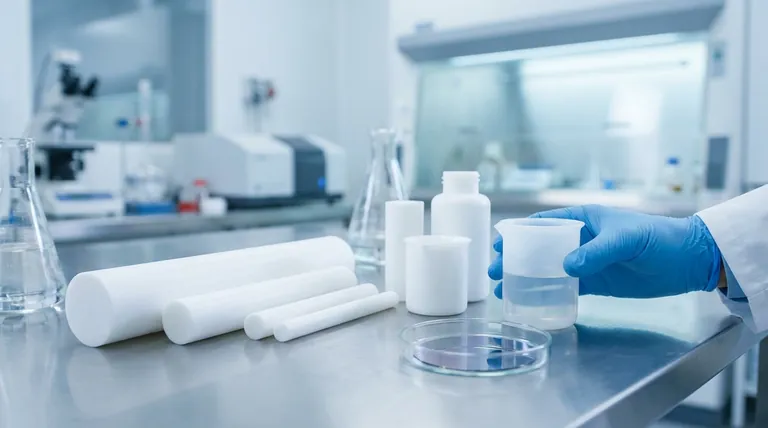
Imagine a laboratory cleanroom. A researcher is handling a hydrofluoric acid solution used to etch a silicon wafer worth thousands of dollars. Or, in a medical facility, a technician prepares a high-purity reagent for a diagnostic test where a single foreign ion could invalidate the results.
In both scenarios, the container holding the liquid is not merely a vessel. It is a silent, critical variable in the entire process. The assumption is that the container is inert. But that assumption rests on a profound, often overlooked, distinction in material science.
The Molecular Fortress of PTFE
Polytetrafluoroethylene (PTFE) is an elegant solution born from a simple, powerful molecular design. A chain of carbon atoms, each completely shielded by larger fluorine atoms. This carbon-fluorine bond is one of the strongest in organic chemistry.
This structure creates a molecular fortress. It's why PTFE is almost universally non-reactive. It scoffs at aggressive acids, bases, and solvents that would dissolve lesser materials. This near-absolute chemical inertness is its primary mandate.
The Purity Covenant: "Virgin" is a Promise, Not a Buzzword
In high-stakes applications like semiconductor manufacturing or biomedical research, the term "virgin PTFE" is not a marketing flourish. It is a covenant of purity.
It signifies that the material is 100% pure, first-generation Polytetrafluoroethylene. It contains no recycled content, no fillers, and no plasticizers that could leach into a sample and introduce catastrophic contamination.
When you choose a bottle milled from solid, virgin PTFE, you are buying certainty. You are ensuring that the only thing interacting with your sample is the stable, predictable C-F bond structure of pure PTFE. Nothing else.
A Tale of Two Geometries: Solid Form vs. Surface Liner
The term "PTFE" is often used as a blanket description, but this creates a dangerous ambiguity. The engineering choice isn't just if to use PTFE, but how. This decision boils down to geometry and intent.
The Solid Component: Full-Body Integrity
A bottle, beaker, or valve body machined from a solid block of virgin PTFE offers the material's properties through and through.
- Total Chemical Resistance: The entire component is the fortress. There is no weak point.
- Maximum Purity: The non-stick surface ensures complete sample retrieval and minimizes cross-contamination.
- Thermal Stability: It performs reliably from cryogenic temperatures to over 260°C (500°F).
This is the choice for direct, long-term storage of aggressive chemicals or when the absolute purity of a sample is paramount. The trade-off is higher material cost and less mechanical rigidity than common plastics.
The Lined Component: A Strategic Barrier
Many components, like bottle caps or gaskets, employ a more pragmatic design. A structural part made from an inexpensive, rigid material like polypropylene is fitted with a thin PTFE liner.
This is an intelligent engineering compromise. It places the chemically inert barrier precisely where it's needed—at the interface with the contents—while leveraging the cost and mechanical benefits of the base material. You get the crucial surface properties of PTFE without the expense of a solid PTFE part.
The Psychology of Material Selection: Cost vs. The Cost of Failure
Choosing between a solid PTFE component and a PTFE-lined one is not just a technical decision; it's a psychological one about risk assessment.
The lined solution appears cheaper on a purchase order. But what is the true cost?
In many industrial or laboratory settings, the cost of the container is negligible compared to the value of its contents or the process it enables. A failed seal that ruins a batch of pharmaceuticals or compromises a multi-million-dollar research experiment makes the initial savings tragically expensive.
The decision is a calculation of consequences.
- For storing aggressive chemicals or high-purity standards: The risk of failure is too high. A solid, 100% virgin PTFE container is the only responsible choice.
- For sealing a standard container holding a less sensitive reagent: A cap with a quality PTFE liner provides a perfectly reliable and cost-effective solution.
Understanding this distinction is key to engineering success. It's about matching the tool not just to the task, but to the consequences of failure.
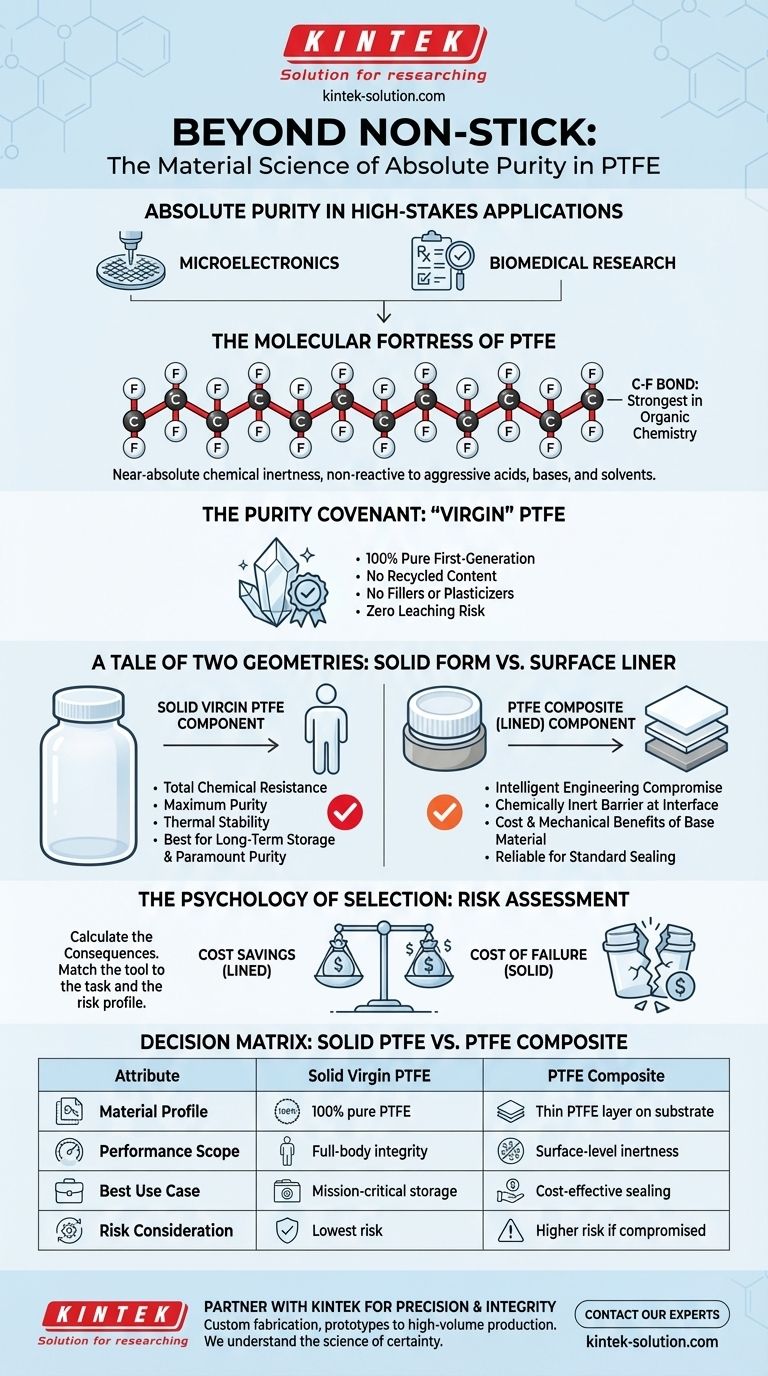
Decision Matrix: Solid PTFE vs. PTFE Composite
| Attribute | Solid Virgin PTFE Component (e.g., Bottle) | PTFE Composite (e.g., Lined Cap) |
|---|---|---|
| Material Profile | 100% pure Polytetrafluoroethylene | A thin PTFE layer on a different substrate (PP, etc.) |
| Performance Scope | Full-body chemical and thermal integrity | Surface-level chemical inertness at the interface |
| Best Use Case | Mission-critical storage, high-purity applications | Cost-effective, reliable sealing for general use |
| Risk Consideration | Lowest risk of contamination or material failure | Higher risk if barrier is compromised or misapplied |
At KINTEK, we specialize in manufacturing precision PTFE components that honor these critical distinctions. We understand that whether you need the uncompromising purity of a solid virgin PTFE bottle for semiconductor processing or a precisely fabricated PTFE liner for a medical device, the integrity of your work depends on the integrity of our materials.
We provide custom fabrication from single prototypes to high-volume production, ensuring your component is perfectly matched to your application's risk profile and performance demands. When you can't afford to be wrong, you need a partner who understands the science of certainty. Contact Our Experts
Visual Guide
Related Products
- Custom PTFE Filtration System Acid Resistant High Purity Semiconductor Grade Chemical Processing Filter
- High Corrosion Resistant PTFE Faucet Polytetrafluoroethylene Valve for Chemical Storage Drums and Fluid Transfer Systems Customizable Industrial Grade
- PTFE PFA Vacuum Filtration System Corrosion Resistant Customizable Shatterproof Laboratory Device
- PTFE Corrosion Resistant Filter with PFA Valve Connections and Integrated Sieve Plate
- High Temperature Chemical Resistant 50ml PTFE Syringe Customized Teflon Injector with Threaded Seal for Trace Analysis
Related Articles
- The Physics of a Perfect Fit: How PTFE Eliminates an Athlete's Hidden Distractions
- The Invisible Threat: Why Material Inertness Defines Success in Ultra-Pure Systems
- The Engineer's Dilemma: Navigating the Trade-offs Between PTFE and Its Alternatives
- The Hidden Risk of PTFE: Why Your Go-To Material Is Now a Liability—And What to Do About It
- The Unseen Workhorse: Why PTFE Is the Default Choice for Impossible Problems