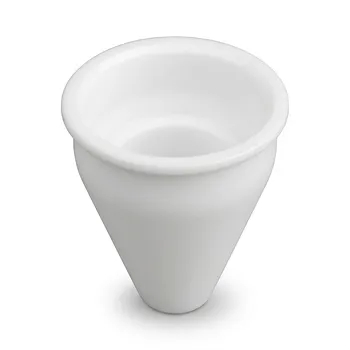
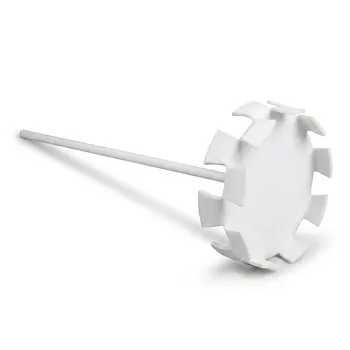
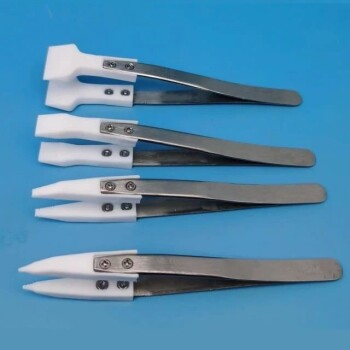
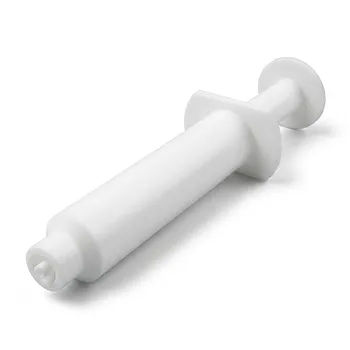
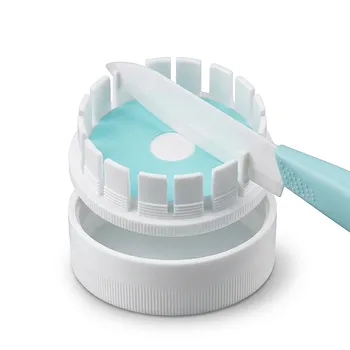
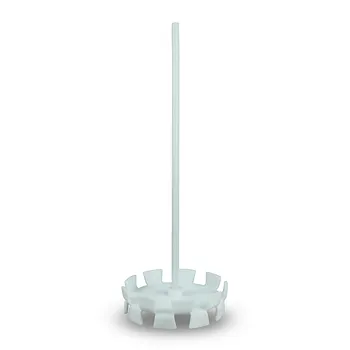
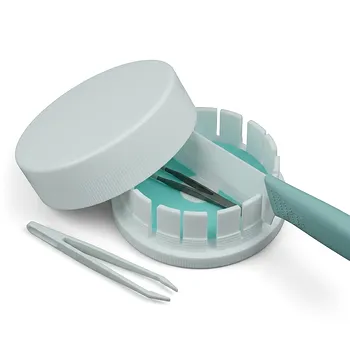
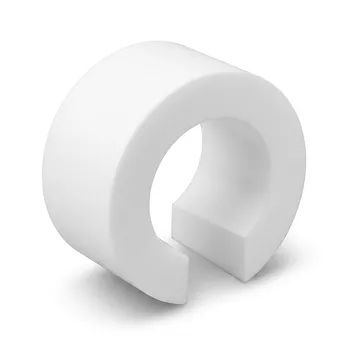
Precision CNC machining is necessary because PTFE cannot be conventionally melt-processed into complex laboratory parts. Its extreme chemical resistance means it cannot be dissolved in ordinary solvents, acids, or bases, while its very high melt viscosity prevents it from flowing like standard thermoplastics during injection molding. Instead, PTFE is typically molded and sintered into solid billets, then CNC machined into the required geometry and tolerances.
CNC machining converts chemically resistant PTFE stock into precise, application-specific components that standard equipment and conventional molding cannot provide. It is especially important when a reaction setup requires complex geometry, reliable sealing, accurate interfaces, or compatibility with aggressive chemicals.
Why Standard PTFE Processing Is Not Enough
PTFE does not flow normally when heated
Unlike many thermoplastics, PTFE does not become a readily flowing liquid above its melting temperature. Its extremely high melt viscosity makes conventional injection molding and melt extrusion unsuitable for many intricate shapes.
PTFE may also degrade if exposed to excessive heat before it can be processed effectively. CNC machining avoids relying on melt flow and instead removes material from a stable, molded stock shape.
PTFE cannot be shaped by dissolution
PTFE’s resistance to organic solvents, acids, and bases is valuable in laboratory environments, but it limits fabrication options. Chemical dissolution, solvent casting, and similar approaches cannot be used to form ordinary PTFE components.
The usual route is therefore to compress and sinter granular or powder PTFE resin into a solid billet, tube, or other stock shape. The final features are then produced mechanically.
Why Custom Laboratory Setups Require Precision
Standard components cannot accommodate every experiment
Research equipment often requires geometries that are unavailable in catalog hardware. Examples include specialized electrochemical cells, custom manifold blocks, reaction-vessel lids, filtration hardware, sensor holders, valves, and microfluidic components.
CNC machining translates a CAD design into a physical part with the specific ports, channels, mounting points, cavities, and interfaces required by the experiment.
Interfaces and seals must fit accurately
A custom reaction setup may need to connect to tubing, electrodes, sensors, vacuum lines, or neighboring components. Small dimensional errors can cause leaks, misalignment, poor sealing, or interference between parts.
Precision machining provides repeatable control over mating surfaces and functional dimensions. This is particularly important for fluid handling, vacuum operation, and assemblies exposed to pressure or thermal cycling.
Complex shapes can be produced consistently
Multi-axis CNC equipment can machine features from several directions, enabling more complicated geometries than manual methods can reliably produce. Automated tool paths also improve repeatability across replacement parts or repeated experimental runs.
This consistency reduces variation between assemblies and lowers the risk that a result is caused by hardware differences rather than the intended experimental conditions.
PTFE’s Material Behavior Makes Machining Challenging
Thermal expansion affects dimensional accuracy
PTFE has relatively low thermal conductivity and a coefficient of thermal expansion much higher than that of common metals. Heat generated by cutting can therefore remain localized and cause the workpiece to expand during machining.
If the part is measured or finished while thermally distorted, it may contract afterward and fall outside the intended dimensions. Precision machining therefore requires controlled cutting conditions, sharp tools, appropriate feeds and speeds, and careful temperature management.
PTFE is soft and can deform
PTFE is softer and more compliant than many engineering plastics and metals. Excessive clamping force can distort the workpiece, while unsuitable tooling can produce burrs, tearing, poor surface finish, or inaccurate edges.
The machining strategy must account for the material’s flexibility rather than treating it like a rigid metal component.
Tight tolerances require process control
Critical laboratory parts may require tight control of dimensions for sealing, alignment, or fluid-volume consistency. Achieving those dimensions depends on more than CNC automation alone.
The process may require stable fixturing, sharp cutting tools, controlled cooling, suitable tool paths, and inspection after the part has returned to a stable temperature.
How Precision CNC Machining Supports Laboratory Performance
Chemical resistance remains available in the finished part
Machining a sintered PTFE billet preserves the fundamental bulk-material properties of PTFE throughout the component. The finished part can therefore provide resistance to many aggressive acids, bases, solvents, and reactive chemicals.
This makes PTFE suitable for parts that would quickly corrode, contaminate, or degrade if made from less resistant materials.
Custom geometry enables new experimental capabilities
A bespoke component can combine several functions in one part, such as fluid routing, electrode positioning, sensor mounting, and sealing. This can reduce the number of joints and interfaces in a reaction setup.
The result is hardware designed around the experiment rather than an experiment constrained by standard hardware.
Repeatability improves experimental confidence
CNC machining uses programmed tool paths and CAD-defined dimensions to reduce dependence on manual fabrication. This improves consistency in dimensions, hole locations, channel geometry, and mating surfaces.
Repeatable hardware is valuable when experiments must be reproduced, modified incrementally, or transferred between laboratories.
Understanding the Trade-offs
Machining generates material waste
Unlike near-net-shape molding, CNC machining removes material from a billet. Complex parts can therefore consume more stock material and produce more scrap.
However, for low-volume, highly customized laboratory components, avoiding custom molds and tooling can make machining the more practical option.
CNC machining is not automatically inexpensive
Programming, fixturing, specialized tooling, inspection, and material stabilization all contribute to cost. A simple part may not justify a high-precision process if a standard component already meets the requirement.
The strongest case for CNC machining is usually a component whose geometry, chemical compatibility, or interface requirements cannot be met by off-the-shelf hardware.
“Chemical resistance” does not eliminate design constraints
PTFE is highly resistant to many chemicals, but the complete assembly must still be evaluated for temperature, pressure, permeation, mechanical loading, creep, and compatibility with seals or inserts.
The material should be selected and designed for the actual operating conditions rather than treated as universally inert or dimensionally rigid.
Precision must include inspection and temperature control
A CNC machine can produce a programmed path accurately, but PTFE’s thermal expansion and compliance can still affect the final part. Inspection should occur after the component has stabilized, using measurement methods appropriate to the required tolerance.
For critical assemblies, dimensional inspection and functional leak or fit testing are as important as the machining operation itself.
How to Apply This to Your Project
The correct fabrication approach depends on whether the main challenge is material compatibility, geometric complexity, or assembly precision.
- If your primary focus is chemical resistance: Use machined PTFE stock for components exposed to aggressive reagents, while verifying temperature, pressure, permeation, and chemical compatibility for the complete system.
- If your primary focus is complex geometry: Use CAD-driven CNC machining to create custom channels, ports, cavities, mounting features, or integrated reaction hardware that standard components cannot provide.
- If your primary focus is sealing and alignment: Define critical interfaces and tolerances early, then control fixturing, cutting heat, stabilization, and post-machining inspection.
- If your primary focus is repeatable research results: Use CNC-produced components with documented dimensions and inspection criteria so experimental assemblies remain consistent over time.
Precision CNC machining gives laboratories a practical way to turn otherwise difficult PTFE designs into reliable, chemically resistant experimental hardware.
Summary Table:
| Aspect | Challenge | CNC Solution |
|---|---|---|
| Material Processing | PTFE cannot be melt-processed or dissolved | Machined from sintered billets |
| Complex Geometries | Standard parts don't fit custom setups | CAD-driven multi-axis machining |
| Sealing & Alignment | Leaks due to dimensional errors | Tight tolerances and accurate interfaces |
| Material Behavior | Thermal expansion and deformation | Controlled cutting and temperature management |
| Repeatability | Manual fabrication variability | Automated tool paths and inspection |
Need custom PTFE parts? At KINTEK, our precision CNC machining services deliver tailored PTFE/PFA components for your lab, from complex reaction vessels to high-volume orders. Contact us today to discuss your project and get a quote! Contact Us
Related Products
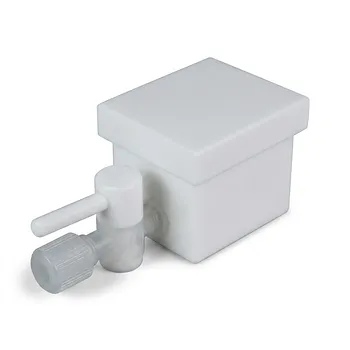
- Custom PTFE Laboratory Apparatus Corrosion Resistant Low Background Reaction Cells Precision CNC Fabrication
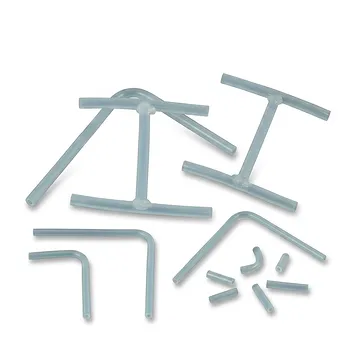
- High Performance PFA Coiled Spring Tubing and Custom PTFE Fabrication Services with Welded Fittings and Precision Bent Components
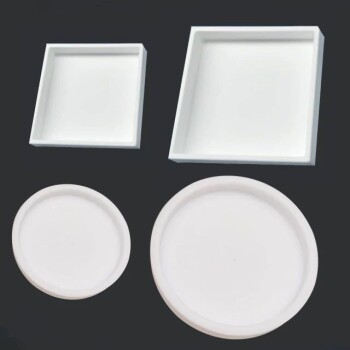
- Custom PTFE Parts Manufacturer for Teflon Containers and Components
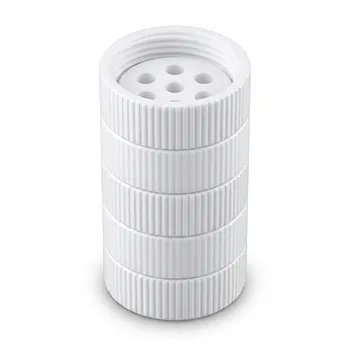
- High Temperature PTFE Reaction Sieve with Customizable Layers and Precision Pore Sizes for Threaded Sample Separation Devices
- Customizable PTFE Scrapers and Shovels for Demanding Applications
People Also Ask
- What are the primary fabrication methods for PTFE laboratory apparatus? Expert Insights into Fluoropolymer Engineering
- What is the chemical compatibility range for PTFE laboratory apparatus? Explore Near-Universal Chemical Resistance.
- What are the primary chemical resistance properties of PTFE laboratory apparatus? Unmatched Purity and Inertness
- What customization options are available for PTFE materials? Tailor Performance for Your Application
- What are the solvent resistance limits and chemical swelling behaviors of PTFE laboratory equipment? Key data and practical guidance for safe use.