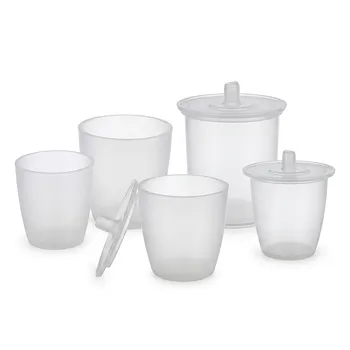
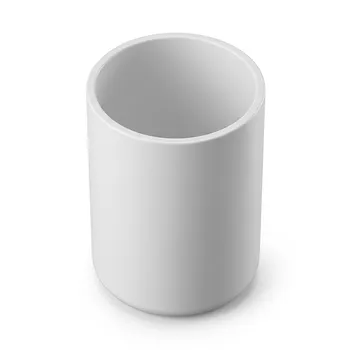
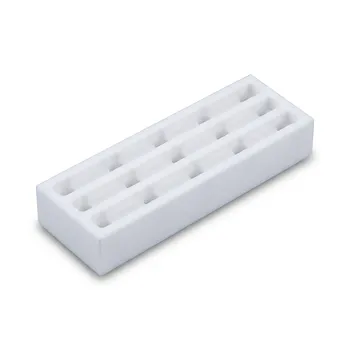
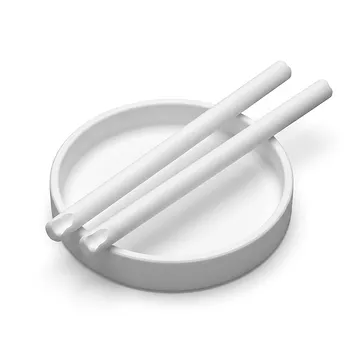
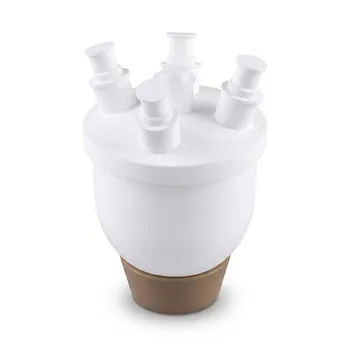
PTFE requires specialized fabrication because it does not become a freely flowing liquid when heated. Unlike conventional thermoplastics, high-molecular-weight PTFE softens near its melting transition, around 327°C, into a stiff, highly viscous gel rather than a low-viscosity melt. As a result, standard injection-molding equipment cannot reliably force it through gates and cavities to form custom labware.
The central issue is flow: PTFE must generally be cold-compressed and sintered into solid stock before the final geometry is produced by precision machining. This process preserves the material's chemical resistance and purity while allowing manufacturers to create custom vessels, fittings, cells, and other non-standard laboratory components.
Why Standard Injection Molding Does Not Work
PTFE Does Not Form a Conventional Melt
Most melt-processable thermoplastics become sufficiently fluid above their processing temperature. That flow allows injection pressure to fill a mold cavity and reproduce its shape.
PTFE behaves differently. Its extremely high molecular weight, highly linear structure, and strong fluorine shielding produce exceptionally high melt viscosity. Above its melting transition, it forms a stiff gel with little practical flow.
High Pressure Cannot Solve the Problem
Injection molding depends on a material flowing through narrow passages before it cools. PTFE's resistance to flow makes it impractical to push through standard runners, gates, and thin sections using conventional molding conditions.
Increasing pressure also does not convert PTFE into a normal injection-molding melt. It can create equipment demands, incomplete filling, dimensional problems, or damage to the part and mold without providing reliable reproduction of intricate geometry.
PTFE Cannot Be Dissolved or Easily Reprocessed
PTFE is also resistant to essentially all common solvents, acids, and bases. It therefore cannot be made into a solution for solvent casting or reshaped through ordinary solution-processing methods.
This leaves manufacturers with a fundamentally different production route: solid-state forming followed by mechanical working.
How PTFE Is Fabricated Instead
Powder Compaction Creates the Preform
PTFE resin is supplied as granular material or fine powder. The resin is first compacted at or near room temperature into a preliminary shape, such as a billet, rod, tube, or molded blank.
This compaction step gives the loose resin enough density and physical integrity to undergo thermal treatment.
Sintering Fuses the Particles
The compacted preform is heated above PTFE's melting transition under controlled conditions. The particles fuse together as the material consolidates, producing a dense solid with the characteristic chemical and thermal performance of PTFE.
Sintering is not equivalent to conventional melt molding. The material is consolidated from a pressed powder body rather than injected as a freely flowing liquid into a mold.
Paste Extrusion Handles Some Specialized Shapes
Certain PTFE products can also be produced through paste extrusion. In this method, lubricated fine-powder PTFE is forced through a die and then thermally processed.
Paste extrusion is useful for selected geometries, particularly tubing and profiles, but it does not eliminate the need for specialized processing or secondary machining when a component has complex features or tight tolerances.
Why CNC Machining Is Essential for Custom Labware
Solid Stock Provides a Reliable Starting Point
After compaction and sintering, PTFE is available as a dense block, rod, tube, or other preformed stock shape. This stock can be inspected and then machined into the required component.
For custom laboratory equipment, this approach is more adaptable than designing and qualifying a dedicated mold for every non-standard part.
Machining Creates Complex Geometry
CNC machining can produce features that are difficult or impractical to form through powder molding alone. These include:
- Custom internal cavities
- Threads and precision bores
- Fluid channels and manifold passages
- Sealing surfaces and grooves
- Flanges, ports, and mating features
- Specialized electrochemical-cell geometries
This makes it possible to manufacture custom reaction vessels, digestion-vessel liners, transfer fittings, valve bodies, and laboratory fixtures.
Tight Tolerances Matter in Laboratory Systems
Custom labware often must mate with tubing, sensors, electrodes, valves, seals, or other components. Small dimensional errors can cause leakage, poor alignment, dead volume, or unreliable experimental results.
Precision CNC machining allows the final dimensions and surface finish to be controlled after sintering, where shrinkage and material consolidation have already occurred.
The Process Protects Material Performance
PTFE's value in laboratory equipment comes from its broad chemical resistance, low friction, thermal endurance, and clean, non-reactive surface. Controlled fabrication and machining help maintain these properties without introducing incompatible additives or contaminating coatings.
The finished part remains a continuous PTFE component rather than a conventional molded assembly that depends on multiple bonded or coated surfaces.
Understanding the Trade-offs
Machining Can Generate More Waste
CNC machining removes material from a billet or rod, so complex parts may produce substantial scrap. This is less material-efficient than high-volume injection molding, where each mold cycle can produce near-net-shape parts.
For one-off or low-volume custom labware, however, avoiding a specialized mold can outweigh the additional machining waste.
Production Is Slower and More Expensive
Compaction, sintering, inspection, and CNC machining require more processing time than conventional injection molding. Tooling, machine time, operator expertise, and dimensional verification all contribute to the cost.
The specialized route is therefore most justified when the part requires PTFE's performance or when the geometry and production volume do not support dedicated molding tooling.
Sintering Introduces Dimensional Considerations
PTFE preforms can change dimensions during thermal consolidation. Manufacturers must account for this behavior when designing the preform and machining allowance.
Final dimensions should be established through post-sintering machining and inspection rather than assumed directly from the compacted shape.
Not Every PTFE Part Needs the Same Process
Simple high-volume shapes may be produced using compression molding and sintering, while tubing may use paste extrusion. Highly customized components typically require machining from sintered stock, sometimes combined with other specialized operations.
The correct process depends on the geometry, tolerance, quantity, wall thickness, and performance requirements.
Making the Right Choice for Your Goal
The manufacturing method should follow the part's required geometry, production volume, and material performance.
- If your primary focus is custom geometry: Specify sintered PTFE stock followed by CNC machining, especially for internal channels, ports, threads, and non-standard vessel shapes.
- If your primary focus is chemical purity and resistance: Use an appropriate unfilled PTFE grade and a controlled fabrication process that avoids incompatible materials and contamination.
- If your primary focus is tight dimensional control: Treat sintering as a preforming step and establish final tolerances through post-sintering CNC machining and inspection.
- If your primary focus is high-volume production: Evaluate compression molding, paste extrusion, or another specialized near-net-shape process before committing to extensive machining.
- If your primary focus is a one-off laboratory apparatus: CNC machining from preformed PTFE billets is usually the most flexible route because it avoids custom injection-mold tooling.
PTFE is difficult to injection mold because it never becomes a conventional flowing melt, but specialized compaction, sintering, and CNC machining make its unique laboratory performance available in precise custom forms.
Summary Table:
| Aspect | Conventional Thermoplastics | PTFE |
|---|---|---|
| Melting behavior | Forms low-viscosity melt, flows easily | Softens to stiff gel, extremely high viscosity |
| Injection molding | Standard process, effective | Not viable, cannot fill molds |
| Fabrication method | Melt processing (injection, extrusion) | Powder compaction, sintering, then machining |
| Custom parts | Requires custom molds, costly for small volumes | CNC machining from stock, flexible for custom geometry |
| Tolerances | Good, but dependent on mold design | Controlled via post-sintering machining |
| Material properties | Process-dependent | Maintains chemical resistance and purity |
Need custom PTFE labware that withstands extreme chemicals and temperatures? Our precision CNC machining and end-to-end PTFE/PFA fabrication capabilities deliver complex, bespoke components from sintered stock. Contact us today to discuss your project and receive a tailored solution.
Related Products
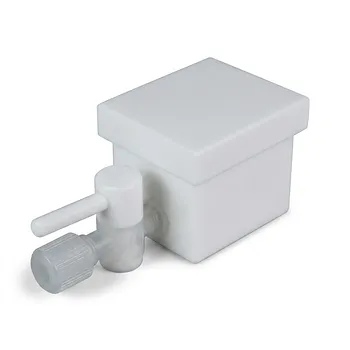
- Custom PTFE Laboratory Apparatus Corrosion Resistant Low Background Reaction Cells Precision CNC Fabrication
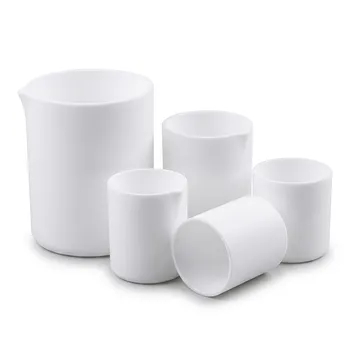
- Large Scale PTFE Beakers and Flasks for High Temperature Corrosion Resistant Laboratory Applications with Custom CNC Fabrication
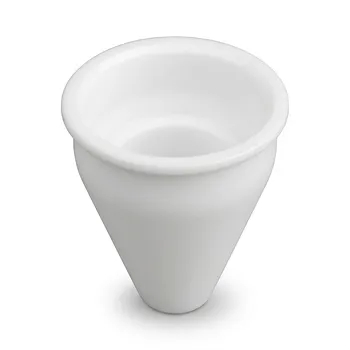
- Custom Machined PTFE Conical Sample Cell Corrosion Resistant Triangular Fluoropolymer Container for Trace Analysis
- Custom PTFE Constant Pressure Separatory Funnel Corrosion Resistant Low Background Labware for PFA Flasks
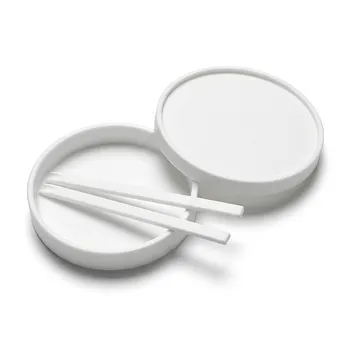
- Custom Polytetrafluoroethylene PTFE Petri Dishes 60mm Corrosion Resistant Low Background Labware
People Also Ask
- How does PTFE's melting behavior affect custom lab apparatus? Key insights for manufacturing.
- What are the primary fabrication methods for PTFE laboratory apparatus? Expert Insights into Fluoropolymer Engineering
- What is the chemical compatibility range for PTFE laboratory apparatus? Explore Near-Universal Chemical Resistance.
- Why use PTFE or PFA for modified Cu-MOF synthesis? Ensure High Purity and Exceptional Chemical Stability
- What are the primary chemical resistance properties of PTFE laboratory apparatus? Unmatched Purity and Inertness