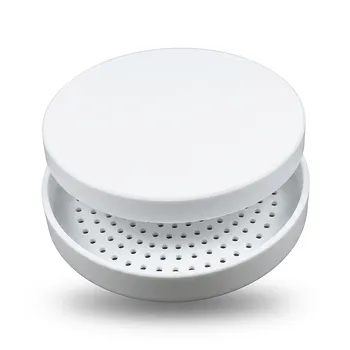
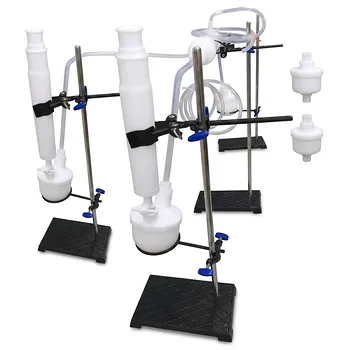
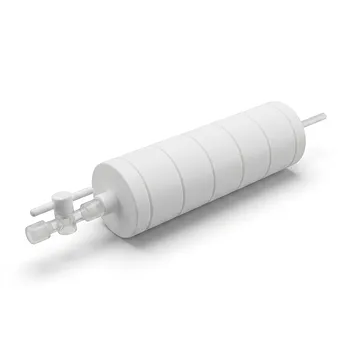
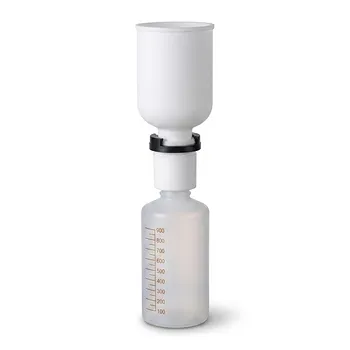
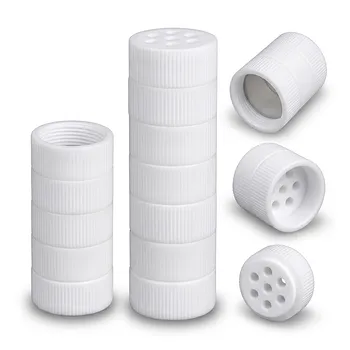
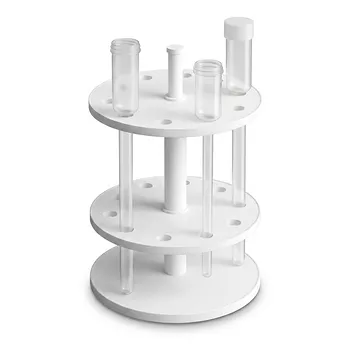
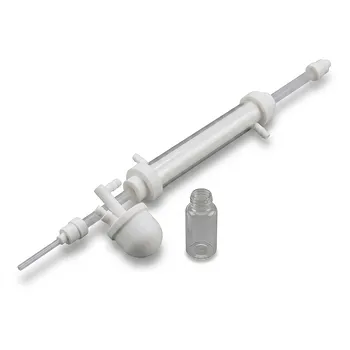
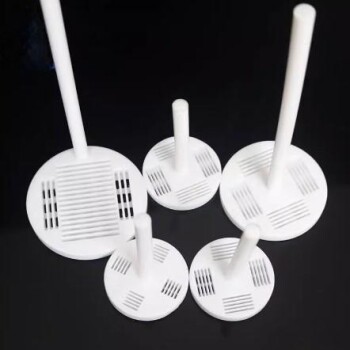
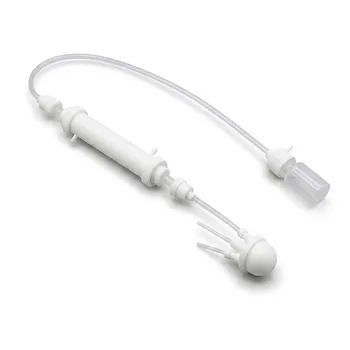
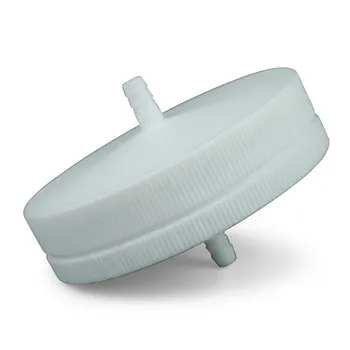
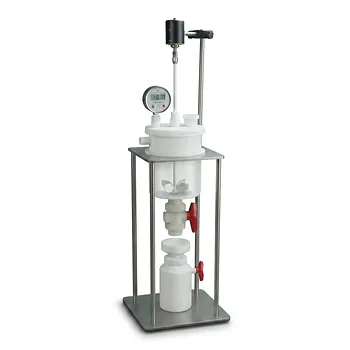
To ensure experimental integrity and mechanical stability, Teflon (PTFE) mesh is used at both ends of a fixed-bed column to act as a durable physical barrier that retains granular adsorbents while allowing fluid to pass. Beyond simple containment, its primary purpose is to provide extreme chemical resistance against the aggressive acids and bases used during adsorption and elution cycles, preventing material degradation and sample contamination.
Core Takeaway: Teflon mesh acts as a chemically inert "gatekeeper" that prevents adsorbent loss and eliminates the risk of leaching ions into the system, which is critical for maintaining the accuracy of high-sensitivity analytical results.
Ensuring Physical Containment and Flow Stability
Preventing Adsorbent Migration
The most immediate function of the PTFE mesh is to serve as a physical barrier that keeps granular media inside the column. Without these meshes, the fluid flow—especially under pressure—would carry the adsorbent particles out of the bed, leading to "channeling" or total loss of the media.
Maintaining Bed Uniformity
By securing both the inlet and outlet, the mesh helps maintain the structural integrity of the fixed bed. This ensures that the fluid moves evenly through the adsorbent layers, which is necessary for calculating accurate breakthrough curves and kinetic data.
Sealing Against Pressure
In many experimental setups, the mesh works in tandem with O-rings and mating surfaces to create a leak-proof seal. Because PTFE can withstand pressurized fluids and gases, it prevents bypass flow around the edges of the column housing.
Chemical Resilience in Aggressive Environments
Resistance to pH Extremes
Fixed-bed experiments, particularly those involving copper recovery, often require the use of highly acidic elution steps to strip captured metals from the adsorbent. Teflon is uniquely suited for this because it remains completely stable when exposed to the strong acids and bases that would dissolve or weaken standard plastic or metal screens.
Eliminating Interacting Ions
Standard metal meshes can corrode over time, releasing interfering ions into the effluent stream. Teflon is chemically inert, meaning it will not react with the mobile phase or introduce "ghost" signals that could skew the concentration measurements of the target analytes.
Long-Term Operational Durability
In continuous flow operations, materials are subjected to constant chemical stress for days or weeks. Teflon’s non-corrosive nature ensures that the mesh does not become brittle or fail mid-experiment, which would compromise the entire data set.
Understanding the Trade-offs
Mechanical Limitations
While Teflon is chemically superior, it is softer than stainless steel. Under extremely high-pressure industrial applications, a PTFE mesh may require a secondary support structure to prevent it from deforming or "creeping" into the plumbing.
Pore Size Restrictions
Teflon meshes must be carefully selected based on particle size distribution. If the mesh openings are too large, fine particles will escape; if they are too small, they may cause a significant pressure drop across the column, potentially straining the pump system.
How to Apply This to Your Project
When designing your fixed-bed experiment, the choice of mesh material should be dictated by your solvent's chemistry and your analytical sensitivity.
- If your primary focus is high-acid elution or metal recovery: Use Teflon mesh to prevent corrosion and ensure that no external metal ions contaminate your recovery data.
- If your primary focus is high-pressure chromatography: Consider a reinforced PTFE mesh or a hybrid setup where the Teflon provides chemical protection while a rigid housing provides mechanical support.
- If your primary focus is cost-effective water filtration at neutral pH: You may be able to use standard polypropylene meshes, though Teflon remains the "gold standard" for avoiding long-term degradation.
Choosing Teflon mesh transforms the column ends from potential points of failure into reliable, inert boundaries that protect the purity of your results.
Summary Table:
| Key Feature | Benefit in Adsorption | Experimental Impact |
|---|---|---|
| Chemical Inertness | Resists aggressive acids and bases | Prevents leaching and sample contamination |
| Physical Barrier | Retains granular adsorbent media | Eliminates bed migration and channeling |
| Flow Stability | Ensures uniform fluid distribution | Leads to accurate breakthrough curve data |
| Pressure Sealing | Maintains leak-proof boundaries | Protects system integrity under pressure |
| High Durability | Resists corrosive degradation | Ensures reliable, long-term operational life |
Enhance Your Research with KINTEK’s Precision Fluoropolymer Solutions
Maximize your experimental accuracy with high-performance materials designed for the most demanding laboratory environments. KINTEK specializes in manufacturing an exhaustive range of laboratory supplies crafted exclusively from PTFE and PFA, ensuring absolute chemical inertness and durability for your sensitive applications.
Whether you need:
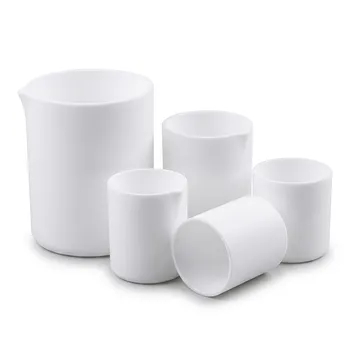
- Everyday Labware: Beakers, measuring cylinders, crucibles, and reagent/wash bottles.
- Fluid Handling: High-purity tubing, fittings, valves, and filtration tools like separatory funnels.
- Advanced Apparatus: Custom electrochemical cells, battery testing fixtures, and microwave digestion vessels.
- Bespoke Engineering: End-to-end custom CNC fabrication for complex, non-standard machined parts.
From high-volume orders of general consumables like stirring bars and O-rings to bespoke laboratory setups, KINTEK delivers the high-performance fluoropolymer components your project requires.
Ready to upgrade your lab setup? Contact us today to discuss your custom requirements and experience the KINTEK advantage!
References
- Yun Lee, Youngkyun Jung. Controlled in-situ crystallization in amine-rich millicapsules for hyper-efficient copper recovery. DOI: 10.1007/s42114-025-01439-2
This article is also based on technical information from Kintek Knowledge Base .
Related Products
- Custom Virgin Polytetrafluoroethylene Sieve Mesh Solid Waste Analysis Round Square Customizable PTFE Screens
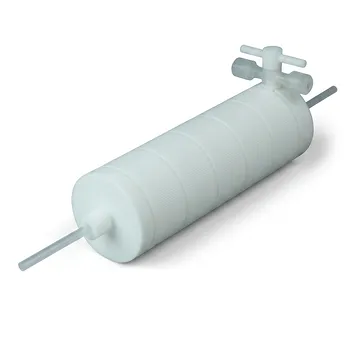
- Custom PTFE Distillation Chromatography Filtration Columns for Semiconductor Chemical Analysis and Corrosion Resistant Lab Processing
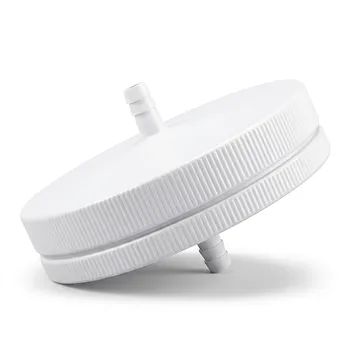
- PTFE Corrosion Resistant Filter with PFA Valve Connections and Integrated Sieve Plate
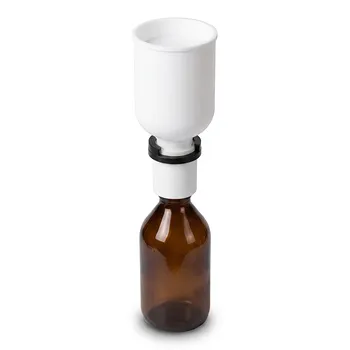
- PTFE PFA Vacuum Filtration System Corrosion Resistant Customizable Shatterproof Laboratory Device
- Corrosion Resistant PTFE Multi Layer Sieve with Threaded Connections for Bio Chemical Laboratory Extraction and Customizable Mesh Size
People Also Ask
- What is the chemical name for Teflon, and what is its abbreviation? Unveiling PTFE’s Unique Properties
- What are common industrial applications of PTFE filters? Master Critical Filtration in Demanding Industries
- What are the primary uses of PTFE filters? Achieve Pure, Sterile Filtration for Aggressive Chemicals
- Why are PTFE filters advantageous for gravimetric analysis? Achieve Unmatched Accuracy and Precision
- What are the main benefits of PTFE filters? Achieve Unmatched Chemical Resistance and Purity