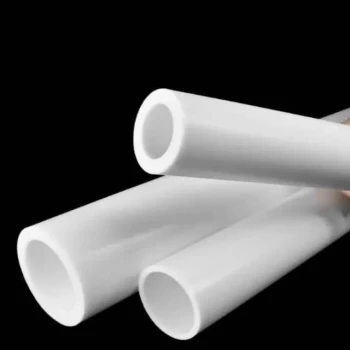
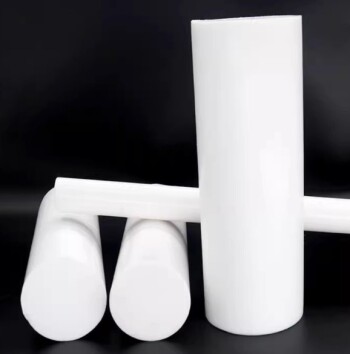
Presintered granular PTFE resin provides both easier processing and stronger extruded stock. Its higher bulk density and free-flowing granules feed more uniformly into ram extruders, reducing bridging, void formation, and inconsistent compaction. For small-diameter rods and thin-walled tubing, the resulting material offers better structural integrity and greater resistance to fracture at charge marks.
Presintering thermally conditions PTFE into controlled, free-flowing granules that are better suited to high-pressure ram extrusion. The result is more consistent feeding and compaction, producing rods and tubing with fewer internal defects and improved resistance to extrusion-related fracture.
Why Presintered PTFE Processes More Reliably
Higher Bulk Density Improves Feeding
Presintered resin has a higher bulk density than fine-cut granular PTFE. More material enters the feed section for a given volume, which helps maintain a consistent supply during ram extrusion.
This is important because ram extrusion depends on repeatable powder charging and compaction. Variations in the resin bed can create dimensional inconsistencies or weak areas in the finished profile.
Free-Flowing Granules Reduce Bridging
The controlled granules, typically several hundred microns in size, flow more readily than finer powders. They are less likely to form a stable arch or “bridge” across the feed path.
Reducing bridging helps prevent interruptions in resin delivery. It also limits the formation of poorly compacted regions that can become internal voids during extrusion.
Thermal Conditioning Lowers the Processing Melt Point
Presintering involves melting the polymerized PTFE, cooling it, and disintegrating it into granules. This thermal conditioning reduces the referenced melting point from approximately 342°C to 327°C.
The lower processing melt point can make the resin more manageable during the extrusion cycle. However, the principal manufacturing benefit is the combination of thermal conditioning, particle structure, bulk density, and flowability rather than the temperature reduction alone.
How the Resin Improves Extruded Structures
More Uniform Compaction
Consistent feeding allows the ram extruder to compact the resin more uniformly throughout the charge. Uniform compaction is especially important when the finished shape has little material available to absorb defects.
For thin-walled tubing, uneven packing can translate directly into wall-thickness variation or weak sections. For small rods, it can create internal discontinuities that compromise machining or service performance.
Fewer Internal Voids
Fine-cut powders can bridge or pack unevenly, leaving void spaces inside the extruded billet or profile. Presintered granules reduce this risk by entering and filling the extrusion cylinder more consistently.
Minimizing voids improves the continuity of the PTFE structure. It also produces raw stock that is more suitable for precision machining into finished components.
Greater Resistance to Charge-Mark Fracture
During ram extrusion, pressure gradients and interfaces between successive charges can create localized weaknesses. In severe cases, these areas may fracture in a phenomenon commonly called “poker chipping.”
Presintered PTFE grades are better suited to the higher pressures associated with small rods and thin-wall tubing. Their more consistent structure helps resist fracture at charge marks and reduces the likelihood that extrusion interfaces will become critical defects.
Why the Benefits Matter for Small Profiles
Small-Diameter Solid Rods
Small rods, including rods in the approximate 2 to 20 mm range, are relatively sensitive to internal defects. A void or weak charge interface occupies a larger proportion of the cross-section than it would in a large-diameter rod.
Presintered resin supports a more uniform, defect-resistant structure. This is valuable when the rod will later be machined into bearings, bushings, seals, or other precision components.
Thin-Walled Tubing
Tubing with wall thickness below approximately 2 mm has limited material thickness to maintain pressure resistance and dimensional stability. Minor compaction defects can therefore have a disproportionate effect on the tube's integrity.
Consistent resin flow and packing help produce more uniform walls and reduce fracture-prone regions. The result is raw tubing better suited to fluid transfer applications where continuity and cleanliness are important.
High-Pressure Ram Extrusion
Small-diameter rods and thin-walled tubes generally require more demanding extrusion conditions than larger, thick-walled profiles. The resin must tolerate higher pressures without developing interfacial fractures.
Presintered grades are therefore matched to applications where structural uniformity and pressure resistance are more important than simply achieving a free-flowing powder.
Understanding the Trade-offs
Presintered Resin Is Not the Universal Choice
General-purpose free-flowing granular PTFE can be appropriate for larger rods, typically above 20 mm, and thick-walled tubing. These profiles encounter different compaction and pressure conditions and may not require the same resistance to high-pressure interfacial fracture.
The correct grade depends on the profile dimensions, extrusion pressure, required mechanical strength, and intended service conditions.
Better Flow Does Not Replace Process Control
Presintered resin reduces feed-related variability, but it does not eliminate the need for controlled extrusion parameters. Ram pressure, charging practice, temperature, tooling, and cooling conditions still affect the final structure.
A suitable resin can prevent common powder-related defects, but poor equipment setup or inconsistent operating procedures can still produce dimensional or mechanical problems.
The Lower Melt Point Requires Proper Interpretation
The reduction from approximately 342°C to 327°C is a characteristic of the thermally conditioned resin described in the references. It should not be treated as a standalone guarantee of improved product performance.
The practical advantage comes from how the resin's thermal history and granule morphology affect feeding, compaction, and resistance to fracture during the complete ram extrusion process.
Making the Right Choice for Your Goal
Select the resin grade according to the profile geometry and the stresses imposed during extrusion.
- If your primary focus is producing small-diameter solid rods: Use a presintered grade to support uniform high-pressure compaction and reduce fracture at charge marks, especially when the rod will be precision-machined.
- If your primary focus is producing thin-walled fluid-transfer tubing: Use presintered granular PTFE to improve feeding consistency, minimize internal voids, and support uniform wall integrity.
- If your primary focus is producing large-diameter rods or thick-walled tubes: Evaluate general-purpose free-flowing granular PTFE as well, since these profiles may encounter lower extrusion pressures and different structural requirements.
- If your primary focus is reducing extrusion defects: Prioritize resin flowability and bulk density, then validate the selection through controlled charging, pressure, temperature, and dimensional checks.
For demanding small-profile extrusion, presintered granular PTFE offers the combination of feed reliability, uniform compaction, and fracture-resistant structural integrity needed to produce dependable rods and thin-walled tubing.
Summary Table:
| Advantage | Description |
|---|---|
| Higher bulk density | More material per volume, consistent supply during ram extrusion. |
| Free-flowing granules | Reduces bridging, prevents void formation. |
| Thermal conditioning | Lower processing melt point (327°C), easier extrusion. |
| Uniform compaction | Fewer internal voids, better dimensional stability. |
| Charge-mark fracture resistance | Withstands high pressures, reduces 'poker chipping'. |
Ready to enhance your PTFE extrusion quality? KINTEK offers high-performance presintered PTFE resins and expert custom machining. [Contact us today] to get the right solution for your small rods and tubing needs!
Related Products
- Custom PTFE Sleeves and Hollow Rods for Advanced Applications
- Customizable PTFE Rods for Advanced Industrial Applications
- High Performance PFA Coiled Spring Tubing and Custom PTFE Fabrication Services with Welded Fittings and Precision Bent Components
- Custom Graphite Filled PTFE Rods for Advanced Industrial Applications
- Corrosion Resistant PTFE Digestion Tubes for Graphite Digestion Systems with Reflux Caps and Customizable Dimensions
People Also Ask
- What industries benefit most from custom PTFE parts? Solve Extreme Environment Challenges
- What advantages do custom PTFE parts offer for industrial efficiency? Boost Uptime & Cut Costs
- What design considerations are important for custom PTFE parts? Design for Performance & Reliability
- What industries use custom PTFE parts and for what purposes? Solve Critical Challenges with High-Performance Materials
- What are the main advantages of using PTFE for custom parts? Solve Complex Engineering Challenges