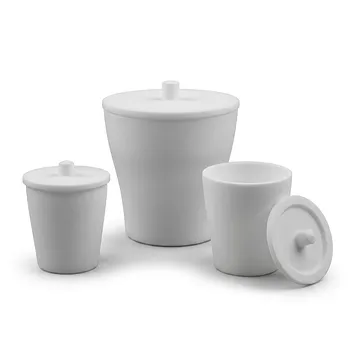
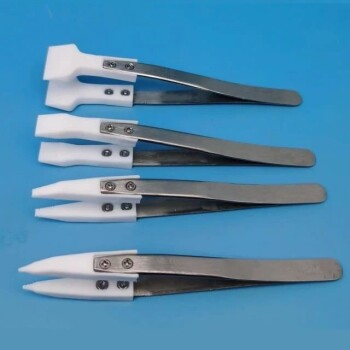
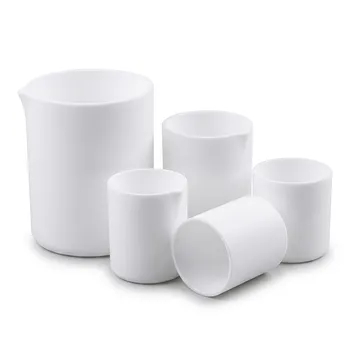
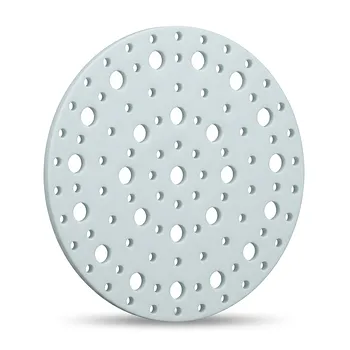
Billet molding and sintering turn granular PTFE into dense, machinable stock for custom laboratory equipment. The powder is first compacted at room temperature under high pressure to form a preform, then heated above PTFE’s melting point so its particles fuse into a cohesive billet. Because PTFE has extremely high melt viscosity and does not flow like conventional thermoplastics, this solid-state route provides the reliable material base required for CNC-machined reaction vessels, electrochemical cells, valve bodies, fittings, and other non-standard laboratory components.
The key advantage is the combination of material integrity and geometric flexibility: sintering creates dense, chemically resistant PTFE stock, while CNC machining converts that stock into precise equipment tailored to a specific laboratory process.
Why Granular PTFE Requires Specialized Processing
PTFE Cannot Be Conventionally Injection Molded
High-molecular-weight PTFE does not become a readily flowable liquid when heated. Instead, it forms a stiff gel, making conventional melt extrusion and injection molding unsuitable for many custom shapes.
Manufacturers therefore compact granular resin below its melting point and use heat later to consolidate the compacted particles. This preserves the processing advantages of PTFE while making large or complex stock shapes available for machining.
Preforming Establishes the Initial Shape
During preforming, granular PTFE powder is loaded into a mold and compressed at room temperature using a mechanical press. The mold allows trapped air to escape as the powder is compacted into an intermediate shape.
The resulting preform may be rectangular, cylindrical, or otherwise suited to the required billet dimensions. Filled PTFE compounds can also be processed when a particular mechanical or friction characteristic is needed.
How Sintering Creates Reliable Machining Stock
Particles Fuse Into a Dense Structure
The preform is heated above PTFE’s melting point during sintering. Individual particles coalesce and consolidate into a cohesive polymer matrix, producing a solid billet with substantially reduced microporosity and internal voids.
This transformation is essential for laboratory equipment because porous or weakly consolidated stock could compromise leak tightness, dimensional stability, and resistance to chemical exposure.
Mechanical Properties Become More Uniform
Proper sintering establishes more consistent strength throughout the billet. A uniform material structure gives machinists a more predictable workpiece when cutting threads, channels, bores, sealing surfaces, valve seats, and other functional features.
The resulting stock can be machined into components whose performance is not limited to the original shape of the molding tool.
Sintering Influences Crystallinity and Stability
The thermal cycle affects PTFE’s crystalline structure and final density. Controlled sintering helps produce stock with the mechanical strength and dimensional stability needed for heavy-walled vessels, covers, fittings, and reaction-cell components.
These properties are particularly important when equipment must remain impermeable to reactive liquids or gases.
How Billets Support Custom CNC Machining
Large Stock Shapes Accommodate Non-Standard Designs
Billet or block molding produces large rectangular or cylindrical stock shapes. These blocks can be machined into custom reaction vessels, crucibles, electrochemical cells, valve bodies, and specialized laboratory housings.
Starting from a solid billet allows the manufacturer to create dimensions and internal features that are impractical to produce as standard molded products.
Machining Adds Functional Precision
CNC machining can produce the precise interfaces required for laboratory systems, including:
- Fluid passages and ports
- Threaded connections
- Sealing grooves
- Electrode openings
- Valve cavities
- Custom flanges and covers
- Mating surfaces for glass, metal, or other polymer components
This makes the process suitable for equipment designed around a particular experiment, fluid path, instrument, or analytical workflow.
The Finished Part Retains PTFE’s Core Advantages
Machining changes the geometry without replacing the underlying PTFE material. The finished component retains low surface friction, strong resistance to thermal degradation, and broad resistance to aggressive chemical environments.
For high-purity applications, the use of suitably selected and processed PTFE stock also supports clean fluid handling and minimizes concerns associated with corrosion or material interaction.
Matching the Stock Form to the Equipment Design
Billets and Blocks
Billets are appropriate for large, thick, or structurally demanding components. They provide enough material for machining deep cavities, heavy walls, large sealing faces, and complex external profiles.
This form is often used for custom reaction vessels and other apparatus where strength and impermeability are central requirements.
Sheets
Sheet molding produces flat PTFE plates for parts such as gaskets, diaphragms, vessel covers, and flat sealing elements. These components can be machined or cut to match a custom assembly.
Isostatically Molded Shapes
Isostatic molding can provide more uniform compaction for certain three-dimensional geometries. It is useful when consistent density is especially important across a complex shape.
Rods and Tubes
Ram extrusion is commonly used for continuous PTFE rods and tubes. These stock forms can be CNC machined into fluid fittings, valves, connectors, and other cylindrical components.
The selected forming method should reflect the part’s dimensions, wall thickness, geometry, and required density uniformity.
Why This Matters for Laboratory Equipment
It Enables Bespoke Fluid Handling
Laboratory fluid systems often require unusual port arrangements, specialized volumes, or connections that are unavailable in catalog equipment. Machined PTFE billets provide a practical route to producing custom valves, fittings, transfer components, and reaction-cell bodies.
It Supports Leak-Tight Construction
Dense, properly sintered PTFE reduces the internal porosity that could allow fluid or gas permeation. This supports the manufacture of components that must contain aggressive reagents or maintain controlled flow paths.
Leak tightness still depends on design, machining tolerances, surface finish, and sealing method, but sintering provides the necessary material foundation.
It Preserves Chemical and Thermal Performance
Custom geometry does not require sacrificing PTFE’s resistance to chemical attack and thermal degradation. This is valuable in trace-analysis labware, electrochemical equipment, reaction vessels, crucibles, and components exposed to corrosive process fluids.
Material selection remains important because operating temperature, pressure, chemical concentration, and mechanical loading determine the suitability of any PTFE grade.
Understanding the Trade-offs
Machining Can Generate Material Waste
CNC machining removes material from a larger billet to create the final geometry. Complex cavities and thin-wall designs can therefore produce significant scrap compared with near-net-shape molding.
For low-volume or highly specialized equipment, this waste may be acceptable because the same process avoids the cost and limitations of dedicated molding tools.
Dimensional Control Requires Process Discipline
PTFE’s thermal behavior and relatively low stiffness can affect machining accuracy and dimensional stability. The billet’s sintering history, machining conditions, geometry, and service temperature must all be considered when tight tolerances are required.
Critical dimensions should be verified after machining and, where appropriate, under conditions representative of actual use.
Material Grades Must Match the Application
Unfilled PTFE is often selected for purity and chemical resistance, while filled compounds may offer different wear, stiffness, or dimensional characteristics. A filled grade is not automatically interchangeable with virgin PTFE in high-purity or chemically sensitive equipment.
The resin grade, molding method, sintering cycle, and cleanliness controls should be specified together.
Sintering Quality Cannot Be Recovered by Machining
Machining can correct geometry, but it cannot eliminate poor consolidation or non-uniform density within the original stock. The billet must therefore be properly compacted and sintered before it reaches the CNC operation.
How to Apply This to Your Project
The most reliable workflow is to define the operating environment first, then select the PTFE grade, stock form, sintering quality, and machining method as one connected design decision.
- If your primary focus is chemical purity: Specify an appropriate virgin PTFE grade and controlled processing so the machined component preserves low contamination and broad chemical resistance.
- If your primary focus is dimensional precision: Use dense, uniformly sintered stock and account for PTFE’s thermal and mechanical behavior during machining and inspection.
- If your primary focus is leak-tight fluid handling: Prioritize low-porosity billets, carefully machined sealing surfaces, and a joint design suited to the required pressure and temperature.
- If your primary focus is a large or complex apparatus: Use billet or block molding to provide sufficient material for deep cavities, thick walls, custom ports, and integrated features.
- If your primary focus is wear or stiffness: Evaluate filled PTFE compounds, while confirming that their additives remain compatible with the laboratory’s purity and chemical requirements.
A properly molded and sintered PTFE billet gives CNC machining a dense, dependable foundation for laboratory equipment that standard molding cannot provide.
Summary Table:
| Aspect | Billet Molding & Sintering | CNC Machining |
|---|---|---|
| Purpose | Form dense, machinable PTFE stock | Shape stock into custom components |
| Key Steps | Compaction at room temp, then heating above melting point | Cutting, drilling, milling from billet |
| Advantages | • Dense, low porosity • Uniform mechanical properties • Chemical resistance |
• Custom geometry • Precise features • Retains PTFE benefits |
| Limitations | Requires specialized equipment | Material waste; thermal sensitivity |
Ready to bring your custom PTFE lab equipment to life? With KINTEK's expertise in billet molding, sintering, and CNC machining, we deliver precise, durable components tailored to your exact specifications. From reaction vessels to electrochemical cells, our PTFE and PFA solutions ensure chemical resistance and purity. Contact us today to discuss your project and discover how we can support your lab's unique needs. Get in touch with our team.
Related Products
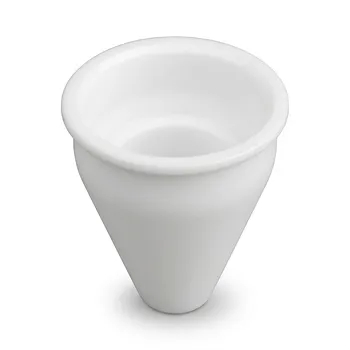
- Custom Machined PTFE Conical Sample Cell Corrosion Resistant Triangular Fluoropolymer Container for Trace Analysis
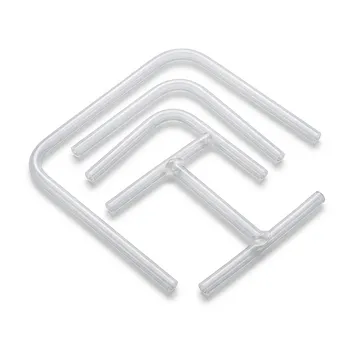
- High Purity PFA Coiled Tubing Custom PTFE Machining PFA Welding and Precision Bending Solutions
- Custom Graphite Filled PTFE Rods for Advanced Industrial Applications
- Custom PTFE Ball Mill Grinding Jar 50ml Corrosion Resistant Low Background Lab Milling Vessel
- Customizable PTFE Rods for Advanced Industrial Applications
People Also Ask
- What customization options are available for PTFE materials? Tailor Performance for Your Application
- How do Polytetrafluoroethylene (PTFE) containers perform regarding gas permeation? Expert Insights on Solvent Absorption
- What are some common applications of machined PTFE? Leverage its Unique Properties for Demanding Applications
- How are PTFE laboratory containers and apparatus typically manufactured? Inside the Precision Machining Process
- What inherent material characteristics of non-melt-processable PTFE make it suitable for manufacturing high-purity laboratory containers and custom-machined apparatus?