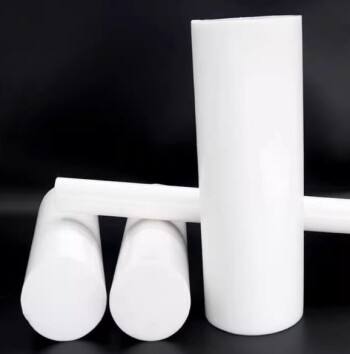
Extrusion pressure is an indirect control over PTFE rod stock hardness and machinability. In paste extrusion, higher pressure generally reflects greater mechanical work, particle deformation, and fibril formation within the fine-powder PTFE. After lubricant removal and sintering, that structure can produce a stiffer, harder, more dimensionally stable rod that is better suited to CNC machining of valve bodies, fittings, and vessel components, although pressure alone does not determine final hardness.
The useful relationship is not “higher pressure always means harder PTFE.” Pressure must be interpreted together with reduction ratio, resin molecular weight, lubricant content, die geometry, extrusion speed, temperature, and the sintering cycle. Properly controlled pressure improves structural integrity and machining stability; excessive pressure can create defects that reduce both performance and machinability.
How Extrusion Pressure Changes PTFE Structure
Pressure Increases Mechanical Work
Paste extrusion forces a lubricant-containing PTFE fine-powder preform through a shaping die. The required pressure determines how much deformation and shear work the powder experiences as it passes through the die.
That work promotes contact and fibrillation, in which PTFE particles form microscopic elongated structures. These fibrils provide green strength before sintering and contribute to the coherence and dimensional stability of the finished stock.
Reduction Ratio Is a Major Pressure Driver
The reduction ratio is the ratio of the preform cross-sectional area to the die-exit cross-sectional area. A higher reduction ratio normally requires greater pressure and produces more shear deformation and fibril orientation.
This can improve the rod's structural integrity, but the result is not equivalent to simply compressing PTFE more densely. Pressure, flow geometry, resin behavior, and fibril orientation all influence the final microstructure.
Pressure Does Not Act Alone
Higher-molecular-weight PTFE resins generally require higher extrusion pressures. Higher lubricant concentrations generally reduce the required pressure, but excessive lubricant can produce a softer or less robust extrudate and may complicate subsequent processing.
Die cone angle, die land length, extrusion speed, temperature, and guide clearances also alter pressure. Therefore, a pressure reading is most useful as a process-control indicator when the rest of the formulation and tooling are held constant.
Influence on Hardness and Dimensional Stability
Higher Controlled Pressure Can Produce Stiffer Stock
When pressure and reduction ratio are properly selected, increased fibrillation and a coherent extrudate can produce rod stock with greater stiffness and resistance to deformation. This is valuable for components that must retain a precise bore, sealing face, thread, or mating surface during machining and service.
The practical benefit is often described as increased hardness, but the more precise interpretation is improved resistance to deformation and structural instability. Final hardness also depends on PTFE grade, filler content, porosity, orientation, and sintering conditions.
Sintering Determines the Final Mechanical State
Paste-extruded PTFE is not finished rod stock immediately after it exits the die. The lubricant must be removed, and the material must then be sintered to develop its final dense polymer structure.
An extrusion condition that produces strong green material can still yield poor finished stock if drying or sintering causes voids, distortion, incomplete consolidation, or excessive shrinkage. Hardness comparisons should therefore be made on fully processed and conditioned specimens.
Dimensional Stability Matters More Than Hardness Alone
For custom laboratory components, dimensional stability is often the primary machining concern. A rod that resists compression and deflection allows more predictable production of valve seats, threaded fittings, channels, and sealing interfaces.
This is especially important when the component must maintain alignment or a controlled fluid path. A softer grade may be chemically suitable but can deform under clamping, cutting, or assembly loads.
Influence on CNC Machinability
Stiffer Rod Stock Supports More Predictable Cutting
Higher-stiffness PTFE rod stock is less likely to deflect under the cutting tool or collapse under chuck pressure. That improves dimensional control during turning, boring, threading, and milling.
It also reduces the risk that a bore or sealing surface will change size after the part is released from the fixture. For precision laboratory components, this stability can be more important than achieving the highest possible nominal hardness.
Excessive Hardness or Orientation Can Complicate Cutting
Harder or more highly oriented stock is not automatically easier to machine. Greater resistance to cutting can increase tool loading, while anisotropic fibril orientation may cause different surfaces to cut or deform differently.
The machining response also depends on tool geometry, sharpness, support, cutting speed, feed, and heat control. PTFE has low thermal conductivity and can deform if cutting heat or clamping pressure is excessive.
Surface Finish Depends on Material and Process
A stable, coherent rod generally supports a cleaner machined surface than material containing micro-voids or weakly consolidated regions. However, surface roughness can still result from poor die flow, excessive reduction ratio, unsuitable tooling, or inappropriate machining conditions.
For fluid-handling components, the objective is a consistent, low-defect surface that minimizes contamination retention and sample carryover. Extrusion quality and machining practice must be controlled together.
Why Temperature Control Is Necessary
The Paste Must Flow Uniformly
Barrel and die temperatures affect lubricant flow, paste resistance, and the way fibrils form during extrusion. The process should keep the material above the relevant room-temperature phase transition; an operating condition above approximately 30°C is commonly used as a practical control point in the supplied reference.
The exact temperature window remains formulation- and equipment-dependent. Temperature should be selected to support uniform flow without causing lubricant instability, premature drying, or nonuniform pressure.
Poor Temperature Control Creates Machining Problems
If the paste does not flow coherently, the rod may contain density variations, surface flaws, or internal defects. These regions can deform unpredictably during machining or cause edge breakout around holes, grooves, and threads.
A stable pressure signal, uniform surface appearance, and consistent dimensions are better indicators of process quality than pressure alone.
Understanding the Trade-offs
Higher Pressure Can Become Excessive
An unnecessarily high reduction ratio or restricted die flow can cause pressure spikes, surface roughness, internal defects, and nonuniform structure. These defects can outweigh any benefit from increased fibrillation.
Die design and process settings should therefore seek the required structural integrity at the lowest pressure that produces a coherent, defect-free extrudate.
Low Pressure Can Produce Softer, Less Stable Stock
Too little deformation may produce insufficient fibrillation and weaker green strength. After sintering, the material may show poorer dimensional stability or greater susceptibility to deformation during machining and assembly.
Lower-pressure processing can still be appropriate where flexibility or conformability is more important than machining rigidity, such as certain sealing applications.
Guide Clearance Can Distort Pressure Interpretation
In tubing or mandrel-based extrusion, the clearance between the internal guide tube tip and die land strongly affects paste flow. Clearance that is too small restricts flow and raises pressure; clearance that is too large can increase drag, tighten the PTFE sheath, and promote cracking or back-extrusion.
Although this issue is most directly associated with tubing, it illustrates a broader principle: a pressure change may indicate a tooling or flow problem rather than a desirable material change.
Pressure Is Not a Substitute for Grade Selection
A process adjustment cannot fully compensate for choosing a PTFE grade that is unsuitable for the component. Resin molecular weight, virgin or filled formulation, lubricant system, and intended service conditions must be selected before pressure is optimized.
For example, a component requiring high stiffness or wear resistance may need a filled PTFE formulation rather than simply a higher extrusion pressure. Filled PTFE is generally associated with compression molding rather than conventional fine-powder paste extrusion, so the manufacturing route must match the material.
Making the Right Choice for Your Goal
The best setting is the one that produces a uniform, fully sintered rod with the required resistance to deformation and no extrusion-induced defects.
- If your primary focus is CNC dimensional accuracy: Use a controlled, relatively high-work extrusion condition that produces coherent, stiff stock, then verify final dimensions after sintering and stress relaxation.
- If your primary focus is easy cutting and conformability: Avoid unnecessarily high reduction ratios and pressure, and select a grade and process that provide adequate integrity without making the stock excessively resistant to deformation.
- If your primary focus is leak-tight laboratory fittings: Prioritize uniform density, low void content, stable shrinkage, and smooth machined surfaces rather than nominal hardness alone.
- If your primary focus is process repeatability: Track extrusion pressure together with reduction ratio, lubricant concentration, resin lot, die geometry, temperature, and speed so pressure changes can be interpreted correctly.
For custom laboratory components, optimize extrusion pressure for a stable and defect-free microstructure, then judge hardness and machinability on the fully sintered rod rather than from pressure alone.
Summary Table:
| Factor | Influence on Hardness | Influence on Machinability |
|---|---|---|
| Higher Pressure | Increases stiffness (harder feel) | Better dimensional control; may increase tool loading |
| Lower Pressure | Softer, less stable | Easier cutting but risk of deformation |
| Reduction Ratio | Higher ratio increases fibrillation | More orientation can cause anisotropic cutting |
| Sintering | Determines final density and hardness | Affects voids and stability |
| Temperature | Affects flow and uniformity | Poor control leads to defects |
| Grade Selection | Molecular weight and fillers set base hardness | Filled grades may machine differently |
Optimize your PTFE components with KINTEK’s precision-machined lab supplies.
Our PTFE and PFA products, backed by end-to-end CNC machining, are engineered for superior dimensional stability and machinability. Whether you need custom valve bodies, fittings, or high-purity analysis tools, we deliver solutions that meet your exact specifications.
Contact us today to discuss your application and discover how our expertise enhances your lab’s performance.
Related Products
- Customizable PTFE Rods for Advanced Industrial Applications
- Custom Graphite Filled PTFE Rods for Advanced Industrial Applications
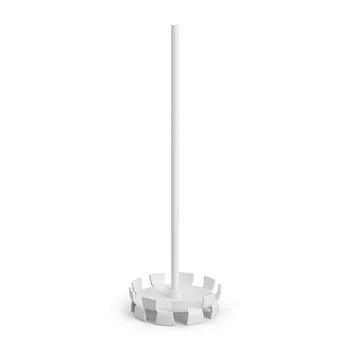
- Custom PTFE Dispersing Disc and Stirring Rod for Chemical Processing and Laboratory Mixing
- Custom PTFE Sleeves and Hollow Rods for Advanced Applications
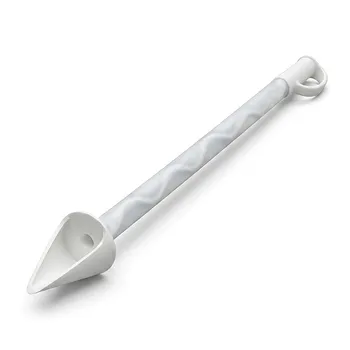
- Corrosion Resistant White PTFE Solid Sampler Manual Sampling Tool Customizable Length
People Also Ask
- How do PTFE rods contribute to energy efficiency in industrial applications? Reduce Friction & Power Consumption
- What are PTFE rods and how are they manufactured? A Guide to Their Properties and Production
- What are the different types of PTFE rods available based on manufacturing technology? Choose the Right Type for Your Project
- How are PTFE rods utilized in electronic and electrical applications? Unlock Superior Performance & Reliability
- Why are PTFE rods suitable for medical applications? Unmatched Safety and Sterilization Performance