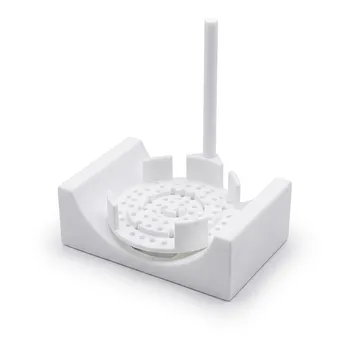
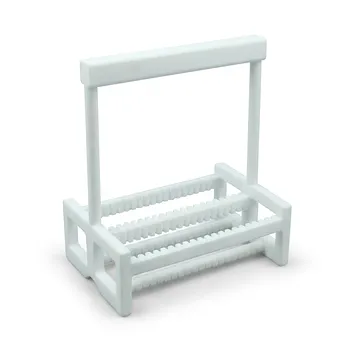
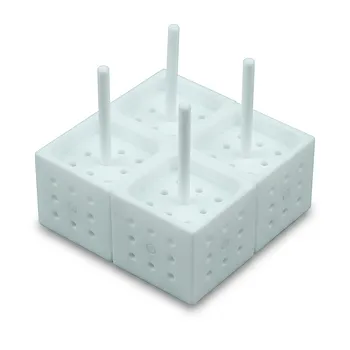
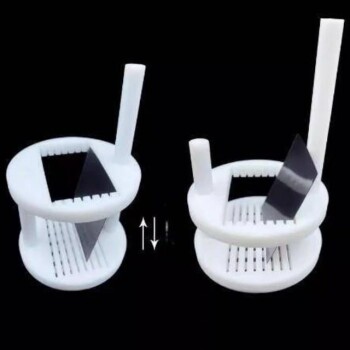
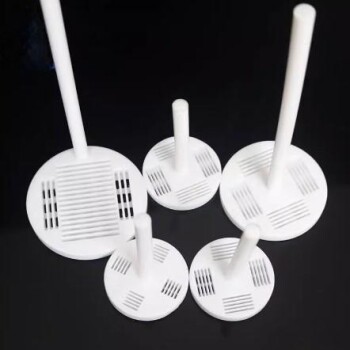
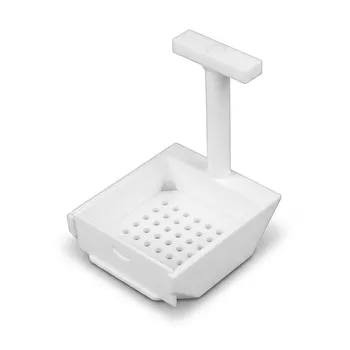
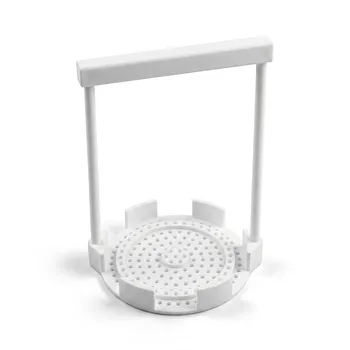
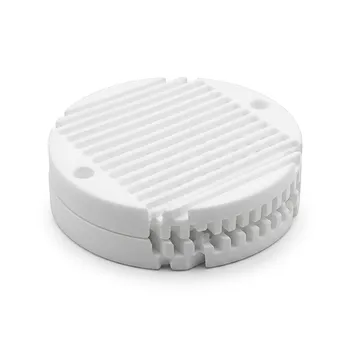
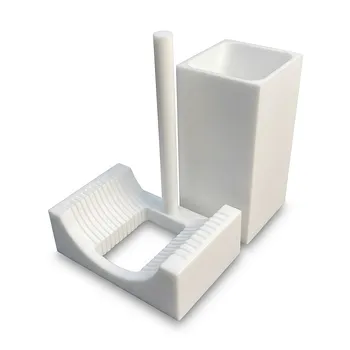
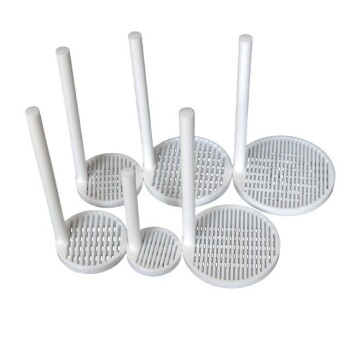
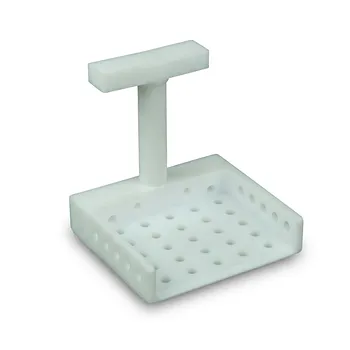
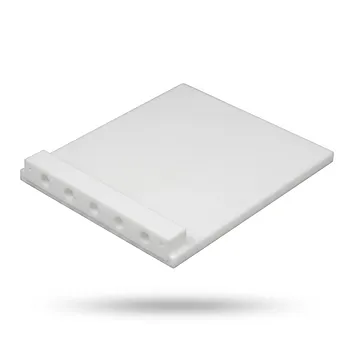
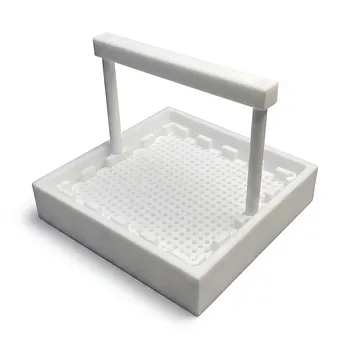
PTFE flower baskets maximize rinsing and drying efficiency through a combination of high-flow structural design and unique surface chemistry. These carriers utilize an open framework to facilitate rapid chemical displacement and unrestricted fluid drainage. By leveraging the hydrophobic nature of PTFE, the baskets prevent the formation of residual liquid films, significantly shortening drying cycles and reducing the risk of chemical carry-over between processing stages.
The core advantage of a PTFE flower basket lies in its ability to combine a high open-area ratio (30% to 50%) with a non-wetting surface. This synergy ensures that fluids move freely around the substrate while the material itself resists droplet retention, directly improving process uniformity and yield.
The Mechanics of Rapid Fluid Displacement
High Open-Area Ratios for Unrestricted Flow
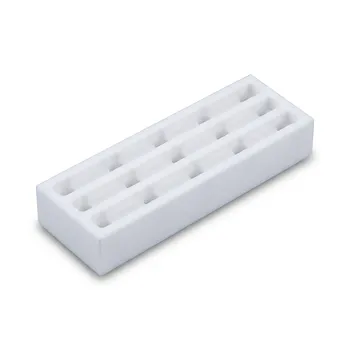
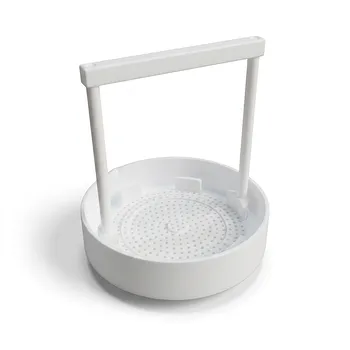
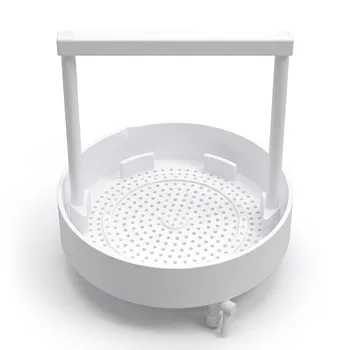
The structural design of a PTFE flower basket features an open framework with parallel grooves and perforated side plates. A base containing an array of vertical through-holes creates interconnected fluid pathways with open area ratios typically between 30% and 50%.
This high porosity allows process liquids to enter from all directions, ensuring a continuous renewal of fresh chemistry at every substrate surface. During rinsing, this design enables the rapid displacement of aggressive chemicals by the rinsing agent.
Eliminating Chemical Carry-Over
Efficiency is not just about speed, but also about purity. The open structure ensures that no "pockets" of stagnant chemistry remain trapped within the carrier.
By facilitating quick drainage, the basket prevents the transfer of etching or cleaning solutions into subsequent baths. This reduction in chemical carry-over is critical for maintaining the integrity of sensitive processes like RCA cleaning or HF-based etching.
Leveraging PTFE Surface Science for Drying
Hydrophobic Characteristics and High Contact Angles
PTFE is a non-wetting material characterized by a high contact angle for aqueous solutions. This surface property minimizes the formation of residual liquid films on the basket surface during the transition from wet to dry phases.
Because the material "repels" water, liquid beads up and rolls off rather than clinging to the frame. This characteristic significantly enhances the efficiency of overflow rinsing and spin-drying cycles.
Reducing Drag and Droplet Retention
PTFE possesses an extremely low coefficient of friction, typically between 0.05 and 0.10. This low friction, combined with its non-stick surface, reduces drag forces during immersion and withdrawal from chemical baths.
By preventing droplet retention after the final rinse, the basket ensures that the drying phase is focused entirely on the substrates themselves. This results in faster drying times and a lower likelihood of water spots or drying-related defects.
Material Integrity and Substrate Safety
Chemical Inertness in Aggressive Environments
In semiconductor manufacturing, high purity is non-negotiable. PTFE is chosen because it is totally chemically inert and provides a high-purity profile with no extractables or outgassing.
This prevents metallic contamination and particle generation, even when exposed to harsh acids or solvents. Maintaining contamination levels below 10 ppt on 300 mm wafers is only possible with materials that do not leach ions into the process stream.
Securing Delicate Substrates
PTFE flower baskets are engineered with parallel racks and adjustable-height dividers to accommodate various sizes, from 300 mm wafers to small 2 cm x 2 cm GaAs chips.
Machined grooves and toothed stop levers hold these delicate substrates securely. This stability prevents vibration-induced damage during high-speed spin-drying or turbulent rinsing cycles.
Understanding Design Constraints and Trade-offs
Mechanical Strength and Thermal Limits
While PTFE is exceptionally resistant to chemicals, it is a relatively soft fluoropolymer compared to materials like PEEK or quartz. It can be prone to "creep" or deformation under heavy loads or extreme temperatures if not properly reinforced.
Engineers must ensure the basket design accounts for the specific thermal profile of the chemical bath to prevent warping. Over-tightening or excessive mechanical stress can lead to dimensional changes over long-term use.
Managing Static Electricity
PTFE is an excellent electrical insulator, which can lead to the buildup of static charges during drying processes. In certain environments, this may attract airborne particles to the substrates or pose an ESD (Electrostatic Discharge) risk.
Users must often integrate grounding measures or deionizing systems into the drying equipment to mitigate these effects. This is a critical consideration when processing highly sensitive electronic components.
How to Apply This to Your Project
Recommendations Based on Processing Goals
- If your primary focus is high-throughput production: Prioritize baskets with the highest open-area ratios (approaching 50%) to minimize the time required for chemical displacement and drainage.
- If your primary focus is multi-size substrate processing: Select carriers with adjustable-height dividers and customizable parallel racks to ensure secure holding without needing multiple dedicated carriers.
- If your primary focus is ultra-high purity (sub-10ppt): Ensure the basket is fabricated from high-purity, virgin PTFE to eliminate any risk of ion leaching or particle generation during aggressive RCA or HF cleaning cycles.
By correctly matching the structural design and material properties of a PTFE flower basket to your specific fluid dynamics, you can achieve a level of process uniformity that is impossible with standard carriers.
Summary Table:
| Feature | Technical Advantage | Process Impact |
|---|---|---|
| High Open-Area Ratio | 30% to 50% porosity | Rapid chemical displacement & drainage |
| Hydrophobic Surface | High contact angle (non-wetting) | Prevents liquid films & cuts drying time |
| Chemical Inertness | Virgin PTFE material | Zero metallic contamination (sub-10ppt) |
| Low Friction | CoF between 0.05 and 0.10 | Reduces drag and droplet retention |
| Secure Design | Adjustable racks & toothed levers | Prevents substrate damage during spinning |
Elevate Your Laboratory Precision with KINTEK
Maximize your process yield and ensure ultra-high purity with KINTEK’s specialized fluoropolymer solutions. Whether you are performing critical RCA cleaning or complex semiconductor etching, our high-performance PTFE and PFA equipment is engineered to withstand the harshest environments without compromising integrity.
Our Comprehensive Product Range Includes:
- Essential Labware: Beakers, measuring cylinders, crucibles, reagent bottles, and digestion tubes.
- Fluid Handling: Tubing, fittings, valves, and high-purity transfer components.
- Sample Prep & Filtration: Separatory funnels, burettes, filters, and precision tweezers.
- Advanced Apparatus: Custom electrochemical cells, battery testing fixtures, and microwave digestion vessels.
From everyday consumables like O-rings and stirring bars to complex, custom-machined CNC parts and bespoke laboratory setups, KINTEK provides end-to-end fabrication tailored to your exact specifications.
Ready to optimize your workflow with high-performance fluoropolymers?
Contact our experts today to discuss your custom project!
Related Products
- High Purity PTFE Wet Cleaning Flower Basket Single Wafer Etching Rack Customizable 4 Inch Mask Plate Carrier
- PTFE Polytetrafluoroethylene Flower Basket Small Silicon Wafer Cleaning Rack Carrier for Laboratory Acid Pickling
- Custom PTFE Wafer Cleaning Flower Basket Chemical Resistant Fluoropolymer Carrier for Semiconductor Etching and New Energy Processing
- Custom PTFE Teflon Parts Manufacturer Adjustable Height Flower Basket
- Custom Machined Molded PTFE Teflon Parts Manufacturer for Laboratory ITO FTO Conductive Glass Cleaning Flower Basket
People Also Ask
- How does the mechanical design of PTFE flower baskets accommodate different substrate sizes? Versatile Wafer Handling
- What is the continuous service temperature range for PTFE laboratory cleaning baskets? Durable Lab Solutions Explained
- What is the working principle of a PTFE flower basket? Optimize Fluid Flow and Purity for Chemical Immersion
- How does the structural design of a PTFE flower basket ensure uniform fluid access to substrates? Optimize Lab Yields
- What are the primary functions and design features of a PTFE flower basket? Optimize High-Purity Chemical Processing