Dispersion and suspension polymerization produce different PTFE resin morphologies because they use different surfactant levels and agitation conditions. Dispersion polymerization uses relatively high surfactant concentrations and mild agitation to maintain submicron polymer particles, producing aqueous dispersions and fine powders. Suspension polymerization uses little or no surfactant with vigorous agitation, producing larger, stringy or granular particles that are finished into molding resins for thick-walled laboratory equipment and machined shapes.
The key distinction is resin form and downstream processing: dispersion polymerization supplies fine powders and liquid dispersions for coatings, films, and thin flexible products, while suspension polymerization supplies granular resin for compression molding and precision machining.
Why the Polymerization Method Matters
Dispersion Polymerization Uses Surfactants and Mild Agitation
In dispersion polymerization, TFE reacts in an aqueous medium containing fluorinated surfactants. Mild agitation helps keep the negatively charged polymer particles separated as they form.
The result is an aqueous colloidal dispersion containing submicron PTFE particles, generally below about 0.5 micrometers in maximum dimension.
Suspension Polymerization Uses Minimal Surfactant and Vigorous Agitation
Suspension, also called slurry, polymerization uses little or no dispersing agent. Vigorous agitation keeps the reaction mixture moving while the growing PTFE precipitates into larger particles.
These particles have a granular or fibrous, sometimes stringy morphology rather than the stable colloidal structure produced by dispersion polymerization.
Both Methods Produce High-Molecular-Weight PTFE
The methods do not primarily differ in whether they produce chemically resistant PTFE. Both can produce high-molecular-weight fluoropolymer suitable for demanding laboratory applications.
Their major difference is particle morphology, which determines whether the resin is best suited to molding, machining, paste extrusion, film formation, or coating.
What Resin Forms Does Each Method Provide?
Dispersion Polymerization Provides Liquid Dispersions
The direct product is an aqueous PTFE dispersion. These dispersions can be concentrated or formulated into coating materials.
For laboratory manufacturing, dispersion resins are suited to thin protective coatings, impregnated materials, and film-casting applications where the polymer must be deposited as a thin, continuous layer.
Dispersion Polymerization Also Provides Fine Powder
The aqueous dispersion can be coagulated and dried to produce fine-powder PTFE.
Fine powder is commonly associated with paste-processing routes, including the production of thin-walled tubing, films, membranes, and liners. These products are useful where flexibility or a thin, chemically resistant barrier is more important than bulk structural rigidity.
Suspension Polymerization Provides Granular Resin
Suspension polymerization produces granular PTFE resin. The resin is processed into molding powders or stock shapes rather than being used primarily as a liquid coating dispersion.
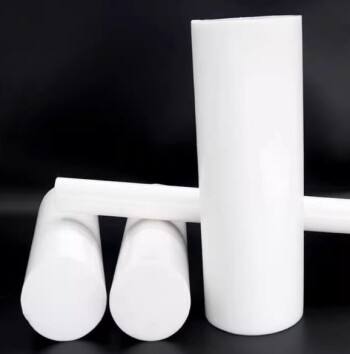
Granular resin is appropriate for compression molding blocks, billets, blanks, and other dense shapes that can later be machined.
How the Resin Forms Map to Laboratory Products
Granular Resin for Thick-Walled Equipment
Granular PTFE is the principal choice for robust, thick-walled laboratory components. Compression molding creates dense blanks that can be machined into beakers, reaction vessels, fluid fittings, valve bodies, and custom apparatus.
This route is especially important for microwave digestion vessels, where wall thickness, dimensional precision, and chemical resistance are central requirements.
Granular Resin for CNC-Machined Shapes
Manufacturers can CNC-machine suspension-derived stock shapes into complex laboratory parts. This supports low-volume, custom, or tightly toleranced products that would be impractical to form directly.
The resin's granular structure and molding behavior make it suitable for producing the solid stock needed for high-precision machining.
Fine Powder for Flexible and Thin-Walled Products
Fine-powder PTFE is suited to paste extrusion and related processes. These methods can produce flexible tubing, thin liners, films, and other products with relatively low wall thickness.
The resulting products serve fluid-transfer and protective-barrier applications, where conformability and low-friction surfaces may be more important than the rigidity of a molded vessel.
Liquid Dispersion for Coatings and Film Casting
Liquid dispersions are useful when PTFE must be applied to a surface rather than formed into a self-supporting bulk component.
They can support thin coatings on laboratory equipment and film-casting processes, providing chemical resistance without adding the thickness of a machined or compression-molded part.
Understanding the Trade-offs
Dispersion Resins Require More Processing Aids
Dispersion polymerization generally depends on higher surfactant concentrations to stabilize the fine particles. The resin must then be converted into a coating formulation, concentrated dispersion, or coagulated powder.
For high-purity laboratory applications, manufacturers must control residual processing aids and demonstrate that the finished product meets applicable purity and leachables requirements.
Suspension Resin Is Less Suited to Thin Coatings
Granular PTFE is excellent for compression molding and machining, but it is not the natural choice for making uniform liquid coatings or very thin films.
Attempting to use a granular resin for those applications can require additional conversion steps and may not provide the required film quality or processing behavior.
Fine Powder and Granular Resin Need Different Processing
Fine powder is generally associated with paste extrusion and thin product forms. Granular resin is associated with compression molding and subsequent machining.
These routes are not interchangeable. Selecting the wrong resin morphology can lead to poor consolidation, dimensional instability, unsuitable surface quality, or an inefficient manufacturing process.
Surfactant History Requires Careful Specification
Some historical dispersion processes used fluorinated surfactants such as APFO or PFOA salts. Current material selection should consider the manufacturer's process controls, regulatory compliance, and documentation regarding residual surfactants and other potential leachables.
This is particularly important for trace analysis, pharmaceutical, and other applications where contamination from the laboratory component could affect results.
Making the Right Choice for Your Goal
The intended laboratory product should determine the polymerization route and resin form selected.
- If your primary focus is thick-walled vessels or precision-machined components: Choose suspension-polymerized granular PTFE that can be compression-molded into dense stock and CNC-machined into the required geometry.
- If your primary focus is thin coatings or film casting: Choose dispersion-polymerized PTFE supplied as an aqueous dispersion or a coating-grade resin.
- If your primary focus is flexible tubing, thin liners, or membranes: Choose dispersion-derived fine powder designed for paste extrusion and thin-wall processing.
- If your primary focus is high-purity trace analysis equipment: Specify documented controls for surfactants, processing aids, and extractable or leachable contaminants in addition to selecting the correct resin form.
The correct polymerization method is the one whose particle morphology matches the finished laboratory product's required processing route, thickness, flexibility, and purity.
Summary Table:
| Polymerization Method | Surfactant Level | Agitation | Resulting Resin Form | Typical Lab Products |
|---|---|---|---|---|
| Dispersion | High | Mild | Aqueous dispersion & fine powder | Coatings, films, thin-walled tubing, membranes |
| Suspension | Low/None | Vigorous | Granular resin | Thick-walled vessels, machined parts, microwave digestion vessels |
Need PTFE labware tailored to your application? Whether you require dispersion-based coatings or suspension-molded precision components, KINTEK offers a full range of high-performance PTFE and PFA products, backed by custom CNC machining. Contact us today to discuss your needs and get a quote! [#ContactForm]
Related Products
- Custom PTFE Filtration System Acid Resistant High Purity Semiconductor Grade Chemical Processing Filter
- PTFE Corrosion Resistant Filter with PFA Valve Connections and Integrated Sieve Plate
- High Temperature Chemical Resistant 50ml PTFE Syringe Customized Teflon Injector with Threaded Seal for Trace Analysis
- Custom PTFE Teflon Balls for Advanced Industrial Applications
- Custom PTFE Insulating Gaskets and Corrosion Resistant Fluoropolymer Seals for Industrial Electrical Applications
People Also Ask
- What makes PTFE filtration systems advantageous for industrial and scientific use? Unmatched Chemical & Thermal Stability
- What steps are involved in selecting the proper PTFE filter? A 4-Step Guide to Optimal Filtration
- What sizes and pore options are available for PTFE filters? Choose the Right Filter for Your Application
- What temperature resistance do PTFE filters offer? Unmatched Thermal Stability from -200°C to +260°C
- How does the hydrophobicity of PTFE filters benefit their use? Ensure Uninterrupted Gas Flow and Solvent Filtration