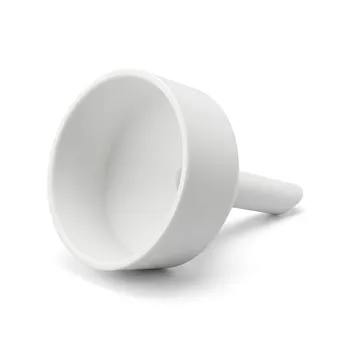
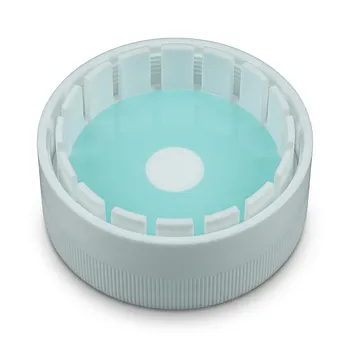
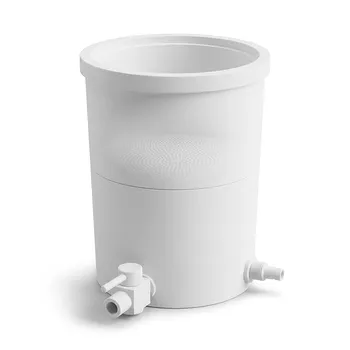
The fundamental benefit of PTFE's hydrophobicity is its ability to prevent water and ambient moisture from blocking the filter's pores. This ensures consistent, reliable performance in applications involving gases, air, aggressive solvents, and acids, where a water-saturated (or "wet-out") filter would fail.
The core value of a PTFE filter's water-repelling nature is not simply an abstract property; it is the key to its reliability. This hydrophobicity guarantees that air and specific liquids can pass through freely, even in high-humidity environments that would render other filters useless.
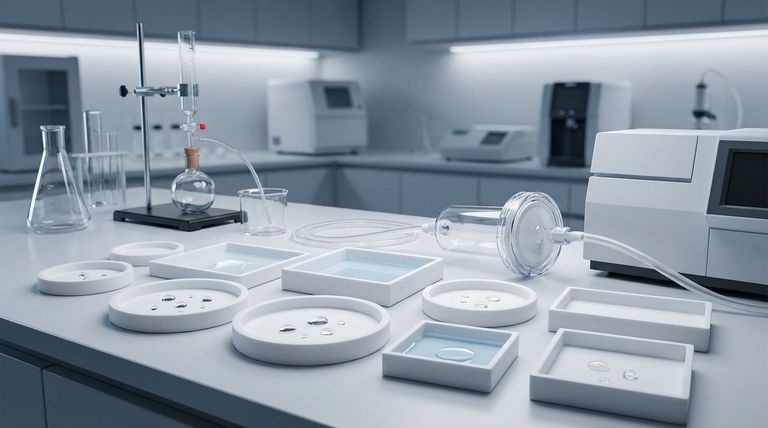
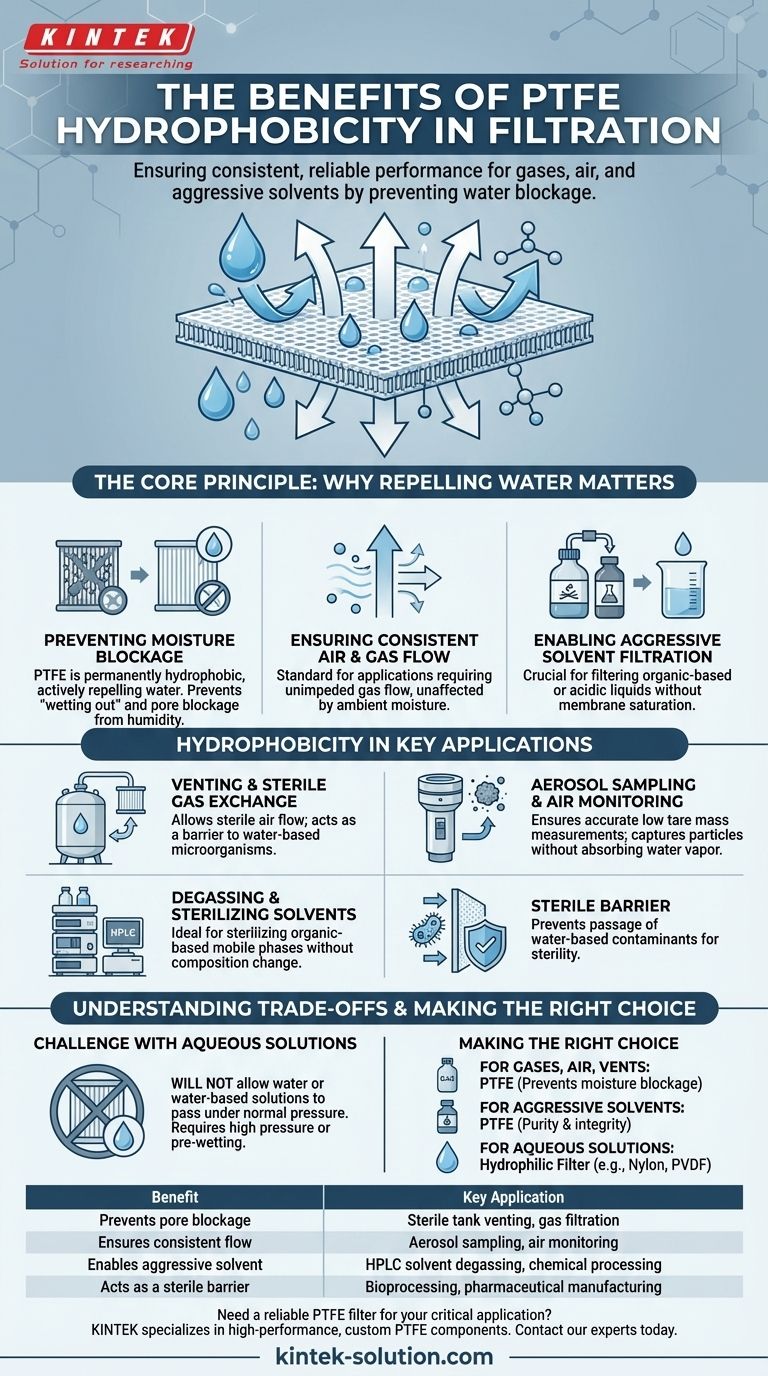
The Core Principle: Why Repelling Water Matters
A filter's job is to allow certain substances to pass through while blocking others. When a filter membrane becomes saturated with a liquid it wasn't designed for, its performance is compromised.
Preventing Moisture Blockage
Unlike hydrophilic filters that readily absorb water, PTFE membranes are permanently hydrophobic. They actively repel water molecules.
This means they will not become clogged by humidity in the air or by trace amounts of water in a sample. This phenomenon, known as "wetting out," can completely block airflow in a hydrophilic filter.
Ensuring Consistent Air and Gas Flow
Because PTFE filters do not get wet from ambient moisture, they are the standard for applications that demand unimpeded gas flow.
This makes them exceptionally reliable for sterile venting, sampling airborne particles, and filtering high-purity gases without pressure fluctuations or blockages.
Enabling Aggressive Solvent Filtration
While PTFE's renowned chemical inertness is critical for filtering aggressive solvents, its hydrophobicity is equally important.
It ensures that organic-based or highly acidic liquids can be filtered without the membrane becoming saturated by any residual aqueous content, preserving the purity of the filtrate.
Hydrophobicity in Key Applications
The theoretical benefit of repelling water translates directly into superior performance in several critical industrial and laboratory settings.
Venting and Sterile Gas Exchange
PTFE filters are essential for applications like protecting the contents of a fermentation tank or sterile container.
They allow sterile air to move in and out to equalize pressure while their hydrophobic surface prevents water-based microorganisms and contaminants from entering, effectively acting as a sterile barrier.
Aerosol Sampling and Air Monitoring
When measuring airborne particulates for environmental or occupational safety, accuracy is paramount.
PTFE filters capture solid particles without absorbing water vapor from the air. This stability ensures the filter's weight remains constant (low tare mass), leading to precise and interference-free measurements.
Degassing and Sterilizing Solvents
In analytical chemistry, such as HPLC, it is crucial to use pure, degassed solvents.
PTFE membrane filters are ideal for this task. They can sterilize organic-based mobile phases without altering their composition, as the filter will not absorb or react with the solvent.
Understanding the Trade-offs
No material is perfect for every task. The very property that makes PTFE filters so effective in some areas becomes a limitation in others.
The Challenge with Aqueous Solutions
The primary trade-off of hydrophobicity is that PTFE filters will not allow water or water-based solutions to pass through under normal pressure.
This makes them unsuitable for filtering standard aqueous samples. Forcing an aqueous solution through requires very high pressure or pre-wetting the membrane with an alcohol, which adds complexity to the process.
Not a Universal Solution
PTFE is the right tool for a specific set of jobs. For filtering aqueous solutions, a hydrophilic filter (such as nylon, PVDF, or PES) is the correct choice.
Understanding this distinction is the most important factor in selecting the right filter membrane for your application.
Making the Right Choice for Your Goal
Your application's needs will determine whether PTFE's hydrophobicity is an asset or a liability.
- If your primary focus is filtering gases, air, or vents: PTFE is the ideal choice because its hydrophobicity prevents moisture from blocking the filter pores.
- If your primary focus is filtering aggressive organic solvents or strong acids: PTFE's combined hydrophobicity and chemical inertness ensure sample purity and filter integrity.
- If your primary focus is filtering water-based (aqueous) solutions: You must choose a hydrophilic filter, as a standard PTFE membrane will actively resist the flow of water.
By understanding its inherent water-repelling nature, you can leverage PTFE's reliability for the most demanding technical applications.
Summary Table:
| Benefit | Key Application |
|---|---|
| Prevents pore blockage from moisture | Sterile tank venting, gas filtration |
| Ensures consistent gas/air flow | Aerosol sampling, air monitoring |
| Enables aggressive solvent filtration | HPLC solvent degassing, chemical processing |
| Acts as a sterile barrier | Bioprocessing, pharmaceutical manufacturing |
Need a reliable PTFE filter for your critical application?
KINTEK specializes in manufacturing high-performance, custom PTFE components, including filters, seals, and labware. Our precision production ensures your equipment performs reliably with gases, aggressive solvents, and in high-humidity environments.
Contact our experts today to discuss your specific requirements for the semiconductor, medical, laboratory, or industrial sectors. We provide custom fabrication from prototypes to high-volume orders.
Visual Guide
Related Products
- Custom PTFE Vacuum Filter with Integrated Sieve Plate and Corrosion Resistant Particle Free Design for High Purity Water Quality Analysis
- Custom PTFE Filtration System Acid Resistant High Purity Semiconductor Grade Chemical Processing Filter
- Custom PTFE Water Quality Filter 202mm Diameter 142mm Membrane Corrosion Resistant Holder
- High Purity PTFE Filter with PFA Valve Connections and Integrated Sieve Plate for Corrosive Fluid Processing
- PTFE Corrosion Resistant Filter with PFA Valve Connections and Integrated Sieve Plate
People Also Ask
- What temperature resistance do PTFE filters offer? Unmatched Thermal Stability from -200°C to +260°C
- What steps are involved in selecting the proper PTFE filter? A 4-Step Guide to Optimal Filtration
- What sizes and pore options are available for PTFE filters? Choose the Right Filter for Your Application
- Which chemicals are fully compatible with PTFE filters? Discover Unmatched Chemical Resistance
- Why are Polytetrafluoroethylene (PTFE) filters preferred for pharmaceutical and laboratory bioprocessing applications?