KINTEK PTFE (Teflon) labware supports laboratories and process teams that handle corrosive chemicals, high-purity samples, and sensitive substrates. The category includes evaporating dishes, trays, reaction flasks, sampling spoons and scoops, stirring components, storage barrels, tanks, separatory-funnel racks, cleaning racks, and wafer carriers. Built for reliable use in chemical research, trace analysis, semiconductor wet processing, pharmaceutical handling, and industrial cleaning, these fluoropolymer products help protect samples, equipment, and process consistency.
Toggle Categories
Get Instant Support
Choose your preferred way to connect with our team
Response Time
Within 8 hours on working days, 24 hours on holidays
PTFE(Teflon) Labware
High-Purity PTFE Labware for Corrosive, Clean, and Custom Laboratory Processes
PTFE labware, often referred to as Teflon labware, is selected when ordinary glass, metal, and standard plastics are not compatible with the chemistry, cleanliness requirement, temperature, or handling conditions of a process. KINTEK designs and manufactures PTFE laboratory supplies for users who need stable, low-contamination contact surfaces in demanding environments, from analytical laboratories and chemical R&D departments to semiconductor wet benches and industrial production lines.
The range brings together practical daily-use tools and specialized process equipment. It includes PTFE evaporating dishes for concentrating or handling aggressive samples; square, round, and deep trays for transfer, staging, rinsing, and containment; single-neck and multi-neck reaction flasks for chemical synthesis and process development; sampling spoons, scoops, scrapers, and shovels for powders, solids, and chemical materials; and stirring discs, dispersing plates, propellers, and paddles for mixing systems. For larger-volume operations, KINTEK also provides PTFE storage barrels, reaction vessels, rectangular tanks, overflow tanks, acid-pickling baths, and other containment solutions.
For semiconductor, conductive-glass, and precision-substrate workflows, our PTFE wafer carriers, flower baskets, cleaning racks, cassettes, and holders are designed to support controlled cleaning, etching, soaking, rinsing, and transport. Configurations can be developed for 2-, 4-, 6-, and 8-inch wafers and for application-specific substrates. Precision-machined slots, support points, drainage patterns, handles, and spacing help hold parts securely while allowing process liquids to circulate effectively. This is particularly important where uniform wet exposure, safe handling, and reduced particle or material-transfer risk directly affect process repeatability.
Why PTFE Is Widely Used in Laboratory and Process Equipment
PTFE is a high-performance fluoropolymer valued for its exceptionally broad chemical resistance. It is generally inert to many acids, alkalis, solvents, and other reactive reagents encountered in laboratory and industrial processing. This property makes PTFE a practical material choice for vessels, tools, racks, and tanks exposed to corrosive liquids that can attack metals, stain glass, embrittle common plastics, or introduce unwanted contamination.
In operation, the material creates a stable barrier between the process medium and the equipment body. Rather than relying on a coating over a dissimilar base material, solid PTFE components place the fluoropolymer directly at the wetted surface. This can simplify material compatibility decisions for high-purity process equipment and helps users avoid concerns associated with damaged or worn protective linings. Material suitability must still be evaluated against the exact chemicals, concentrations, temperatures, pressures, exposure durations, and process controls used in each application, but PTFE provides a strong starting point for challenging chemical service.
PTFE also offers high thermal stability, with many applications operating at temperatures up to approximately 260 degrees C under appropriate conditions. Its low-temperature toughness can be valuable for operations that involve chilled reagents or variable processing conditions. Actual working limits depend on part geometry, mechanical loading, sealing design, heating method, and process media, so critical applications should be reviewed with the equipment supplier before implementation.
Another defining benefit is PTFE's very low coefficient of friction. Its naturally smooth, non-stick surface helps reduce material adhesion and simplifies cleanup after handling many liquids, powders, viscous mixtures, and residues. In laboratory practice, easier release and cleaning can reduce turnaround time between batches and help lower the chance that residual material affects the next sample or process step. For sampling and transfer tools, this property is especially valuable where operators need to retrieve, dispense, or move small quantities with minimal retained material.
Low moisture absorption supports use in wet environments and helps PTFE maintain its characteristics during repeated contact with aqueous solutions. The material also has strong dielectric properties, making it useful around electrically sensitive laboratory systems where nonconductive supports, surfaces, or handling components are needed. Its non-flammability, weathering resistance, durability, and lightweight nature further extend its usefulness in both enclosed laboratory settings and industrial work areas.
Product Options for Everyday Lab Handling and Advanced Process Work
KINTEK PTFE labware is not limited to generic containers. The category covers a broad set of functional forms so users can specify equipment around the actual workflow.
Evaporating dishes and laboratory trays provide chemically resistant surfaces for sample preparation, evaporation-related tasks, reagent staging, rinsing, temporary containment, and clean transfer. Deep evaporating dishes can support workflows requiring added liquid capacity, while flat, round, or square PTFE trays can be optimized for bench space, sample format, drainage needs, and handling convenience. High-purity tray solutions are useful in analytical, pharmaceutical, semiconductor, and chemical settings where exposed surfaces need to be easy to clean and compatible with aggressive media.
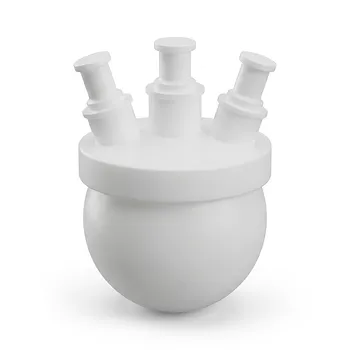
Reaction flasks and fluoropolymer vessels support chemical reactions, synthesis, digestion-related workflows, controlled mixing, and storage of reactive process media. Single-neck PTFE flasks are suited to simpler vessel configurations, while three-neck and multi-neck designs enable more complex setups involving addition, venting, temperature monitoring, stirring, filtration connections, or other accessories. KINTEK can provide custom capacities, neck arrangements, interfaces, flange details, and support features to suit the user's process arrangement. Properly engineered sealing and connection design are central to dependable operation where chemical containment matters.
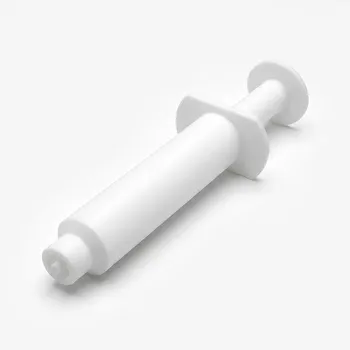
Sampling spoons, scoops, scrapers, shovels, and other handling tools are made for accurate transfer of chemicals, powders, granules, and samples. Their non-stick PTFE surfaces help with cleaning and can reduce product retention during repetitive handling. For trace-analysis, pharmaceutical, and high-purity applications, a well-matched tool material can help users control background interference and reduce contact with less compatible materials. Dimensions, bowl geometry, handle length, edge shape, and wall thickness can be tailored around the container opening, material behavior, operator reach, and intended batch quantity.
Stirring paddles, propellers, dispersing discs, and mixing accessories bring PTFE's chemical resistance into agitated reaction and blending systems. The correct impeller or disc design depends on liquid viscosity, vessel geometry, desired flow pattern, mixing speed, and the need to avoid excessive shear or splashing. PTFE components are especially valuable when a metal mixing part would be unsuitable due to corrosion, contamination, or chemical compatibility concerns. KINTEK can machine stirring elements to specified diameters, shaft connections, blade shapes, and process requirements.
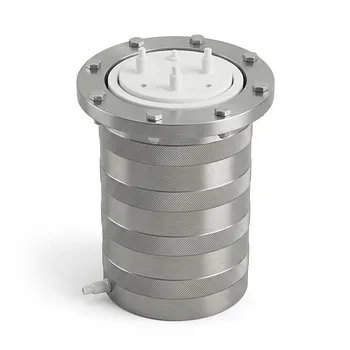
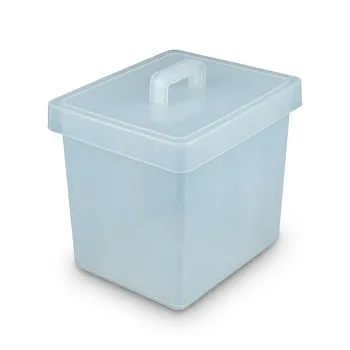
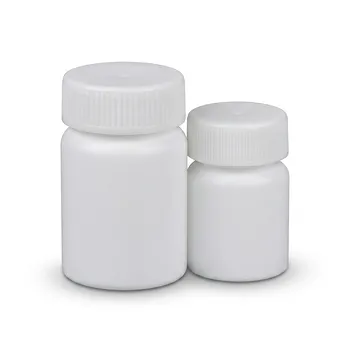
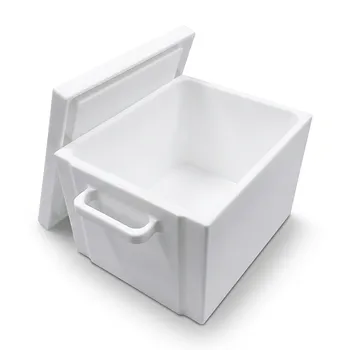
Storage tanks, barrels, rectangular vessels, and overflow baths address bulk containment and wet-process handling. PTFE tanks can be used for chemical storage, immersion cleaning, acid soaking, filtration-related workflows, reaction service, and high-purity liquid handling. Integrated overflow designs help accommodate process circulation and level management, while flange-sealed or threaded-lid designs can be considered where controlled containment is required. Rectangular tank dimensions, drain locations, cover structures, internal supports, and mounting features can be engineered to fit available equipment space and operating procedures.
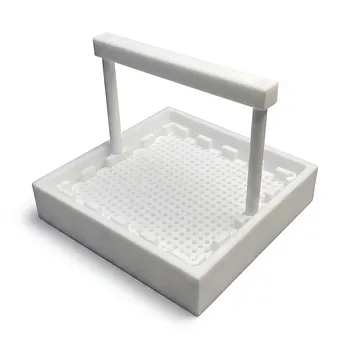
Wafer carriers, flower baskets, cleaning racks, and substrate holders support demanding semiconductor and clean-process workflows. These products can hold silicon wafers, conductive glass, glass substrates, and other delicate parts while enabling liquid access during acid cleaning, alkaline cleaning, etching, pickling, rinsing, and immersion operations. High-purity PTFE provides chemical resistance in process environments that may involve highly aggressive media, including hydrofluoric-acid-related service when the complete process design is properly evaluated. Slot geometry, contact locations, carrier orientation, spacing, and drainability must be selected carefully to balance substrate protection, solution exchange, handling ergonomics, and throughput.
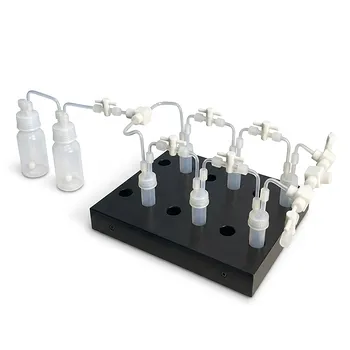
Laboratory supports and insulation boards complete the workflow by providing chemically resistant, metal-free surfaces or structures where needed. Separatory-funnel racks with custom hole counts and diameters can support orderly liquid-liquid separation work. PTFE thermal-insulation boards and stands can provide stable, corrosion-resistant platforms for ultra-clean laboratory layouts, trace-analysis workflows, and specialized assemblies. These components are often simple in appearance but critical to keeping corrosive process areas organized, safe, and free from unsuitable exposed materials.
Cleaner Handling, Better Compatibility, and More Repeatable Results
The main value of PTFE labware is not merely resistance to chemical attack. It is the ability to build a more dependable working environment around sensitive materials and aggressive chemistries. When equipment surfaces remain compatible with the process medium, users can focus on process parameters instead of frequently replacing corroded tools, removing adhered residue, or troubleshooting contamination from unsuitable contact materials.
For trace analysis and high-purity chemistry, low-background material selection is a practical consideration. PTFE is commonly used where sample integrity and low contamination are important, including acid handling, sample preparation, cleaning, and storage. Product cleanliness, manufacturing controls, cleaning procedures, and the user's own analytical method all influence final results. KINTEK can help align the product design and material approach with the intended analytical or high-purity workflow.
In semiconductor processing, equipment design influences more than chemical compatibility. A wafer carrier that is too loose can allow movement and contact damage; a carrier that is too restrictive can hinder liquid exchange and make loading difficult. Inadequate drainage can retain liquid between steps, while poorly chosen contact points may create marks or nonuniform exposure. KINTEK's custom PTFE machining capability allows users to specify the dimensions and functional details that matter in their process, including wafer size, substrate thickness, slot clearance, spacing, handle orientation, basket height, and drainage requirements.
For chemical and industrial laboratories, PTFE labware can help standardize routine handling tasks. Matching tray sizes across a work area, using dedicated scoops for designated materials, selecting flask neck arrangements that fit existing accessories, and integrating custom tanks around the process footprint can all improve day-to-day usability. Standardization also helps teams establish clearer cleaning, inspection, storage, and replacement procedures.
Custom PTFE Machining for Equipment That Fits Your Process
Off-the-shelf labware is useful for common tasks, but many high-performance applications require a component designed around a specific vessel, instrument, substrate, production line, or operating method. KINTEK is exclusively focused on high-performance fluoropolymers and supports custom PTFE and PFA solutions through end-to-end CNC machining and fabrication capabilities.
Custom manufacturing can include changes to overall dimensions, volume, wall thickness, neck size, thread profile, flange style, port position, hole pattern, slot shape, support geometry, lid configuration, drainage structure, handles, mounting points, and internal features. We can develop custom lab setups, non-standard machined parts, replacement components, and scalable production solutions for customers that need more than catalog dimensions.
This approach is useful when replacing corroded metal equipment, adapting an existing laboratory apparatus to corrosive chemicals, improving a substrate-cleaning fixture, or creating a dedicated container for a unique sample-preparation sequence. It is also valuable when multiple process needs must be combined in one assembly, such as a rectangular cleaning tank with an overflow feature, drain interface, removable carrier support, and custom cover arrangement.
A productive custom-project discussion starts with the application details: chemical media, operating temperature, pressure or vacuum conditions where relevant, capacity, process sequence, dimensional limits, required interfaces, cleaning expectations, and any drawings or reference samples. With this information, KINTEK can assess practical PTFE fabrication options and recommend a solution that prioritizes material compatibility, manufacturability, functional fit, and long-term service.
Choose PTFE Labware With Confidence
Whether you need a simple PTFE dish for everyday chemical handling, a high-purity reaction flask for aggressive synthesis, a customized wafer basket for wet processing, or a complete fluoropolymer tank system, KINTEK can help translate process requirements into usable equipment. Our product range spans standard labware, sample-handling tools, fluid-contact components, cleaning and storage equipment, and advanced custom reaction or semiconductor-processing assemblies.
For a recommendation, quotation, or custom design review, contact KINTEK through our inquiry form. Share your application, dimensions, chemical environment, target quantity, and any drawing or sample information. Our fluoropolymer specialists will work with you to develop PTFE labware that fits the required process, from one-off custom laboratory equipment to repeatable, high-volume production orders.
REQUEST A QUOTE
Our professional team will reply to you within one business day. Please feel free to contact us!
Related Articles
The Hidden Risks of Medical Fluid Transfer: Why Standard Tubing Fails and How to Solve the Purity Puzzle
Discover why standard polymers fail in medical and pharma applications and how precision PTFE tubing ensures biocompatibility, sterilization resilience, and zero contamination.
Read more
Why Flawless Displays Begin with the "Invisible" Physics of PTFE Flower Baskets
Discover why high-tech display yields often fail due to substrate contamination and how precision-engineered PTFE flower baskets solve the "ghost defect" problem.
Read more
Why Your PTFE Tubing Shouldn't Be "Melted": Understanding the Power of Paste Extrusion
Discover why PTFE requires a unique paste extrusion process rather than traditional melting, and how this impacts the quality of your laboratory fluid components.
Read more
Why Your PTFE Microfluidic Chips Leak—and the Fabrication Secrets to a Perfect Seal
Stop struggling with leaky PTFE microchannels. Learn why standard bonding fails and how precision CNC machining and thermal sealing unlock chemical-resistant microfluidics.
Read more
Why Your PTFE Liner Fails Before Its Melting Point: The Truth About Hydrothermal Temperature Limits
Discover why PTFE reactor liners fail at 220°C despite higher melting points. Learn how to choose between PTFE and PPL for safe, high-pressure synthesis.
Read more
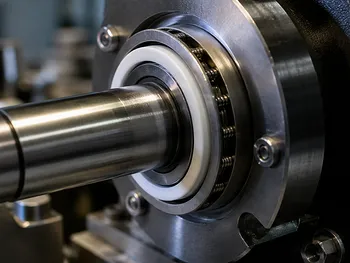
Stop Chasing Leaks: Mastering PTFE Sealing Performance Across Extreme Temperatures
Learn why PTFE seals fail at temperature extremes and how precision engineering—from spring energizers to custom CNC fabrication—ensures leak-free performance.
Read more
Why Your Hydrothermal Synthesis Produces "Dust" Instead of Crystals: Mastering the Invisible Engine
Learn how temperature gradients drive hydrothermal crystal growth and why high-precision liners are critical for achieving high-purity, uniform morphologies.
Read more
Why Your "Perfect" PTFE Seals Are Leaking Under Pressure—and How to Stop the Flow
Discover how PTFE fillers like glass, carbon, and bronze eliminate "cold flow" and increase wear resistance by 1000x for high-pressure industrial sealing.
Read more
Why the "Inner-Outer" Synergy is the Secret to Flawless Hydrothermal Synthesis
Discover why the dual-structure of hydrothermal reactors is critical for safety and purity, and how precision engineering prevents common lab failures.
Read more
Why Your High-Purity Fluid Systems Keep Failing: The Hidden Culprit in Your Connectors
Discover why standard fluid connectors fail in corrosive environments and how precision-machined PTFE components ensure leak-free, high-purity performance.
Read more
Why Your Advanced Materials Are Failing in the Lab—And How Hydrothermal Synthesis Resets the Standard
Discover why conventional synthesis fails to produce high-performance sensors and catalysts, and how KINTEK’s hydrothermal solutions provide the precision required.
Read more
Why Your Hydrothermal Synthesis Results Are Inconsistent—and How to Master the Pressure
Stop hydrothermal reactor failures. Learn why precision PTFE liners and strict thermal protocols are the keys to repeatable nanomaterial synthesis.
Read more
The Invisible Yield Killer: Why Standard Fluid Components Are Compromising Your Semiconductor Purity
Discover why microscopic contamination in fluid paths ruins semiconductor yields and how precision-engineered PTFE components provide the PPT-level purity required.
Read more
Why Your Hydrothermal Crystal Growth is Inconsistent—And How to Achieve Tailored Morphologies Every Time
Stop struggling with messy crystal results. Learn how hydrothermal reactors control morphology and why your choice of liner is the key to precision results.
Read more
Why Your "Indestructible" PTFE Liners Fail—And How to Protect Your High-Value Equipment
Stop unexpected autoclave failures and cross-contamination. Learn the science of PTFE maintenance, from the 1% mass loss rule to preventing vessel corrosion.
Read more
Why Your Hydrothermal Synthesis Results Are Inconsistent—And How the "Dual-Shell" Design Fixes It
Struggling with failed hydrothermal experiments? Learn how the interaction between PTFE liners and stainless steel shells determines your research success.
Read more
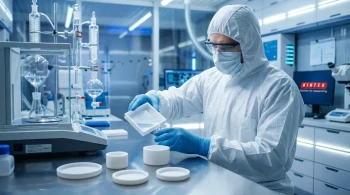
Your Recurring Nightmare: Why High-Purity Fluid Systems Fail and How to Stop It for Good
Discover the root cause of recurring pipe corrosion and contamination in critical systems. It's not wear and tear—it's a chemical war you can win.
Read more
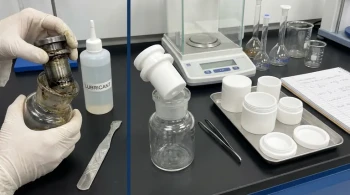
Why Your Lab Plugs Stick and Contaminate: The Hidden Science of Surface Energy
Frustrated with seized plugs and failed experiments? Learn the hidden physics of surface energy and why precision PTFE components are the definitive solution.
Read more
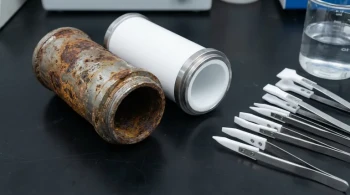
Beyond Exotic Alloys: The Real Secret to Defeating Corrosion in Your Fluid Systems
Discover why 'corrosion-resistant' valves fail and how precision-engineered PTFE liners offer a more reliable, cost-effective solution than exotic alloys.
Read more
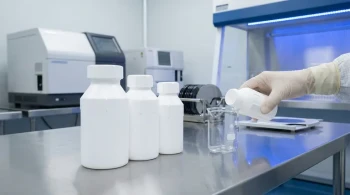
The Price of Purity: When a Simple Bottle Becomes Mission-Critical
Discover why PTFE bottles are not just containers, but precision tools that mitigate invisible risks in high-stakes chemical and sample handling.
Read more