The High Cost of a Single "Minor" Leak
Imagine this: You are running a critical trace-analysis experiment or managing a high-output semiconductor etching line. Everything is calibrated to perfection. Suddenly, the system registers a fluctuation. A microscopic leak at a joint has introduced ambient contaminants, or worse, a "corrosion-resistant" metal fitting has finally succumbed to aggressive acid vapors, leaching metal ions into your high-purity sample.
In the world of precision fluid handling, a connector is never "just a connector." It is the most vulnerable point in your entire system. When a connection fails, the consequences aren't just a wet floor; they include ruined batches, compromised research data, and expensive unplanned downtime that can cost thousands of dollars per hour.
The Cycle of "Band-Aid" Fixes
When leaks or contamination occur, many engineers and lab managers revert to familiar but flawed strategies. They might over-tighten existing metal fittings, leading to cracked tubing or stripped threads. They might switch to "high-grade" stainless steel, only to find that over time, aggressive chemicals like hydrofluoric acid or hot nitric acid still find a way to pit and corrode the surface.
Others turn to generic plastic connectors. While these are cheaper, they often suffer from poor dimensional stability. Under thermal cycling—the constant heating and cooling of a process—standard plastics expand and contract at different rates than the tubing, eventually "creeping" and breaking the seal. These are temporary fixes for a structural problem, and they leave you waiting for the next inevitable failure.
The Science of Failure: Why Standard Materials Can’t Keep Up
To understand why these solutions fail, we have to look at the chemistry of the interface. Most materials fail in high-stakes fluid handling for two reasons: chemical reactivity and surface energy.
- Chemical Vulnerability: Metals, even high-end alloys, rely on a thin oxide layer for protection. Aggressive solvents and acids strip this layer, leading to "ion leaching" where the connector itself contaminates the fluid.
- Porosity and Adhesion: Many polymers have microscopic pores that "trap" chemicals. When you switch fluids, these trapped molecules bleed back into the system (cross-contamination). Furthermore, high surface energy allows "gunk" to build up at the connection point, creating blockages or turbulence.
The solution lies in a material with an almost "miraculous" molecular structure: Polytetrafluoroethylene (PTFE). Because the carbon-fluorine bond in PTFE is one of the strongest in organic chemistry, it is virtually impenetrable. It doesn’t react, it doesn’t leach, and its incredibly low surface energy means nothing—not even the stickiest resins—will adhere to it.
The Solution: Precision-Engineered PTFE Architecture
Identifying PTFE as the right material is only half the battle. Because PTFE is a "soft" high-performance plastic, it cannot be manufactured with the same sloppy tolerances as common hardware. To solve the root cause of leaks, you need a connector that is precision-machined, not just molded.
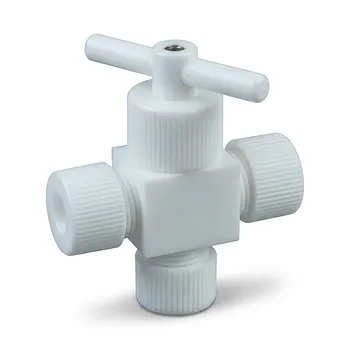
This is where KINTEK’s expertise transforms a material into a solution. We don't just provide "plastic parts"; we deliver CNC-machined PTFE and PFA connectors designed for absolute geometric integrity.
- Zero-Leach Integrity: Our high-purity PFA and PTFE labware ensures that the fluid touching the connector remains as pure as the day it was bottled.
- Thermal Resilience: Unlike molded parts that have internal stresses, our machined connectors handle thermal expansion gracefully, maintaining a leak-tight seal even in high-temperature hydrothermal synthesis or microwave digestion environments.
- Custom Geometry: Because we specialize in end-to-end CNC fabrication, we can create custom unions, NPT fittings, and bellows that accommodate the exact vibration and pressure profiles of your specific reactor or fluid line.
Beyond the Fix: What Becomes Possible?
When you stop worrying about the integrity of your connections, your focus shifts from "maintenance" to "innovation."
By implementing a truly inert, precision-machined fluid path, you unlock new capabilities. You can perform trace-metal analysis with parts-per-trillion accuracy without fear of "ghost peaks" from your fittings. You can run aggressive chemical reactions at higher pressures and temperatures, accelerating your R&D cycles. In industrial settings, you move toward a "set and forget" infrastructure where the service life of your reactors and distillation columns is measured in years, not months.
The reliability of your entire system is only as strong as its weakest link. By choosing connectors engineered for the most hostile environments, you aren't just buying hardware—you are buying the certainty that your process will remain pure, your data will stay accurate, and your operations will never be sidelined by a "minor" leak again.
Ready to eliminate the weak links in your fluid handling system? Our engineering team specializes in translating complex chemical requirements into high-precision PTFE and PFA components. Whether you need a specialized prototype for a new electrochemical cell or high-volume industrial fittings for semiconductor manufacturing, we are here to help. Contact Our Experts to discuss your project specifications today.
Related Products
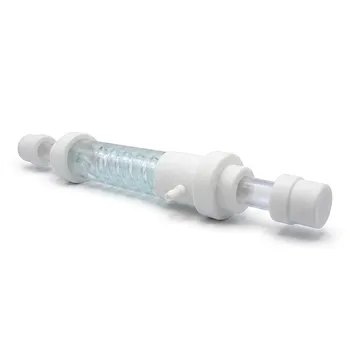
- High Purity PTFE Filter with PFA Valve Connections and Integrated Sieve Plate for Corrosive Fluid Processing
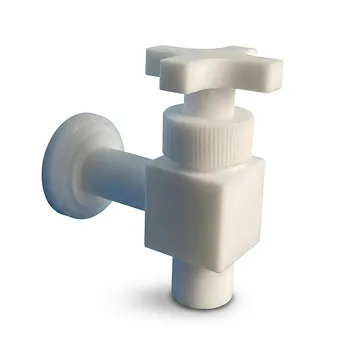
- High Corrosion Resistant PTFE Faucet Polytetrafluoroethylene Valve for Chemical Storage Drums and Fluid Transfer Systems Customizable Industrial Grade
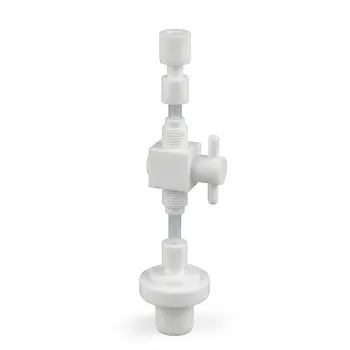
- Custom PTFE Valve 2-Way 3-Way Corrosion Resistant Low Background Virgin Fluoropolymer Industrial Fluid Control
- PTFE Corrosion Resistant Filter with PFA Valve Connections and Integrated Sieve Plate
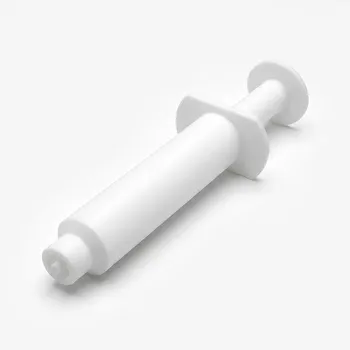
- Custom PTFE Corrosion Resistant White Syringe with Threaded Luer Connector Compatibility
Related Articles
- The Physics of Trust: Why PTFE Is the Bedrock of High-Stakes Electronics
- The PTFE Trap: Why Your Team Is Debating the Wrong Question About "Forever Chemicals"
- The PTFE Paradox: Why Using Less of This 'Miracle' Material Unlocks More Performance
- The Unseen Component: How PTFE Became the Bedrock of Medical Device Reliability
- The Unseen Guardian: How PTFE's Molecular Shield Protects Our Most Critical Systems