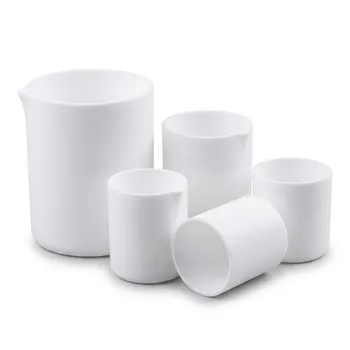
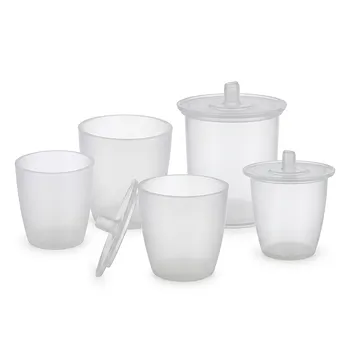
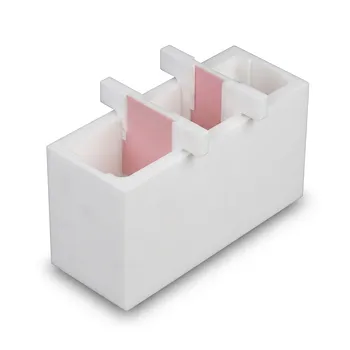
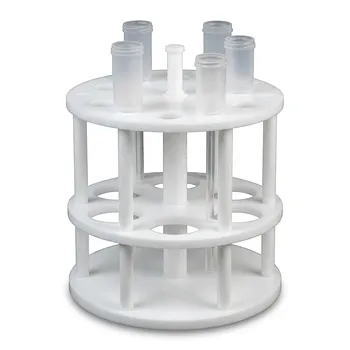
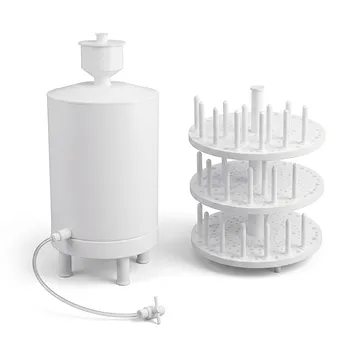
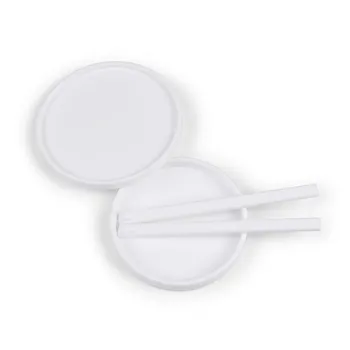
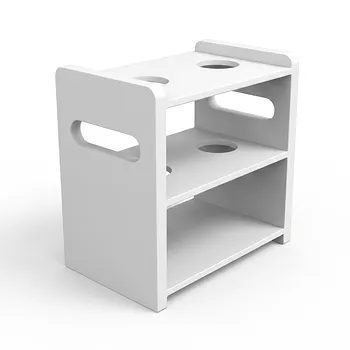
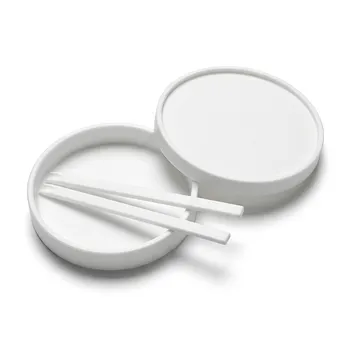
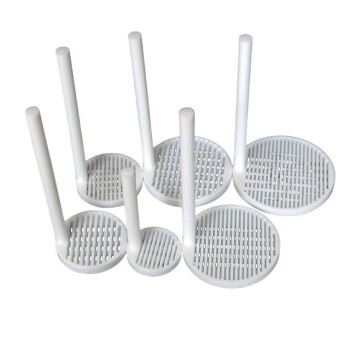
PTFE laboratory components and custom machined parts cannot normally be produced by standard melt-injection molding because high-molecular-weight PTFE does not become a freely flowing liquid when heated. Near and above its melting temperature, PTFE develops an exceptionally high melt creep viscosity of approximately 10^10 Pa·s, or 10^11 poise. It therefore cannot fill an injection mold or pass through conventional extrusion equipment like ordinary thermoplastics. Instead, PTFE resin is cold-compressed, sintered into dense stock, and then precision-machined into the required laboratory geometry.
The key issue is flow: conventional injection molding depends on a polymer becoming fluid under heat and pressure, while PTFE remains an extremely stiff, high-viscosity material. Compression molding and sintering create a solid, chemically resistant blank; CNC machining then provides the dimensional accuracy and custom geometry that laboratory components require.
Why Standard Injection Molding Fails
PTFE Does Not Form a Usable Injection Melt
Standard thermoplastics become relatively low-viscosity liquids above their processing temperatures. Injection equipment can push that liquid through a nozzle, into mold channels, and around cores or inserts.
High-molecular-weight PTFE behaves differently. It passes through a melting transition, but its molecular structure produces virtually no practical liquid flow. Heating it further does not make it suitable for conventional injection molding.
Molecular Weight Creates Extreme Melt Viscosity
PTFE used for demanding laboratory applications has an exceptionally high molecular weight, often approaching or exceeding tens of millions. Its linear molecular structure and fluorine-shielded carbon backbone strongly resist molecular movement.
This produces a melt viscosity more than a million times higher than that of many standard melt-processable plastics. Injection pressure alone cannot reliably overcome this resistance without damaging the material or the equipment.
Melting Temperature Is Not the Same as Processing Behavior
PTFE melts at approximately 327 °C, but reaching that temperature does not transform it into an injection-ready liquid. The distinction is important: melting describes a phase transition, while injection molding requires sufficient flowability.
PTFE can be sintered above its melting point to coalesce compacted particles, but that process is fundamentally different from forcing a polymer melt through a mold.
How Compression Molding and Sintering Work
Granular Resin Is Compacted Into a Preform
PTFE begins as granular or fine-powder resin produced through specialized polymerization processes. The resin is placed into a mold and compressed at room temperature into a billet, rod, tube, plate, or near-net-shape preform.
This cold-compression stage establishes the basic dimensions and consolidates the particles without requiring the polymer to flow as a conventional melt.
Sintering Fuses the Particles
The compressed preform is heated through a controlled sintering cycle. The particles coalesce into a continuous solid structure while the material retains the properties that make PTFE valuable in laboratory service.
The result is dense PTFE stock suitable for machining, rather than a molded part formed by melt flow through narrow cavities.
The Process Protects Material Performance
A properly controlled compression and sintering process supports PTFE's chemical resistance, thermal endurance, purity, and low-friction surface behavior. These properties are essential for components exposed to aggressive reagents, elevated temperatures, or demanding fluid-handling conditions.
The process also avoids relying on melt flow to reproduce fine channels, threads, sealing surfaces, or internal features.
Why Precision CNC Machining Is Required
Laboratory Components Are Often Non-Standard
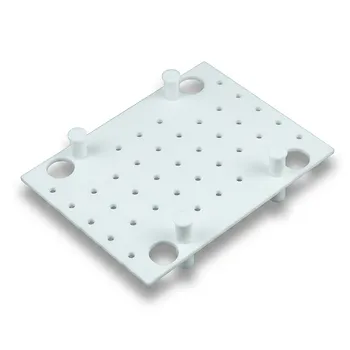
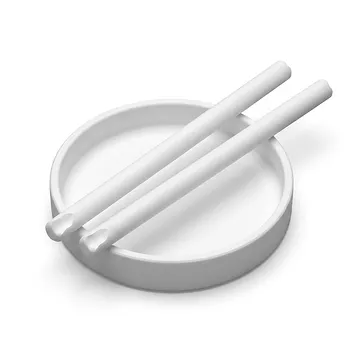
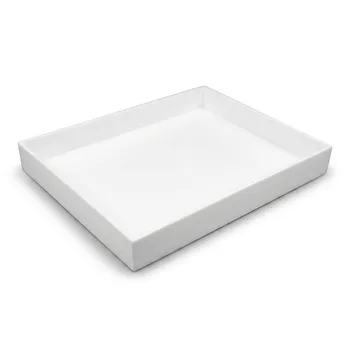
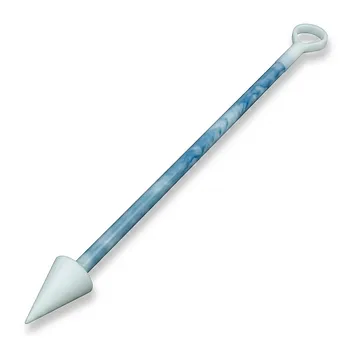
Laboratory equipment frequently includes specialized electrochemical cells, digestion vessel liners, reaction vessels, manifold blocks, filtration hardware, valves, and fluid-transfer fittings.
These parts are commonly designed for one process, instrument, or experiment. Their geometry may not justify a dedicated injection mold, and many features cannot be produced reliably through conventional mold filling.
Machining Provides Exact Geometry
CNC machining removes material from a sintered billet or other pre-formed PTFE stock to create the final part. This allows manufacturers to produce precise bores, grooves, ports, threads, sealing faces, cavities, and mating surfaces.
Machining is particularly effective when a component requires tight tolerances or a geometry that differs from standard catalog shapes.
Solid Stock Supports Consistent Features
Because the part is cut from a dense, continuous preform, its geometry is defined by the machining program rather than by how a highly viscous polymer melt travels through a mold.
This is important for leak-free fluid paths, accurate interfaces, uniform wall sections, and custom laboratory assemblies where dimensional errors can affect experimental results.
Why This Route Suits Laboratory Applications
Chemical Resistance Remains Central
PTFE is valued because its carbon-fluorine structure provides broad resistance to acids, bases, solvents, and other aggressive chemicals. Laboratory parts must preserve that resistance across the entire fluid-contacting surface.
Compression molding, sintering, and machining provide a practical route for creating chemically resistant parts without requiring conventional melt processing.
Thermal Endurance Supports Harsh Service
Laboratory vessels, liners, and fluid-control components may experience elevated temperatures or repeated thermal cycles. Sintered PTFE stock can be fabricated into parts designed for this environment while retaining its established thermal performance.
The manufacturing route must still account for dimensional changes, thermal expansion, and the specific service conditions of the application.
Purity and Surface Quality Matter
Contamination, rough surfaces, or poorly controlled features can affect chemical handling and experimental repeatability. Precision machining allows the manufacturer to control the contact surfaces, ports, and sealing features required by the design.
The final result is a component tailored to the application rather than a generic molded shape.
Understanding the Trade-offs
Machining Can Generate More Waste
CNC machining begins with a larger billet or preform and removes material to reach the final geometry. Complex parts can therefore produce substantially more scrap than a near-net-shape process.
For low-volume, custom, or highly specialized laboratory components, the flexibility and accuracy usually outweigh this material inefficiency. High-volume designs may justify optimized preforms or specialized molding approaches.
PTFE Is Dimensionally Challenging
PTFE has relatively high thermal expansion and can deform or creep under sustained load. Machining parameters, cooling, fixturing, tolerances, and post-processing must be selected with these behaviors in mind.
A nominally precise machining program does not eliminate the need for material-specific design and inspection.
Compression Molding Has Shape Limitations
Compression molding is effective for producing billets, rods, tubes, plates, and selected preforms, but it does not provide unlimited geometric complexity. Deep cavities, intersecting passages, fine threads, and unusual interfaces may still require extensive secondary machining.
The preform and machining strategy should therefore be developed together.
Not Every Fluoropolymer Behaves Like PTFE
The limitation described here applies primarily to high-molecular-weight, unmodified PTFE. Some other fluoropolymers and specially modified grades are melt-processable and may be suitable for injection molding.
Material selection must be based on the exact resin grade and required performance, not simply on the broader label “fluoropolymer.”
Making the Right Choice for Your Goal
The appropriate manufacturing route depends on the part's material, geometry, quantity, and performance requirements.
- If your primary focus is chemical and thermal performance: Use compression-molded and sintered PTFE stock followed by controlled machining to preserve the material properties required for aggressive laboratory service.
- If your primary focus is custom geometry or tight tolerances: Specify precision CNC machining from a properly consolidated PTFE billet or preform.
- If your primary focus is high-volume production: Evaluate whether a different fluoropolymer or modified, melt-processable grade can meet the application requirements before considering injection molding.
- If your primary focus is leak-free fluid handling: Prioritize material consolidation, machining accuracy, surface finish, and inspection of ports and sealing interfaces.
For PTFE laboratory components, the manufacturing method must follow the polymer's behavior: compress and sinter the resin into a stable solid, then machine that stock into the exact part the application requires.
Summary Table:
| Aspect | Compression Molding + CNC Machining | Standard Melt-Injection Molding |
|---|---|---|
| PTFE Flow | No melt flow; cold-compressed then sintered | Requires low-viscosity melt (not possible for PTFE) |
| Viscosity | Handles ultra-high viscosity (10^10 Pa·s) | Fails due to extreme melt viscosity |
| Geometries | Custom, tight-tolerance, complex features | Limited by melt flow and mold constraints |
| Material Properties | Preserves chemical resistance, purity, thermal endurance | Cannot achieve due to processing limitations |
| Waste | Higher scrap from machining | Lower scrap but impractical |
| Best For | Custom labware, low-volume, high-performance | Not suitable for PTFE |
Need custom PTFE lab components? At KINTEK, we specialize in precision CNC machining of PTFE and PFA. From standard labware to complex custom parts, we deliver the durability and precision your lab demands. Contact us today to discuss your project and get a tailored solution – contact us now.
Related Products
- Custom PTFE Parts Manufacturer for Teflon Containers and Components
- Custom PTFE Laboratory Apparatus Corrosion Resistant Low Background Reaction Cells Precision CNC Fabrication
- Custom Machined Molded PTFE Teflon Parts Manufacturer for Laboratory ITO FTO Conductive Glass Cleaning Flower Basket
- Corrosion Resistant PTFE Dispersing Disc and High Temperature Propeller Stirring Paddle for Laboratory Chemical Mixing
- Large Scale PTFE Beakers and Flasks for High Temperature Corrosion Resistant Laboratory Applications with Custom CNC Fabrication
People Also Ask
- What industries use custom PTFE parts and for what purposes? Solve Critical Challenges with High-Performance Materials
- What design considerations are important for custom PTFE parts? Design for Performance & Reliability
- What advantages do custom PTFE parts offer for industrial efficiency? Boost Uptime & Cut Costs
- What industries benefit most from custom PTFE parts? Solve Extreme Environment Challenges
- What are the key properties of Teflon (PTFE) used in custom parts? | Achieve Peak Performance