High-molecular-weight PTFE must be machined or mechanically worked because it does not become a freely flowing melt. Although PTFE softens and melts above roughly 327–340°C, its melt viscosity remains extraordinarily high, so it behaves more like a stiff gel than a liquid. Standard injection molding and melt extrusion therefore cannot force it through conventional processing equipment to form custom laboratory geometries.
PTFE is shaped as a solid rather than processed as a conventional thermoplastic melt. Powder is compacted and sintered into dense stock, after which mechanical working or CNC machining produces the required vessel, fitting, valve, liner, or fixture.
Why Standard Melt Processing Fails
High molecular weight prevents melt flow
The long, highly linear PTFE molecules produce an exceptionally high melt viscosity. Even above its melting point, the polymer has little practical flow under the pressures and temperatures used for ordinary injection molding.
This is the critical distinction between PTFE and conventional thermoplastics: reaching the melt temperature does not create a low-viscosity liquid that can rapidly fill a mold.
Melting does not produce a usable processing window
Heating PTFE above its melting point allows its crystalline regions to transition, but the material still resists flowing. Increasing temperature is not a straightforward solution because excessive heating can damage the polymer and create hazardous decomposition products.
As a result, standard injection molding and melt extrusion are unsuitable for unmodified, high-molecular-weight PTFE.
The polymer structure creates the limitation
PTFE has an exceptionally long molecular structure, high crystallinity, and a carbon-fluorine backbone shielded by fluorine atoms. These features give it outstanding chemical resistance and thermal performance, but they also restrict molecular movement during processing.
The same structure that makes PTFE valuable in demanding laboratory environments makes it fundamentally different from easily melt-processable plastics.
How Custom PTFE Components Are Made
Powder is compacted into a preform
PTFE resin is generally supplied as granular or fine powder rather than as a melt-ready pellet. The powder is cold-compressed under pressure into a preliminary shape, such as a rod, block, tube, or other billet.
This compaction step establishes the basic form and density needed for subsequent sintering.
Sintering creates dense stock
The compacted preform is heated above PTFE's melting transition so that adjacent powder particles fuse together. The material does not flow through the mold like an injection-molding resin; instead, the particles coalesce while retaining the polymer's solid-forming behavior.
After cooling, the result is a dense PTFE stock shape suitable for further fabrication.
CNC machining creates the final geometry
The sintered billet can then be turned, milled, drilled, bored, or otherwise machined. CNC equipment is particularly useful for producing exact dimensions, controlled wall thicknesses, internal channels, sealing surfaces, and complex non-standard features.
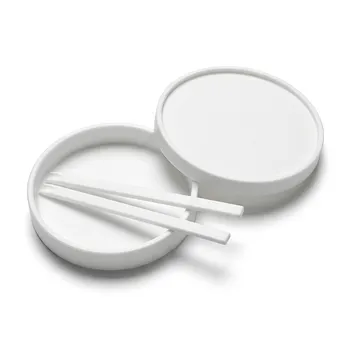
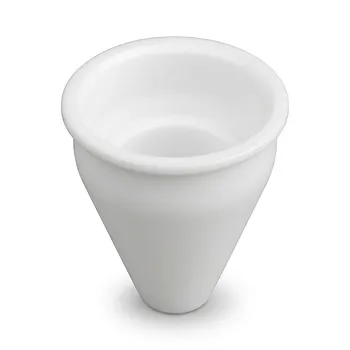
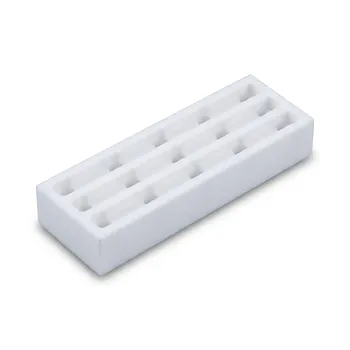
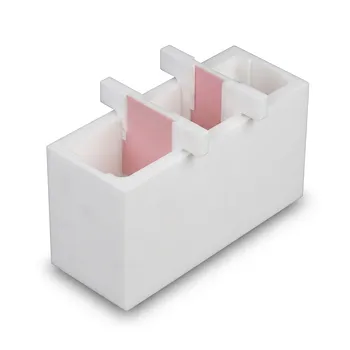
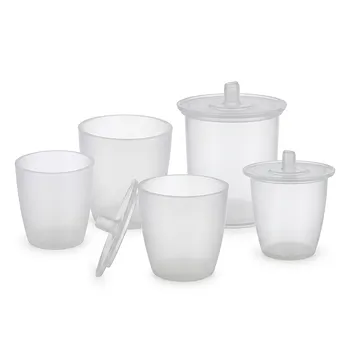
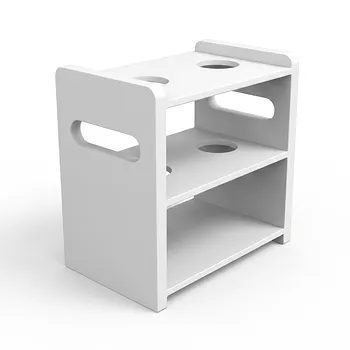
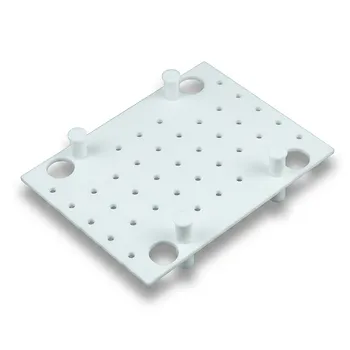
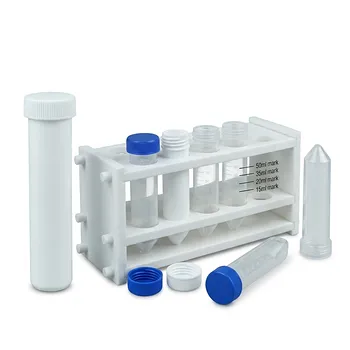
This is how manufacturers produce custom reaction vessels, electrochemical cells, digestion-vessel liners, fluid-transfer fittings, valves, and specialized laboratory fixtures.
Mechanical working supports specialized shapes
Mechanical working includes compression molding followed by sintering and, where appropriate, other specialized solid-state forming methods. Paste extrusion may also be used for certain PTFE products, particularly tubing and similar continuous profiles, but it is not conventional melt extrusion.
For one-off or highly customized laboratory components, machining from pre-formed PTFE stock is often the most direct route.
What This Fabrication Route Preserves
Chemical resistance
Machining does not require dissolving PTFE or blending it into a conventional melt system. This helps preserve the material's inherent resistance to a broad range of chemicals, which is essential for laboratory vessels, liners, and fluid-handling components.
Chemical compatibility still depends on the specific reagent, temperature, pressure, and exposure time, so "chemical resistance" should not be treated as universal immunity.
Thermal performance
The powder-compaction and sintering route allows the finished component to retain PTFE's high-temperature capability. Properly controlled processing also avoids the unnecessary thermal history associated with repeatedly forcing the polymer through a melt-processing cycle.
The operating limit remains application-specific and must account for load, pressure, thermal cycling, and the chemical environment.
Material purity
For laboratory use, contamination control can be as important as dimensional accuracy. Fabricating the component from PTFE stock avoids many additives and processing aids associated with other plastic manufacturing routes, provided that the resin, tooling, machining fluids, and cleaning process are properly controlled.
The final cleanliness level must therefore be specified and verified rather than assumed solely from the PTFE material designation.
Why CNC Machining Suits Custom Laboratory Hardware
Non-standard designs are easier to produce
Laboratory apparatus often requires a geometry that is not commercially available: an unusual port arrangement, an integrated cavity, a custom seal interface, or a vessel sized for a particular experiment.
CNC machining can produce these features directly from a billet without requiring a dedicated injection mold.
Tight interfaces require controlled tolerances
Fluid fittings, valve seats, vessel covers, and sealing surfaces must mate reliably. CNC machining provides control over critical dimensions and allows the manufacturer to adjust a design without redesigning an entire molding tool.
This is especially valuable for prototypes, low-volume production, and research equipment that may evolve during development.
Machining supports internal features
Drilled passages, counterbores, recesses, threads, and other internal details can be produced with appropriate tooling and process control. These features are often difficult or impractical to create through a conventional molding operation, especially when the part is unique.
The achievable tolerance depends on part size, wall thickness, PTFE grade, tool design, and the material's dimensional behavior.
Understanding the Trade-offs
Material waste can be significant
Machining a component from a large block or rod removes material that may not be recoverable for equivalent high-performance use. This makes the process less material-efficient than molding a near-net-shape part.
The trade-off is justified when design flexibility, purity, chemical performance, or low production volume matters more than minimizing scrap.
PTFE can deform under load
PTFE has excellent chemical resistance but relatively low stiffness compared with many engineering plastics and metals. It can exhibit creep, especially under sustained pressure, elevated temperature, or constant compressive load.
Designers must account for wall thickness, support, sealing stress, and operating temperature rather than relying on dimensional accuracy alone.
Dimensional stability requires planning
PTFE can change dimensionally with temperature and can show movement after machining because of residual stress and its relatively soft, deformable nature. Critical parts may require controlled machining conditions, stabilization, inspection, and compensation for expected behavior.
A machined dimension is therefore only one part of the performance specification.
Geometry may still have practical limits
CNC machining expands design freedom, but very thin walls, deep narrow channels, sharp internal corners, and unsupported features can be difficult to produce reliably. Tool access, chip removal, clamping, and distortion all influence the final result.
The best design is developed with the machining process and the intended service conditions considered together.
Making the Right Choice for Your Goal
The fabrication method should follow the part's geometry, quantity, and operating demands.
- If your primary focus is chemical compatibility: Specify the appropriate PTFE grade and validate it against the actual chemicals, temperatures, pressures, and exposure duration; the manufacturing route should preserve cleanliness and material integrity.
- If your primary focus is precision and custom geometry: Use CNC machining from properly compacted and sintered PTFE stock, with tolerances and inspection requirements defined for the critical interfaces.
- If your primary focus is repeated high-volume production: Evaluate whether a specialized preforming or molding process can produce a near-net shape, followed by limited machining of critical surfaces.
- If your primary focus is long-term dimensional reliability: Design for PTFE's creep, thermal expansion, and deformation rather than treating it like a rigid, dimensionally stable thermoplastic.
Understanding PTFE's lack of practical melt flow makes the manufacturing choice clear: custom high-molecular-weight PTFE laboratory components are formed as solid stock and finished mechanically to preserve the properties that make the material valuable.
Summary Table:
| Fabrication Method | Suitable for PTFE? | Key Advantages | Key Limitations |
|---|---|---|---|
| Standard Melt Processing | No | N/A | PTFE does not flow; can't fill molds |
| Compression Molding + Sintering | Yes | Forms dense stock; preserves properties | Limited to simple shapes |
| CNC Machining | Yes | Custom geometries, tight tolerances, internal features | Material waste; creep considerations |
Looking for custom PTFE lab components that demand precision and purity? At KINTEK, we specialize in CNC-machined PTFE and PFA parts, from standard labware to complex electrochemical cells. Our end-to-end machining capabilities ensure your unique designs are realized with exacting tolerances and uncompromised chemical resistance. Contact us today to discuss your project or request a quote – let's engineer your solution together. [#ContactForm]
Related Products
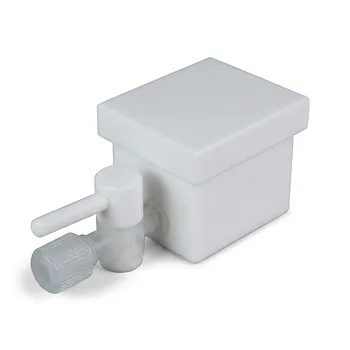
- Custom PTFE Laboratory Apparatus Corrosion Resistant Low Background Reaction Cells Precision CNC Fabrication
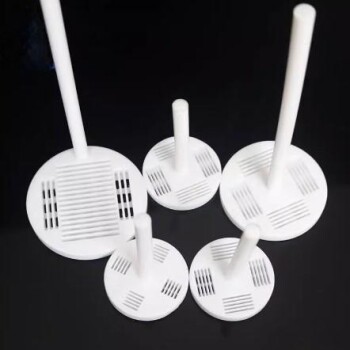
- Custom Machined Molded PTFE Teflon Parts Manufacturer for Laboratory ITO FTO Conductive Glass Cleaning Flower Basket
- Custom PTFE Parts Manufacturer for Teflon Containers and Components
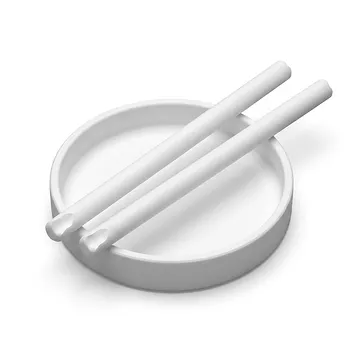
- Custom PTFE Petri Dish 80mm Diameter Corrosion Resistant Low Background High Purity Laboratory Culture Vessel
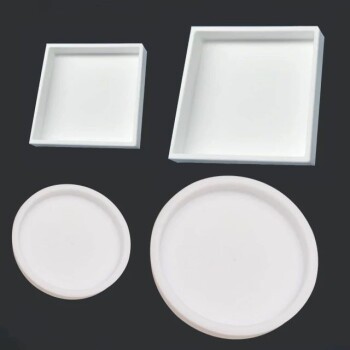
- Custom PTFE Petri Dishes Corrosion Resistant High Purity Low Background Labware
People Also Ask
- How does PTFE's melting behavior affect custom lab apparatus? Key insights for manufacturing.
- What are the primary fabrication methods for PTFE laboratory apparatus? Expert Insights into Fluoropolymer Engineering
- What does the technological maturity of PTFE mean for the quality and reliability of standard laboratory apparatus? Achieve consistent lab results with mature PTFE tech.
- What is the chemical compatibility range for PTFE laboratory apparatus? Explore Near-Universal Chemical Resistance.
- What are the primary chemical resistance properties of PTFE laboratory apparatus? Unmatched Purity and Inertness