Pure PTFE is classified as non-melt-processible because it melts without becoming a usable flowing liquid. Above its melting transition—approximately 342 °C—PTFE forms a stiff, clear gel with an extraordinarily high melt viscosity, commonly reported on the order of 10¹¹–10¹² Pa·s under high-temperature test conditions. As a result, conventional injection molding and standard melt extrusion cannot force the material through molds or dies in the way they can for PFA and other melt-processible fluoropolymers.
Core takeaway: PTFE’s extreme molecular weight and crystallinity give it exceptional chemical and thermal performance, but also prevent normal melt flow. High-performance laboratory parts are therefore made by powder compaction and sintering, followed where necessary by precision CNC machining.
Why PTFE Does Not Process Like a Typical Thermoplastic
Melting does not mean useful flow
For ordinary thermoplastics, heating above the melting point produces a sufficiently fluid melt that can fill a mold or pass through an extrusion die.
PTFE behaves differently. It undergoes a crystalline melting transition, but its melt remains so viscous that it does not flow under practical molding pressures. In processing terms, PTFE melts but is not conventionally melt-processible.
Ultra-high molecular weight limits chain movement
Standard PTFE has an exceptionally high molecular weight, commonly cited in the range of 1 × 10⁶ to 5 × 10⁶ g/mol.
These very long polymer chains become highly entangled. Even when thermal energy disrupts the crystalline structure, the chains cannot readily slide past one another, producing an exceptionally resistant melt.
High crystallinity reinforces the behavior
Virgin PTFE can have initial crystallinity above 90%, with tightly packed carbon–fluorine chains contributing to its dimensional and chemical stability.
The material’s high crystallinity, combined with its molecular weight, means that heating changes its physical state without creating the mobile, easily shaped melt required for conventional thermoplastic processing.
How Extreme Viscosity Changes Fabrication
Powder compaction replaces melt molding
PTFE resin is generally processed as a powder rather than injected as a liquid melt.
The powder is cold-compressed into a preform to remove air and create the approximate shape. This preform is then heated to a high temperature in a controlled sintering cycle, allowing the particles to fuse into a coherent solid.
Machining creates the final geometry
After sintering, PTFE is commonly supplied as blocks, rods, cylinders, tubes, or other stock shapes.
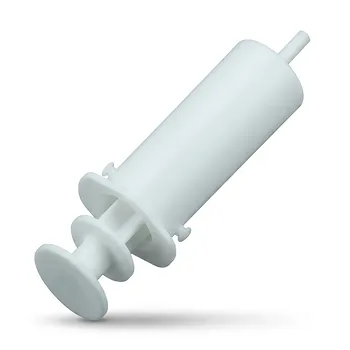
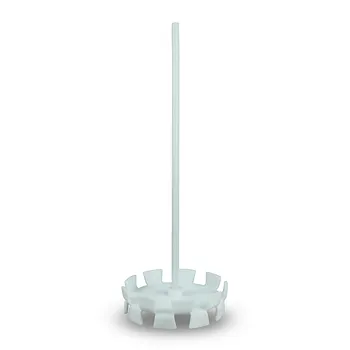
Manufacturers can then use precision CNC machining to produce custom reaction vessels, fittings, electrochemical cells, digestion vessels, and fluid-handling components. This approach is especially valuable when the design includes complex dimensions, close tolerances, or non-standard laboratory interfaces.
Processing affects equipment performance
The compaction and sintering process must be carefully controlled because it influences density, dimensional stability, permeability, crystallinity, and mechanical integrity.
For high-purity laboratory equipment, controlled fabrication also helps preserve the material’s chemical purity and avoids introducing processing residues associated with unsuitable molding methods.
Why This Matters for Laboratory Equipment
PTFE enables demanding chemical service
PTFE is selected for laboratory equipment because it combines:
- Exceptional chemical resistance
- High thermal stability
- Low friction
- Non-stick behavior
- Low surface reactivity
- Good weatherability and aging resistance
These properties make it suitable for aggressive reagents, high-purity analytical work, custom fluid paths, and reaction environments where contamination or corrosion is unacceptable.
Custom designs remain possible
Non-melt-processibility does not mean PTFE can only be made into simple shapes.
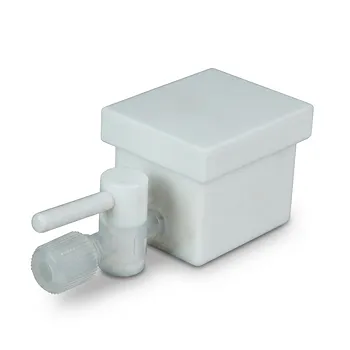
Compression-sintered stock followed by CNC machining allows manufacturers to produce bespoke vessels, covers, manifolds, valve components, tubing interfaces, and specialized laboratory apparatus that are not available as standard catalog items.
Dimensional accuracy requires process discipline
PTFE’s thermal expansion and post-processing structural changes must be considered when designing precision parts.
The manufacturer must account for sintering shrinkage, machining behavior, operating temperature, wall thickness, sealing loads, and dimensional stability. A chemically resistant material can still fail functionally if its geometry or tolerances are not properly engineered.
Choosing PTFE Versus a Melt-Processible Fluoropolymer
When PTFE is the stronger choice
Pure PTFE is often preferred when the application places the highest priority on chemical inertness, low friction, high-purity contact surfaces, and long-term resistance to aggressive chemicals.
Its fabrication route is more specialized, but it provides access to high-performance solid components for severe laboratory environments.
When PFA may be more practical
PFA is a melt-processible fluoropolymer and can be shaped using conventional molding and extrusion methods.
That makes PFA advantageous for complex fluid fittings, thin-walled parts, seamless vessels, and intricate tubing, particularly when the design would be difficult or costly to machine from sintered PTFE stock.
Understanding the Trade-offs
Fabrication is slower and more specialized
PTFE cannot normally be produced by standard injection molding or conventional melt extrusion.
Powder compaction, sintering, and machining require specialized equipment, tooling, process controls, and inspection. This generally increases manufacturing time and cost compared with melt-processible alternatives.
Complex geometries can be expensive
CNC machining is effective for custom parts, but it removes material from a solid preform and can generate substantial waste.
Very intricate geometries may therefore be more economical in PFA or another melt-processible fluoropolymer, provided that the alternative meets the required chemical, thermal, purity, and mechanical specifications.
Heat alone cannot solve the processing problem
Simply raising the temperature does not turn PTFE into a conventional injection-molding resin.
Excessive heating can compromise the material or equipment without providing the flow needed for molding. Processing must instead rely on powder-forming and sintering methods, or on specialized approaches such as paste extrusion for suitable product forms.
PTFE and PFA are not interchangeable by default
PFA’s easier processing does not automatically make it the better material.
The selection must consider reagent compatibility, maximum operating temperature, permeability, mechanical loading, surface requirements, purity, geometry, and whether the part will be machined, molded, or extruded.
How to Apply This to Your Project
The correct choice depends on whether the application prioritizes PTFE’s performance characteristics or the manufacturing flexibility of a melt-processible fluoropolymer.
- If your primary focus is maximum chemical resistance and high-purity custom labware: Specify virgin PTFE fabricated by controlled compression sintering and precision CNC machining.
- If your primary focus is complex molded geometry or seamless fluid handling: Evaluate PFA or another melt-processible fluoropolymer that can be injection molded or extruded.
- If your primary focus is dimensional accuracy: Define sintering shrinkage, machining tolerances, thermal expansion, and operating temperature requirements before finalizing the design.
- If your primary focus is cost and production volume: Compare the tooling and cycle economics of molded PFA with the specialized preform-and-machining route required for PTFE.
Understanding PTFE’s viscosity allows engineers to choose not only the right material, but also the fabrication process that preserves its performance in service.
Summary Table:
| Aspect | PTFE (Non-melt-processible) | PFA (Melt-processible) |
|---|---|---|
| Melt Flow | No flow; forms gel above 342°C | Flows like typical thermoplastic |
| Molecular Weight | Very high (1-5 million g/mol) | Lower, allowing flow |
| Processing Methods | Powder compaction & sintering, CNC machining | Injection molding, extrusion |
| Fabrication Complexity | Specialized, slower, higher cost | Conventional, faster, cost-effective |
| Applications | High-purity, chemically resistant custom parts | Complex geometries, thin walls, seamless vessels |
| Design Flexibility | Limited by machining; waste for complex shapes | High; intricate designs feasible |
Ready to optimize your lab equipment with PTFE or PFA? KINTEK offers expert guidance and custom fabrication for high-performance fluoropolymer components. Whether you need precision-machined PTFE parts or PFA molded solutions, our specialists ensure the perfect match for your application. Contact us today to discuss your requirements and benefit from our end-to-end PTFE/PFA custom CNC machining capabilities.
Related Products
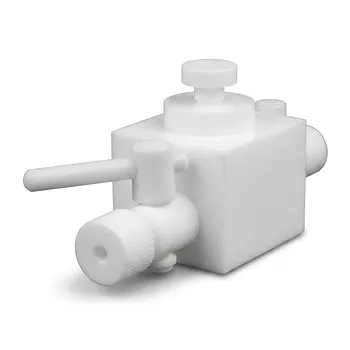
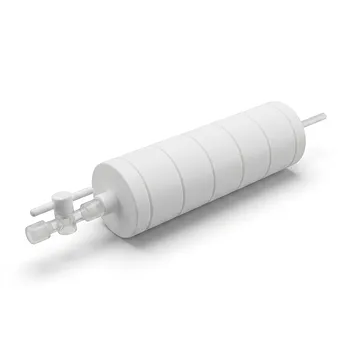
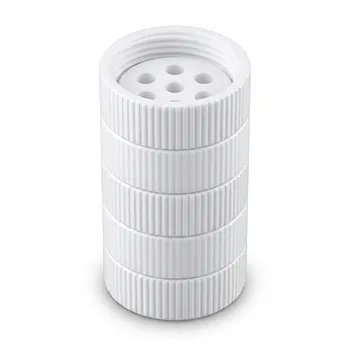
- Custom PTFE Filtration System Acid Resistant High Purity Semiconductor Grade Chemical Processing Filter
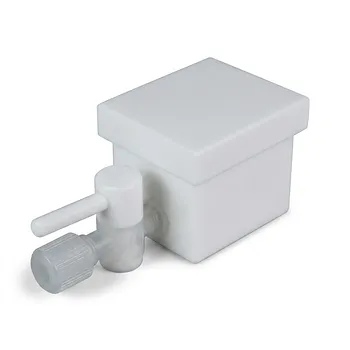
- High Corrosion Resistant PTFE Faucet Polytetrafluoroethylene Valve for Chemical Storage Drums and Fluid Transfer Systems Customizable Industrial Grade
- PTFE PFA Vacuum Filtration System Corrosion Resistant Customizable Shatterproof Laboratory Device
- PTFE Corrosion Resistant Filter with PFA Valve Connections and Integrated Sieve Plate
- High Temperature Chemical Resistant 50ml PTFE Syringe Customized Teflon Injector with Threaded Seal for Trace Analysis
People Also Ask
- What makes PTFE filtration systems advantageous for industrial and scientific use? Unmatched Chemical & Thermal Stability
- What sizes and pore options are available for PTFE filters? Choose the Right Filter for Your Application
- What steps are involved in selecting the proper PTFE filter? A 4-Step Guide to Optimal Filtration
- How does the hydrophobicity of PTFE filters benefit their use? Ensure Uninterrupted Gas Flow and Solvent Filtration
- What temperature resistance do PTFE filters offer? Unmatched Thermal Stability from -200°C to +260°C