Accurate performance metrics are the only way to prove material innovation. High-precision battery testing systems are required for $VS_2/MoS_2@S$ cathodes because they allow for the precise calculation of capacity decay rates and long-term cycle monitoring at varying rates (0.1 C to 2 C). This level of control is essential to verify if the catalyst successfully inhibits the polysulfide shuttle effect, which is the primary failure mechanism in sulfur-based batteries.
Core Takeaway: High-precision testing isolates the electrochemical behavior of the cathode from external noise and mechanical inconsistencies, ensuring that observed stability reflects the material's actual catalytic performance over thousands of cycles.
Quantifying Long-Term Stability and Polysulfide Mitigation
Measuring Incremental Capacity Decay
Evaluating $VS_2/MoS_2@S$ cathodes requires recording capacity changes over thousands of cycles to determine the exact decay rate. High-precision systems ensure that even minute losses in capacity are captured accurately, providing a clear picture of the material's longevity.
Verifying Shuttle Effect Inhibition
The primary role of the $VS_2/MoS_2$ catalyst is to inhibit the polysulfide shuttle effect. Precise data acquisition during charge-discharge cycles allows researchers to verify the catalyst's ability to facilitate polysulfide redox reactions and prevent active material loss.
Managing Variable Discharge Rates
Testing must occur at multiple rates, ranging from 0.1 C to 2 C, to assess the cathode's performance under different loads. High-sensitivity current control is necessary to maintain these constant intensities without fluctuations that could skew the results.
Eliminating Physical and Mechanical Variables
Maintaining Uniform Contact Pressure
Standardized coin cell components, such as cases, springs, and spacers, provide the mechanical support needed for stable physical contact. Consistent pressure between the cathode, electrolyte, and separator is vital to ensure that the data reflects material properties rather than assembly errors.
Minimizing Ohmic Polarization
Stable physical contact pressure reduces ohmic polarization, which can otherwise distort electrochemical signals. High-precision fixtures ensure that the collected voltage curves and capacitance retention data are a result of the material’s activity, not high contact resistance.
Resistance to Corrosive Environments
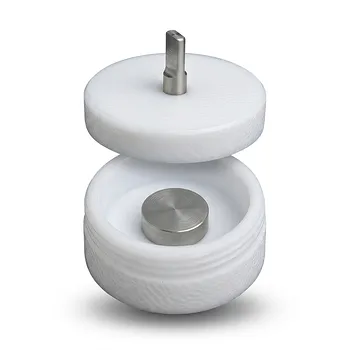
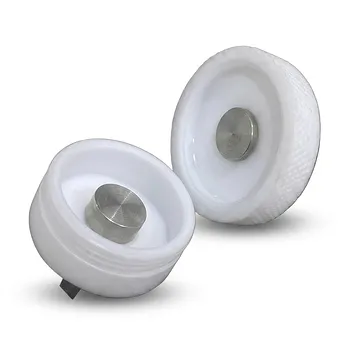
Specialized fixtures are often made from engineering materials like PTFE for superior chemical resistance. These materials withstand corrosive electrolytes and severe electrochemical potential fluctuations, maintaining the integrity of the testing environment over 3000+ cycles.
Understanding the Trade-offs and Pitfalls
The Risk of Assembly Inconsistency
Without high-precision fixtures, minor variations in how a coin cell is assembled can lead to inconsistent data. If mechanical pressure is not uniform, the resulting voltage drops and thermal effects can be mistaken for poor material performance.
Signal Interference and Noise
Low-quality testing systems may fail to isolate interference signals, leading to "noisy" data that obscures the actual electrochemical behavior of the $VS_2/MoS_2@S$ cathode. This makes it impossible to accurately calculate the high percentages of capacitance retention required for modern standards.
Overlooking Long-Term Degradation
Systems lacking high sensitivity may fail to catch early-stage degradation markers. This is particularly dangerous when testing for durability over thousands of cycles, as small errors in the beginning of the test compound over time, leading to inaccurate life-cycle projections.
How to Apply This to Your Research
To ensure your evaluation of $VS_2/MoS_2@S$ cathodes is both accurate and reproducible, consider your specific testing objectives:
- If your primary focus is material durability: Prioritize a system capable of maintaining high-sensitivity current control over 3000+ cycles to accurately track capacitance retention.
- If your primary focus is catalytic efficiency: Use specialized fixtures with PTFE insulation to minimize signal noise and ensure the data reflects the inhibition of the polysulfide shuttle effect.
- If your primary focus is rate performance: Select equipment that offers precise control at various C-rates (0.1 C to 2 C) to capture clear capacity decay data under different load conditions.
- If your primary focus is data repeatability: Invest in standardized coin cell components and high-precision fixtures to ensure uniform mechanical pressure across all test samples.
By utilizing high-precision systems, you ensure that your findings are a true reflection of the material's electrochemical potential rather than a result of testing environment inconsistencies.
Summary Table:
| Key Metric | Impact on $VS_2/MoS_2@S$ Cathodes | High-Precision System Benefit |
|---|---|---|
| Capacity Decay | Determines material longevity over 3000+ cycles | Detects minute losses for exact decay calculation |
| Shuttle Effect | Primary failure mechanism in sulfur batteries | Verifies catalytic inhibition of polysulfides |
| Rate Performance | Assesses stability under loads (0.1C to 2C) | Maintains constant current without fluctuations |
| Mechanical Contact | Prevents ohmic polarization and signal noise | Provides uniform pressure via specialized fixtures |
Elevate Your Battery Research with KINTEK Precision Fluoropolymer Solutions
At KINTEK, we understand that evaluating cutting-edge materials like $VS_2/MoS_2@S$ cathodes requires more than just standard tools—it demands uncompromising accuracy and chemical resistance. Our comprehensive range of laboratory supplies is designed to eliminate external variables and isolate your material's true catalytic performance.
From everyday high-purity PFA labware (beakers, bottles, digestion tubes) and fluid transfer components to advanced battery testing fixtures and electrochemical cells, KINTEK manufactures virtually every fluoropolymer supply imaginable. Backed by end-to-end custom CNC fabrication, we deliver everything from complex non-standard machined parts to high-volume orders, ensuring your setup withstands corrosive electrolytes over thousands of cycles.
Ready to achieve superior data repeatability and long-term stability? Contact KINTEK Today for Your Bespoke Laboratory Setup
References
- Thilini Boteju, Venkataraman Thangadurai. Synergistic Effect of VS<sub><b>2</b></sub>/MoS<sub><b>2</b></sub> as an Electrocatalyst for Accelerating Polysulfide Conversion in Lithium–Sulfur Batteries. DOI: 10.1021/acsami.5c12948
This article is also based on technical information from Kintek Knowledge Base .
Related Products
- Acid Resistant PTFE Button Cell Battery Test Fixture Customizable Machining High Purity Electrochemical Testing Clamp
- Corrosion Resistant PTFE Coin Cell Battery Testing Clamps and Acid Proof Custom Fluoropolymer Battery Fixtures
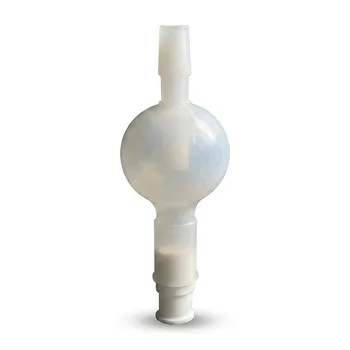
- High Purity PFA Chromatography Column with Collection Bottle Corrosion Resistant Fluoropolymer Filtration System for Trace Analysis
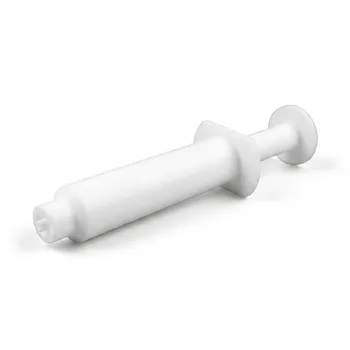
- High Purity 25ml PTFE Syringe for Trace Analysis and Automated Syringe Pump Systems
- High Purity PFA Nitrogen Purge System Corrosion Resistant 4 and 6 Position Evaporation Setup Customizable Laboratory Trace Analysis Equipment
People Also Ask
- How does the chemical inertness of PTFE benefit laboratory-scale battery testing? Ensure high-purity research results.
- In what ways do PTFE battery testing fixtures enhance laboratory throughput and reliability? Maximize Research Efficiency
- In what industrial manufacturing contexts are PTFE battery clamps or fixtures utilized? Optimize Battery Production.
- What is the thermal operating range for PTFE battery clamps in electrochemical research? Stability from -200°C to +260°C
- What are the primary functions and material compositions of PTFE battery clamps? Ensure Precision & Chemical Resistance