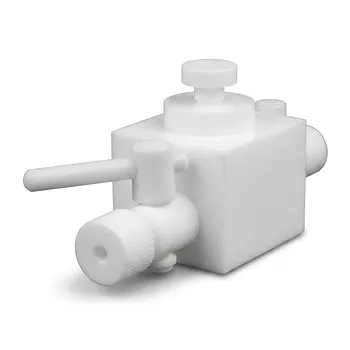
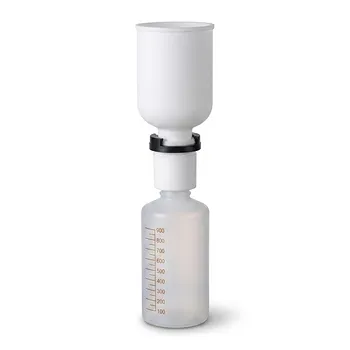
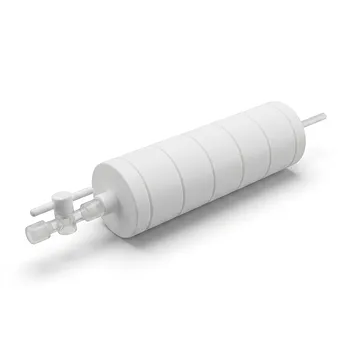
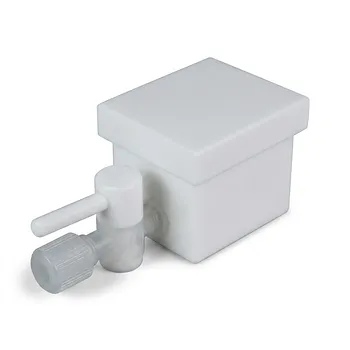
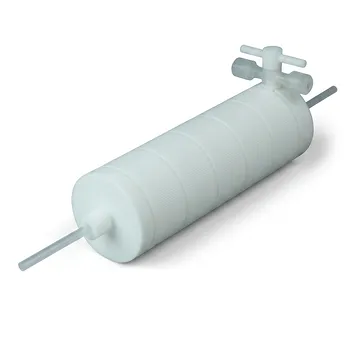
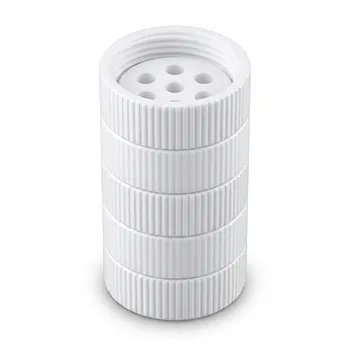
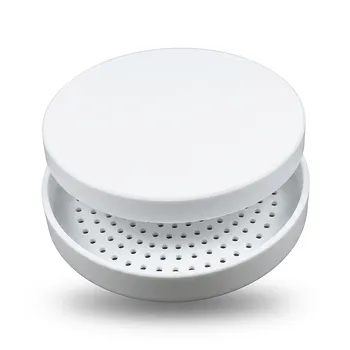
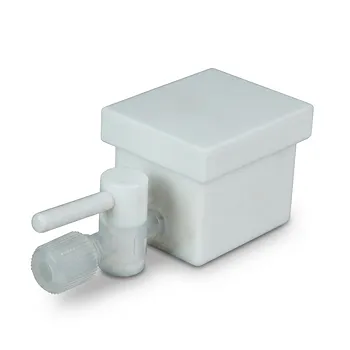
PTFE is chemically inert and thermally stable because its carbon backbone is protected by an exceptionally strong, tightly packed fluorine sheath. The strong carbon–fluorine bonds make the polymer difficult for acids, bases, solvents, and oxidizing agents to attack, while the fully fluorinated structure remains stable across a broad temperature range. This combination makes PTFE particularly valuable for digestion vessels, trace-analysis containers, tubing, valves, and other components where contamination and material degradation are unacceptable.
PTFE’s performance comes from two linked features: strong C–F bonds resist chemical reaction, and a dense fluorine-rich surface shields the carbon chain from external attack. Its high melting point and resistance to oxidation further support reliable operation in demanding laboratory and fluid-handling environments.
How PTFE’s Molecular Structure Creates Chemical Inertness
The carbon backbone is protected by fluorine
PTFE is a linear polymer built from a carbon backbone with fluorine atoms attached to essentially every available bonding site. These fluorine atoms form a continuous, electron-rich sheath around the carbon chain.
This sheath provides both electronic protection and physical shielding. Chemical species have limited access to the carbon backbone, and the highly stable carbon–fluorine bonds are difficult to break under ordinary laboratory conditions.
Carbon–fluorine bonds resist chemical attack
Fluorine’s high electronegativity produces a very strong, stable bond with carbon. Breaking or rearranging these bonds generally requires more severe conditions than those encountered in routine chemical processing.
As a result, PTFE resists reaction with many aggressive acids, bases, organic solvents, and oxidizing chemicals. It is also insoluble in common solvents, which helps it retain its shape and surface integrity during fluid contact.
The fluorine layer limits contamination
PTFE has a low-energy, nonpolar surface. Samples and process chemicals therefore tend to adhere weakly rather than bond strongly to the material.
This reduces sample retention, leaching, and cross-contamination, which is critical in trace analysis, high-purity reagent handling, and laboratory digestion equipment.
Why PTFE Remains Stable at High Temperature
Strong bonds require substantial thermal energy to disrupt
Thermal degradation begins when polymer chains undergo bond scission or chemical rearrangement. PTFE’s strong carbon–carbon and carbon–fluorine bonding makes these processes difficult compared with many conventional hydrocarbon plastics.
Its melting point is approximately 327°C, although practical service temperatures are lower and depend on load, duration, geometry, and the surrounding chemical environment.
The polymer resists oxidation and chemical degradation
Heat often accelerates oxidation and chemical attack in polymers. PTFE’s fully fluorinated structure provides comparatively little opportunity for conventional oxidation reactions to proceed along the polymer chain.
This allows PTFE components to maintain chemical non-reactivity and useful structural integrity during elevated-temperature acid digestion, fluid transfer, and related laboratory processes.
PTFE behaves differently above its melting point
When heated above its melting range, PTFE becomes a highly viscous material rather than flowing readily like many thermoplastics. This behavior supports its high-temperature stability but also makes PTFE more difficult to process and shape.
Manufacturers commonly form PTFE through specialized processing methods, including compression molding and machining, rather than ordinary melt-flow techniques.
Why These Properties Matter in Laboratory Equipment
Digestion vessels can withstand aggressive media
Acid digestion exposes containers to combinations of corrosive chemicals, heat, and prolonged contact. PTFE’s chemical inertness helps prevent vessel attack, sample contamination, and loss of dimensional integrity.
This is especially important when analyzing trace quantities, where contamination from the container can distort results.
Tubing and valves maintain fluid purity
PTFE tubing, fittings, and valve components provide a chemically resistant path for transferring reagents and process fluids. The low-adhesion surface also helps minimize fluid hold-up and residue between operations.
That combination supports high-purity fluid handling and simplifies cleaning between samples or batches.
Machined components remain non-reactive
PTFE can be machined into seals, valve seats, manifolds, and custom laboratory components. The resulting parts combine chemical resistance with low friction and low surface energy, reducing interaction between the component and the fluid.
The value is not merely durability: PTFE helps preserve the composition, purity, and reproducibility of the material being handled.
Understanding the Trade-offs
Thermal stability does not mean unlimited temperature capability
PTFE is highly heat resistant, but it is not immune to thermal decomposition. Excessive temperatures can generate decomposition products, and long exposure near the upper operating range can reduce mechanical performance.
Designers should distinguish between PTFE’s melting point and its recommended continuous-use temperature.
Mechanical strength can limit component design
PTFE has relatively low stiffness compared with metals and some engineering plastics. Under sustained load, it can undergo creep, meaning gradual deformation over time.
Seals, valve seats, and pressure-bearing parts may therefore require appropriate geometry, support, reinforcement, or operating limits.
Chemical inertness has exceptions
PTFE resists most laboratory chemicals, but exceptionally reactive conditions can attack fluoropolymers. Examples include certain molten or highly reactive elemental fluorine systems, alkali-metal conditions, and severe radiation environments.
Chemical compatibility should always be evaluated against the actual reagent concentration, temperature, pressure, exposure duration, and mechanical load.
Low surface energy is not the same as zero adhesion
PTFE’s surface minimizes adhesion, but it does not guarantee that every substance will be completely removed. Surface condition, roughness, contamination, fluid viscosity, and cleaning procedure still influence residue and recovery.
For critical analytical work, cleaning validation remains necessary.
Making the Right Choice for Your Goal
PTFE is most effective when chemical purity and resistance to harsh environments matter more than maximum mechanical stiffness or low cost.
- If your primary focus is chemical compatibility: Choose PTFE for contact with aggressive acids, bases, solvents, and high-purity reagents, while checking compatibility under the actual temperature and concentration conditions.
- If your primary focus is thermal processing: Use PTFE within its specified service-temperature range rather than treating its melting point as a continuous operating limit.
- If your primary focus is trace analysis: Use PTFE to reduce leaching, adsorption, and sample contamination, and pair it with a validated cleaning procedure.
- If your primary focus is fluid handling: Select PTFE tubing, valve seats, and fittings where low friction, low fluid retention, and chemical non-reactivity are more important than high structural rigidity.
- If your primary focus is mechanical load or pressure: Consider supported, reinforced, or alternative materials because unmodified PTFE can deform under sustained stress.
PTFE succeeds in demanding laboratory equipment because its fluorine-protected molecular structure makes chemical attack and thermal degradation unusually difficult.
Summary Table:
| Feature | Benefit |
|---|---|
| Strong C-F bonds | Resists acids, bases, solvents, and oxidizers |
| Dense fluorine sheath | Shielding carbon backbone from chemical attack |
| Low-energy surface | Reduces contamination and sample retention |
| High melting point (327°C) | Withstands harsh thermal and chemical environments |
| Insoluble in solvents | Maintains shape and surface integrity |
Enhance your lab's accuracy and purity with KINTEK's high-performance PTFE and PFA labware. Our custom CNC machining delivers precision components for trace analysis, digestion vessels, and fluid handling. Contact us today to discuss your requirements and experience the KINTEK advantage — contact us for a consultation.
Related Products
- Custom PTFE Filtration System Acid Resistant High Purity Semiconductor Grade Chemical Processing Filter
- High Corrosion Resistant PTFE Faucet Polytetrafluoroethylene Valve for Chemical Storage Drums and Fluid Transfer Systems Customizable Industrial Grade
- PTFE PFA Vacuum Filtration System Corrosion Resistant Customizable Shatterproof Laboratory Device
- PTFE Corrosion Resistant Filter with PFA Valve Connections and Integrated Sieve Plate
- High Temperature Chemical Resistant 50ml PTFE Syringe Customized Teflon Injector with Threaded Seal for Trace Analysis
People Also Ask
- What makes PTFE filtration systems advantageous for industrial and scientific use? Unmatched Chemical & Thermal Stability
- What sizes and pore options are available for PTFE filters? Choose the Right Filter for Your Application
- What steps are involved in selecting the proper PTFE filter? A 4-Step Guide to Optimal Filtration
- What temperature resistance do PTFE filters offer? Unmatched Thermal Stability from -200°C to +260°C
- How does the hydrophobicity of PTFE filters benefit their use? Ensure Uninterrupted Gas Flow and Solvent Filtration