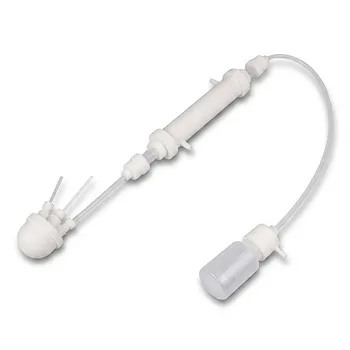
PTFE connectors are the industry standard for sanitary environments because they offer a unique combination of chemical inertness, FDA compliance, and non-porous surfaces that facilitate rigorous sterilization. These properties prevent product contamination, ensure taste neutrality, and maintain the integrity of sensitive biological materials during processing.
PTFE’s value in high-purity sectors stems from its total chemical neutrality and physical smoothness. It bridges the gap between mechanical durability and the strict hygiene requirements of validated cleaning and sterilization protocols.
Ensuring Regulatory Compliance and Product Safety
FDA-Compliant and Physiologically Harmless
PTFE is available in specific FDA-compliant grades, making it safe for direct contact with consumables. It is considered physiologically harmless because it does not react with surrounding media or migrate into food and drug products.
Prevention of Cross-Contamination
The material is taste-neutral and odorless, which eliminates the risk of flavor or scent carry-over between product batches. Furthermore, if any debris from a PTFE seal were to enter the process stream, it would pass through the human body without consequence.
Non-Adsorption of Media
Unlike many elastomers, PTFE does not absorb the fluids it carries, preventing the "sponge effect" where chemicals leach out later. This non-adsorption ensures that the purity of a batch is never compromised by residues from a previous run.
Facilitating Rigorous Sterilization Protocols
Supporting Clean-in-Place (CIP) Systems
The non-porous surface of PTFE is a critical requirement for validated cleaning protocols such as Clean-in-Place (CIP) and Sterilization-in-Place (SIP). These smooth surfaces prevent bacteria and microbes from finding "niches" where they can survive standard cleaning cycles.
Thermal and Chemical Resilience
Sanitary environments often utilize aggressive cleaning agents and high-temperature steam for disinfection. PTFE’s broad chemical resistance and high upper temperature limit allow it to maintain its seal integrity under conditions that would degrade other materials.
Non-Stick Surfaces and Microbial Risk
The natural non-stick properties of PTFE reduce product adhesion within the connector. By preventing the buildup of organic material, the risk of microbial growth is significantly lowered, ensuring a more hygienic production line.
Optimizing Process Fluid Dynamics
Protecting Shear-Sensitive Biologics
In biotechnology, shear-sensitive biologics can be damaged by friction during transport. The low-friction coefficient of PTFE ensures a smooth flow, protecting the delicate molecular structure of these high-value products.
Vibration Absorption in Manifolds
Flexible PTFE hose connectors are frequently used in equipment manifolds to absorb vibration. This mechanical dampening protects sensitive instrumentation and prevents the loosening of connections that could lead to fluid leakage.
Understanding the Trade-offs
Mechanical Deformation and Cold Flow
Despite its chemical advantages, PTFE is prone to "cold flow" or creep, meaning it can slowly deform under a constant load. This requires careful installation and sometimes the use of filled PTFE grades or energized seals to maintain long-term sealing pressure.
Stiffness Compared to Elastomers
PTFE is significantly stiffer than rubber or silicone, which can make it more challenging to achieve a seal on mismatched or uneven surfaces. Precision in flange alignment and torque application is essential to prevent bypass leakage in sanitary connections.
Selecting the Right PTFE Component for Your System
When integrating PTFE connectors into your process, your choice should be dictated by the specific demands of your media and cleaning cycle.
- If your primary focus is extreme purity and taste neutrality: Utilize virgin, FDA-approved PTFE to ensure zero substance migration and complete inertness.
- If your primary focus is high-pressure sterilization cycles: Opt for modified PTFE grades that offer enhanced resistance to deformation under high thermal stress.
- If your primary focus is handling delicate biological fluids: Leverage the low-friction properties of PTFE linings to minimize shear stress and maintain protein stability.
By aligning material properties with regulatory and mechanical requirements, PTFE remains the most reliable choice for maintaining the integrity of pharmaceutical and food-grade processes.
Summary Table:
| Feature | Benefit to Sanitary Environments | Key Application |
|---|---|---|
| FDA Compliance | Physiologically harmless; no product migration | Food & Drug Contact |
| Chemical Inertness | Prevents corrosion and cross-contamination | Aggressive Cleaning/CIP |
| Non-Porous Surface | Eliminates microbial niches and bacterial growth | Sterile Processing (SIP) |
| Low Friction | Minimizes shear stress on delicate molecules | Biotechnology/Biologics |
| Temperature Range | Maintains integrity during steam sterilization | High-Temp Disinfection |
Elevate Your Process Integrity with KINTEK Fluoropolymer Solutions
Ensure the highest standards of purity and performance in your laboratory or production line with KINTEK. We specialize in high-performance fluoropolymer materials, offering an exhaustive range of supplies crafted from PTFE and PFA to meet the rigorous demands of pharmaceutical, biotech, and food processing environments.
Our product portfolio spans from:
- Everyday Labware: Beakers, measuring cylinders, crucibles, reagent/wash bottles, and centrifuge tubes.
- Fluid Transfer & Filtration: High-purity tubing, fittings, valves, separatory funnels, and filters.
- Advanced Apparatus: Custom electrochemical cells, battery testing fixtures, microwave digestion vessels, and microchannel reactors.
- General Consumables: Stirring bars, O-rings, gaskets, and specialized seal tapes.
Backed by end-to-end custom CNC fabrication, KINTEK is equipped to deliver everything from high-volume standard orders to complex, bespoke laboratory setups. Partner with us to leverage our exclusive focus on high-performance materials and precision engineering.
Ready to optimize your system? Contact KINTEK today to discuss your custom requirements!
Related Products
- PTFE Corrosion Resistant Filter with PFA Valve Connections and Integrated Sieve Plate
- Custom PTFE Corrosion Resistant White Syringe with Threaded Luer Connector Compatibility
- Corrosion Resistant PTFE Multi Layer Sieve with Threaded Connections for Bio Chemical Laboratory Extraction and Customizable Mesh Size
- High Purity PTFE Filter with PFA Valve Connections and Integrated Sieve Plate for Corrosive Fluid Processing
- High Temperature Resistant PTFE White Screw Plugs Custom T Shaped Sealing Hole Stoppers Waterproof Dustproof Chemical Inert Laboratory Fasteners
People Also Ask
- What sizes and pore options are available for PTFE filters? Choose the Right Filter for Your Application
- What steps are involved in selecting the proper PTFE filter? A 4-Step Guide to Optimal Filtration
- Which chemicals are fully compatible with PTFE filters? Discover Unmatched Chemical Resistance
- What temperature resistance do PTFE filters offer? Unmatched Thermal Stability from -200°C to +260°C
- How does the hydrophobicity of PTFE filters benefit their use? Ensure Uninterrupted Gas Flow and Solvent Filtration