The key difference is not PTFE chemistry, but resin structure and processability. Granular PTFE is made by suspension polymerization and forms relatively coarse, molding-grade particles for rigid, machined laboratory components. Fine powder PTFE is made by dispersion polymerization and forms small particles that fibrillate during paste extrusion, making flexible tubing, films, membranes, and seals possible. Aqueous PTFE dispersion remains a liquid polymer suspension intended mainly for coatings and impregnation.
Select granular PTFE for structural strength and machinability, fine powder for flexible or thin-wall products, and aqueous dispersion for non-wetting or protective surface treatments. The correct resin form is determined by the manufacturing process required to produce the laboratory product.
Why PTFE Resin Form Matters
The resin determines the manufacturing route
PTFE cannot be processed like a conventional thermoplastic through ordinary melt extrusion because of its extremely high melt viscosity. Each resin form is therefore engineered for a specific route, such as compression molding, paste extrusion, or coating.
The processing route controls the product's geometry, wall thickness, dimensional stability, flexibility, and surface characteristics.
Particle structure affects final performance
Granular PTFE has relatively coarse, molding-grade particles that compact into solid billets or molded shapes. Fine powder contains smaller, more uniform particles that can form a coherent structure through shear-induced fibrillation during paste extrusion.
Aqueous dispersion consists of very small PTFE particles suspended in liquid. It is applied to a surface and then dried and sintered, rather than compacted into a self-supporting bulk component.
Granular PTFE: Rigid, Machined Laboratory Components
How granular resin is produced
Granular PTFE is generally produced by suspension polymerization in aqueous media with vigorous agitation and relatively low surfactant levels. The agitation produces comparatively coarse or fibrous resin particles suitable for molding.
The resin is compacted under pressure and sintered into billets, sheets, rods, or thick-walled tubes. These stock forms can then be machined using CNC or conventional machining methods.
What products it supports
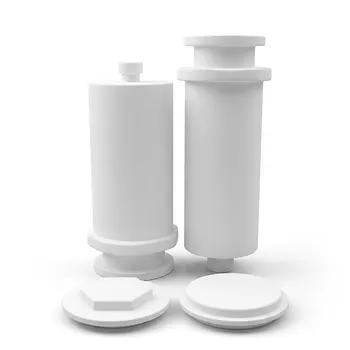
Granular PTFE is the primary choice for rigid, heavy-wall laboratory apparatus, including:
- Beakers and crucibles
- Reagent bottles and storage vessels
- Digestion vessels
- Custom reaction cells
- Electrochemical cell bodies
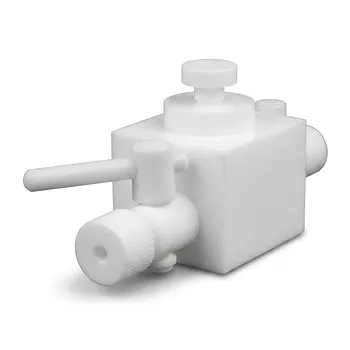
- Stopcocks and fluid-control components
- Structural blocks, rods, and thick-walled tubes
These applications benefit from the material's dimensional stability, chemical inertness, and ability to retain a precise machined shape.
How granular grades differ internally
Not all granular PTFE grades behave identically. Fine-cut granular grades generally support high strength and elongation in critical machined components and seals.
Free-flow grades use larger agglomerated particles and are easier to handle for high-volume compression molding. Their lower mold shrinkage can improve dimensional consistency in standard containers and fittings.
Ram-extrusion grades use larger particles intended for continuous production of thick-walled rods and tubes. Modified PTFE grades can provide higher elongation and improved resistance to deformation in demanding vessels or dynamic seals.
Fine Powder PTFE: Flexible and Thin-Wall Products
How fine powder is produced
Fine powder PTFE is produced through dispersion polymerization, typically using mild agitation and polymerization aids. This produces small, highly uniform particles that can be blended with a hydrocarbon lubricant to create an extrusion paste.
During paste extrusion, shear causes the particles to fibrillate and interlock. The resulting green shape is then sintered to create a continuous PTFE structure.
What products it supports
Fine powder is suited to products that require flexibility, thin walls, or continuous production, such as:
- Fluid-transfer tubing
- Wire and cable insulation
- Thin films
- Sealing tapes
- Gaskets and thin-wall seals
- Porous filtration membranes
- Fine linings for fluid-transfer systems
The paste-extrusion process allows shapes that would be difficult or uneconomical to produce by molding and machining from a solid billet.
Why it is not interchangeable with granular resin
Fine powder is designed to respond to shear by fibrillating. That behavior is essential for producing coherent extruded tubing and films, but it does not make fine powder a direct substitute for granular molding resin in thick structural parts.
Conversely, granular resin is engineered for compaction and sintering. It generally lacks the processing behavior needed to form reliable paste-extruded flexible products.
Aqueous PTFE Dispersion: Surface Treatments
How dispersion differs from fine powder
Aqueous PTFE dispersion is a liquid suspension of fine PTFE particles. It is produced through dispersion polymerization and remains in a form that can be applied as a coating or used for impregnation.
Fine powder and aqueous dispersion therefore share a related polymerization family, but they are supplied and processed differently. Fine powder is a dry resin for paste extrusion; aqueous dispersion is a liquid formulation for surface application.
What products it supports
Aqueous dispersion is mainly selected for:
- Hydrophobic or non-wetting coatings
- Protective anti-corrosion layers
- Impregnation of compatible substrates
- Low-friction surface treatments
- Non-stick laboratory surfaces
After application, the coating is dried and sintered to form the PTFE layer.
When coating is preferable to solid PTFE
A coating is useful when the laboratory component already has the required structural form but needs improved chemical resistance, non-wetting behavior, or low surface adhesion.
It is not a replacement for a thick PTFE vessel when the PTFE itself must provide the primary mechanical structure or containment barrier.
How Processing Changes Laboratory Product Selection
Choose based on geometry first
Rigid, thick-walled, or highly customized geometries usually point to granular PTFE. The material can be molded into stock shapes and machined to accommodate ports, threads, grooves, channels, and precise mating surfaces.
Thin, continuous, or flexible geometries point to fine powder. Paste extrusion is better suited to tubing, tapes, films, and other products where flexibility and uniform wall thickness matter.
Choose based on the dominant mechanical requirement
For load-bearing or containment components, granular PTFE generally provides the appropriate processing route and structural stability. It is the practical choice when the product must maintain its shape during handling, thermal cycling, or chemical service.
For bending, routing, sealing movement, or conformability, fine powder products are usually more appropriate. Their processing enables flexible tubing and thin seals that cannot be produced effectively from rigid molded stock.
Choose based on the required surface function
When the main requirement is a hydrophobic, non-wetting, or protective surface, aqueous dispersion is usually the relevant form. The coating can add the desired surface behavior without fabricating the entire part from bulk PTFE.
The coating's durability still depends on substrate preparation, coating thickness, adhesion, and sintering conditions. Surface treatment should therefore be evaluated as a complete system rather than as a resin choice alone.
Understanding the Trade-offs
Rigid strength versus flexibility
Granular PTFE supports thick, rigid, machinable components, but those components are not intended to behave like flexible tubing. Fine powder products provide flexibility and thin-wall capability, but they are not the default choice for large, load-bearing machined bodies.
The correct selection follows the product's mechanical role, not simply the general chemical resistance associated with PTFE.
Machining flexibility versus manufacturing efficiency
Granular PTFE allows extensive customization after molding, which is valuable for specialized laboratory apparatus. However, machining adds material waste, processing time, and cost compared with producing standardized extruded tubing or molded fittings.
Fine powder paste extrusion is efficient for continuous or repeatable profiles. It is less suitable when each component requires extensive three-dimensional machining.
Dimensional stability and shrinkage
Granular grades differ in mold shrinkage and flow behavior. Fine-cut grades can support high-strength machined parts, while free-flow grades may offer easier handling and lower shrinkage for standard molded products.
Ram-extrusion grades can exhibit higher shrinkage and require process-specific dimensional control. Product tolerances should therefore be matched to the selected resin grade and manufacturing method.
Coatings do not provide bulk structural support
A dispersion coating may improve surface behavior, but it does not have the same role as a solid PTFE wall. It cannot be assumed to provide the containment strength, impact resistance, or machining depth of a granular PTFE component.
Coating selection must also consider substrate compatibility and the risk of wear, cracking, or loss of coverage during use.
Product labels can obscure the real distinction
The terms fine powder, dispersion, and dispersion-polymerized PTFE are sometimes used loosely. The practical distinction is the supplied form and intended processing route: dry fine powder for paste extrusion versus liquid aqueous dispersion for coating.
Procurement specifications should identify the resin form, processing method, particle or grade requirements, and intended product geometry rather than relying on a general PTFE label.
Making the Right Choice for Your Goal
The laboratory product's geometry and primary performance requirement should determine the resin selection.
- If your primary focus is rigid custom laboratory apparatus: Select granular PTFE designed for compression molding and machining, with the grade chosen according to strength, shrinkage, flow, and dimensional requirements.
- If your primary focus is flexible fluid transfer: Select fine powder PTFE intended for paste extrusion into tubing, thin films, tapes, or flexible seals.
- If your primary focus is hydrophobic or non-wetting surfaces: Select an aqueous PTFE dispersion formulated for coating, impregnation, drying, and sintering.
- If your primary focus is high-volume standard components: Evaluate free-flow granular grades or an appropriate extrusion grade based on the required geometry and production method.
- If your primary focus is high-stress vessels or dynamic seals: Consider a fine-cut or modified granular grade when the design requires machined structural strength and improved deformation resistance.
The most reliable selection matches the PTFE resin form to the process that can produce the required laboratory geometry and performance.
Summary Table:
| Resin Form | Structure | Processing Method | Typical Lab Products | Selection Criteria |
|---|---|---|---|---|
| Granular PTFE | Coarse particles from suspension polymerization | Compression molding, ram extrusion, machining | Beakers, crucibles, digestion vessels, custom machined parts | Rigid, thick-walled, structural components requiring dimensional stability |
| Fine Powder PTFE | Small uniform particles from dispersion polymerization | Paste extrusion with lubricant | Tubing, films, sealing tapes, gaskets, membranes | Flexible, thin-wall, or continuous profiles |
| Aqueous PTFE Dispersion | Fine particles suspended in liquid | Coating, impregnation, drying, sintering | Hydrophobic coatings, anti-corrosion layers, non-stick surfaces | Surface treatments without bulk structural support |
Ready to select the ideal PTFE resin for your lab? KINTEK offers a comprehensive range of PTFE/PFA labware and custom machining services. Whether you need machined granular components, extruded fine powder tubing, or applied coatings, our experts can guide you. Contact us today to discuss your specific requirements and benefit from our high-performance fluoropolymer solutions. Get in touch with our specialists to receive tailored support and high-quality PTFE products for your lab needs.
Related Products
- High Temperature Chemical Resistant 50ml PTFE Syringe Customized Teflon Injector with Threaded Seal for Trace Analysis
- Custom PTFE Corrosion Resistant White Syringe with Threaded Luer Connector Compatibility
- High Purity Laboratory Grade PTFE Syringe Chemical Resistant Fluoropolymer Injector for Trace Analysis
- Custom PTFE Filtration System Acid Resistant High Purity Semiconductor Grade Chemical Processing Filter
- PTFE Corrosion Resistant Filter with PFA Valve Connections and Integrated Sieve Plate
People Also Ask
- In what medical devices is PTFE commonly used? Essential Components for Safety and Reliability
- Is PTFE approved for food contact applications? Ensuring Food Safety with Compliant PTFE
- How does PTFE's flexibility affect its performance? Unlock Durability and Sealing Power
- What is notable about the coefficient of friction of PTFE? Achieve Unmatched Low-Friction Performance
- How chemically resistant is PTFE? Discover its near-total inertness to most chemicals