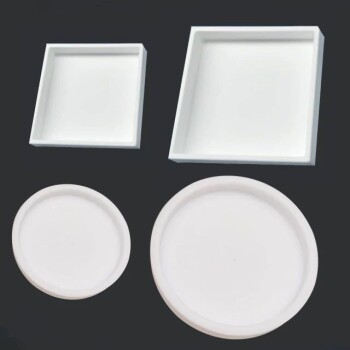
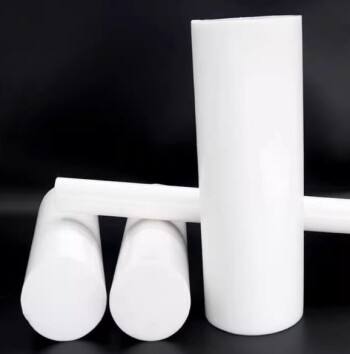
PTFE is classified as non-melt-processible because it does not become a sufficiently fluid melt when heated. Although PTFE reaches a melting transition around 327–342°C, its melt viscosity remains extraordinarily high—approximately 10¹¹–10¹² poise at 380°C—so it behaves more like a stiff gel than a flowing thermoplastic. As a result, solid PTFE laboratory components cannot normally be made by standard injection molding or conventional melt extrusion.
PTFE must be shaped through powder compaction and sintering, then often precision-machined from the resulting solid preform. This increases manufacturing complexity but preserves the material’s chemical resistance, purity, low friction, and dimensional performance.
Why PTFE Does Not Process Like a Typical Thermoplastic
The melting point is not the whole story
A conventional thermoplastic becomes sufficiently fluid above its melting point to flow through an injection mold or extrusion die. PTFE undergoes a melting transition, but it does not develop the practical flow behavior required for those processes.
PTFE is commonly reported with melting transitions near 327°C and 342°C, depending on its thermal history and crystalline state. The important manufacturing issue is not simply the temperature at which crystals melt, but the material’s inability to flow afterward.
Extremely high melt viscosity prevents flow
At elevated temperature, PTFE has a melt viscosity on the order of 10¹¹–10¹² poise. This is many orders of magnitude higher than the viscosity of polymers designed for ordinary melt processing.
Instead of behaving like a freely flowing liquid, molten PTFE forms a stiff, highly viscous gel-like phase. The pressure required to force it through conventional tooling would be impractical and could damage equipment or produce unacceptable parts.
Molecular structure reinforces the processing difficulty
PTFE’s very high molecular weight and rigid, tightly packed fluoropolymer chains contribute to its exceptional melt viscosity. Its high crystallinity also makes the transition from solid to processable melt fundamentally different from that of standard injection-molding plastics.
This combination explains why heating PTFE above its melting point does not make it behave like polyethylene, polypropylene, or other common thermoplastics.
How Solid PTFE Components Are Manufactured
Powder is compacted into a preform
Manufacturing typically begins with granular or fine PTFE resin rather than a conventional polymer melt. The powder is placed into a mold and compressed to form a preliminary shape called a preform or billet.
Compression removes air and consolidates the powder particles. At this stage, the part has the approximate geometry needed for later processing but does not yet have the final strength and density of fully fused PTFE.
Sintering fuses the compacted material
The compressed preform is heated through a controlled sintering cycle. The particles fuse together, producing a dense, continuous PTFE structure without requiring the material to flow through a mold as a conventional melt.
Sintering conditions must be carefully controlled because heating rate, temperature, cooling rate, and part geometry influence shrinkage, internal stresses, density, and dimensional stability.
CNC machining provides final accuracy
After sintering, PTFE billets, rods, cylinders, or other stock shapes are commonly machined using precision CNC equipment. This is especially important for laboratory components that require accurate bores, threads, sealing surfaces, channels, or mating interfaces.
Machining also makes it practical to produce custom or low-volume parts that would not justify dedicated injection-molding tooling.
What This Means for Laboratory Components
Custom geometries are feasible, but not through ordinary molding
PTFE can be used for custom reaction vessels, electrochemical cells, valves, fittings, rods, cylinders, and fluid-handling components. However, their geometry is usually created through a combination of compression molding, sintering, drilling, turning, milling, and CNC finishing.
The manufacturing route resembles powder metallurgy more closely than standard plastic injection molding.
Dimensional control requires process planning
PTFE undergoes dimensional changes during compression, sintering, cooling, and machining. Designers and manufacturers must account for shrinkage and possible distortion when specifying tolerances.
Critical features are often machined after sintering rather than relying entirely on the molded preform. This allows manufacturers to achieve the precision needed for sealing, alignment, and controlled fluid flow.
Material purity can be preserved
The specialized process can be advantageous for laboratory use because the finished component can be fabricated from high-purity PTFE stock without introducing mold-release agents or incompatible processing additives.
The result is a component with strong resistance to aggressive chemicals, low surface friction, and useful thermal and electrical insulation properties.
Why PTFE Remains Valuable Despite Its Processing Difficulty
Chemical resistance supports demanding applications
PTFE is highly resistant to a broad range of chemicals, making it suitable for contact with corrosive reagents and aggressive laboratory fluids. This is one reason it remains a preferred material for specialized reaction and fluid-handling equipment.
Low friction improves moving interfaces
Its low coefficient of friction is useful in valves, plungers, seals, bearings, and sliding interfaces. Machining allows these features to be integrated into custom components.
Thermal and electrical properties broaden its use
PTFE also offers a broad service-temperature range and a low dielectric constant. These characteristics are valuable in laboratory equipment that combines chemical exposure with thermal or electrical demands.
Understanding the Trade-offs
Manufacturing is slower and more expensive
Compared with injection molding, powder compaction, sintering, and CNC machining require more process steps. Custom parts therefore tend to have higher unit costs, particularly when production volumes are low.
Complex shapes may be difficult to produce economically
PTFE can be machined into intricate parts, but deep internal passages, undercuts, very thin walls, and highly complex three-dimensional geometries may increase machining time or require specialized tooling.
For high-volume production or highly complex fluid paths, a melt-processible fluoropolymer such as PFA may be more suitable because it can generally be extruded or injection-molded.
Tolerances must reflect PTFE behavior
PTFE is relatively soft compared with many engineering plastics and can exhibit creep or deformation under sustained load. Tight-tolerance designs must therefore consider not only manufacturing shrinkage but also operating temperature, mechanical loading, sealing force, and long-term dimensional stability.
Not every PTFE grade is processed identically
Filled PTFE grades, modified PTFE, and paste-extrusion grades can have different processing characteristics and performance. Material selection should be based on the intended chemical, thermal, mechanical, and dimensional requirements—not solely on the PTFE designation.
Making the Right Choice for Your Goal
The most appropriate manufacturing route depends on the component’s geometry, production volume, and performance requirements.
- If your primary focus is chemical purity and custom laboratory geometry: Use sintered PTFE stock followed by precision CNC machining, particularly for reaction vessels, fittings, cells, and specialized fixtures.
- If your primary focus is dimensional accuracy: Specify post-sintering machining for sealing surfaces, holes, threads, and interfaces rather than relying only on compression-molded dimensions.
- If your primary focus is high-volume production or complex molded fluid paths: Evaluate melt-processible fluoropolymers such as PFA instead of standard PTFE.
- If your primary focus is long-term mechanical stability: Account for PTFE’s creep, thermal expansion, shrinkage, and load conditions during design and material selection.
PTFE’s non-melt-processible nature makes manufacturing more specialized, but powder processing and precision machining allow it to deliver laboratory components that conventional plastics may not match in chemical resistance and purity.
Summary Table:
| Aspect | Details |
|---|---|
| Melt Viscosity | 10¹¹–10¹² poise at 380°C, too high for conventional melt processing. |
| Manufacturing Method | Powder compaction, sintering, and CNC machining rather than injection molding. |
| Advantages | Excellent chemical resistance, low friction, high purity, and broad temperature range. |
| Challenges | Slow process, higher costs, limited complexity, and creep under load. |
| Alternatives | PFA for melt-processible applications requiring complex geometries or high volume. |
Need PTFE lab equipment that withstands extreme conditions? KINTEK's high-performance PTFE/PFA products are manufactured via precision CNC machining and sintering to meet your exact requirements. From custom reaction vessels to complex fluid handling components, we deliver purity and durability. Contact us today to discuss your project and get a quote!
Related Products
- Custom PTFE Filtration System Acid Resistant High Purity Semiconductor Grade Chemical Processing Filter
- High Corrosion Resistant PTFE Faucet Polytetrafluoroethylene Valve for Chemical Storage Drums and Fluid Transfer Systems Customizable Industrial Grade
- PTFE PFA Vacuum Filtration System Corrosion Resistant Customizable Shatterproof Laboratory Device
- PTFE Corrosion Resistant Filter with PFA Valve Connections and Integrated Sieve Plate
- High Temperature Chemical Resistant 50ml PTFE Syringe Customized Teflon Injector with Threaded Seal for Trace Analysis
People Also Ask
- What makes PTFE filtration systems advantageous for industrial and scientific use? Unmatched Chemical & Thermal Stability
- What sizes and pore options are available for PTFE filters? Choose the Right Filter for Your Application
- What steps are involved in selecting the proper PTFE filter? A 4-Step Guide to Optimal Filtration
- How does the hydrophobicity of PTFE filters benefit their use? Ensure Uninterrupted Gas Flow and Solvent Filtration
- What temperature resistance do PTFE filters offer? Unmatched Thermal Stability from -200°C to +260°C