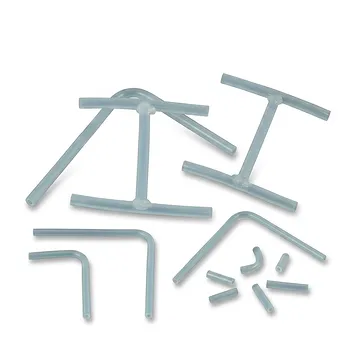
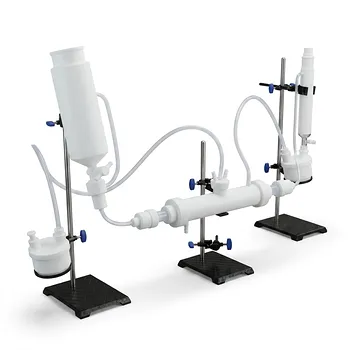
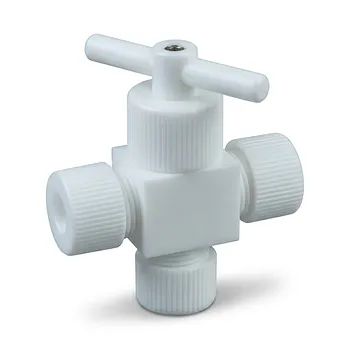
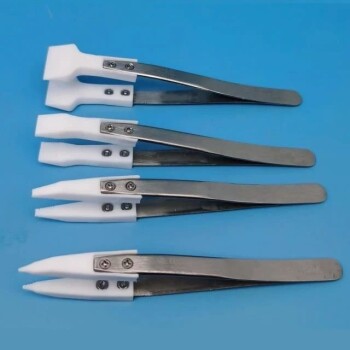
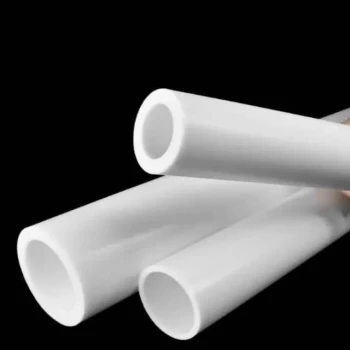
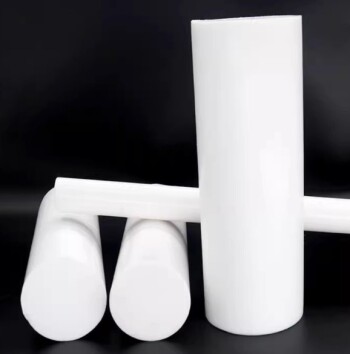
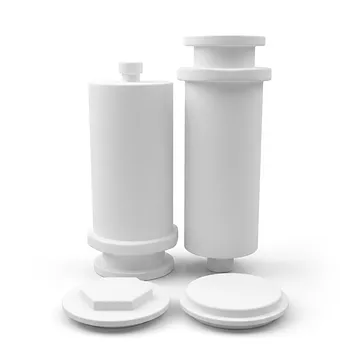
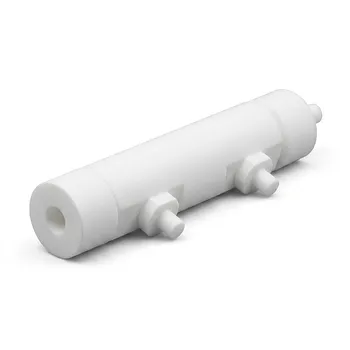
ETFE’s main advantage is that it combines fluoropolymer-level chemical resistance with practical melt processing and unusually strong mechanical durability. Its low melt viscosity enables injection molding of intricate fluid-transfer geometries, while its toughness, abrasion resistance, and cut-through resistance help molded tubing, fittings, valve bodies, and connectors withstand impact, pressure, and repeated handling.
ETFE is well suited to fluid-transfer components when the design requires both chemical resistance and structural durability. Compared with softer or fully fluorinated fluoropolymers, it is generally easier to mold into complex shapes and better able to resist mechanical wear, impact, and damage.
Why ETFE Is Easier to Process
Low melt viscosity supports complex molding
ETFE has relatively low melt viscosity compared with perfluoroplastics such as PTFE. This allows the material to flow more readily through molds and fill intricate features, including thin walls, ports, threads, sockets, and connector geometries.
That processing behavior makes injection molding practical for components that would be difficult or uneconomical to produce from non-melt-processable fluoropolymers.
A broad processing window improves manufacturing flexibility
ETFE can be processed across a relatively broad melt-temperature range, commonly cited at approximately 280°C to 340°C, depending on the grade and processing conditions.
A broad window gives manufacturers more flexibility to balance mold filling, cycle time, surface quality, and part integrity. Actual settings still require control of residence time, shear, mold temperature, and material grade.
High shear-rate capability benefits thin-wall parts
ETFE can tolerate substantially higher critical shear rates than fully fluorinated perfluoropolymers. This makes it easier to mold thin-walled tubing, compact fittings, and detailed connector components without the same degree of flow limitation.
The result is greater design freedom for fluid paths and reduced dependence on machining or assembly from multiple pieces.
It supports multiple fabrication methods
In addition to injection molding, ETFE can be processed into tubing, rods, films, and powder-coated structures. This allows designers to use related ETFE material forms across fluid-transfer systems, linings, insulation, and molded hardware.
For molded components specifically, the key benefit is the ability to produce repeatable, integrated geometries rather than relying entirely on machining or mechanically joined fluoropolymer parts.
Why ETFE Performs Well Mechanically
High toughness improves impact resistance
ETFE has substantially greater mechanical toughness and impact resistance than many softer fluoropolymers. This helps connectors and fittings tolerate installation forces, accidental impacts, vibration, and handling during maintenance.
The material is therefore appropriate for components that must remain chemically resistant while also carrying mechanical loads.
Abrasion resistance supports repeated fluid-system use
ETFE offers strong resistance to abrasion and wear. That is valuable in tubing, valve components, pump internals, and fittings exposed to friction, particulate contact, repeated assembly, or fluid-system movement.
Its wear resistance can extend component life where a chemically resistant but mechanically softer material might degrade more quickly.
High cut-through resistance protects thin sections
ETFE’s cut-through resistance helps protect tubing walls, sealing features, and connector surfaces from damage caused by clamps, edges, tools, or concentrated contact stresses.
This is particularly useful when the component must remain leak-tight despite installation or service-related mechanical abuse.
Strength supports rigid, load-bearing components
ETFE is mechanically stronger and more rigid than softer fluoropolymers, making it suitable for rigid tube fittings, valve bodies, structural labware, seal glands, and fasteners.
The material can preserve component geometry under pressure and handling better than materials selected primarily for flexibility or chemical inertness.
How These Advantages Apply to Fluid Components
Connectors and fittings
The combination of moldability and toughness allows ETFE connectors to incorporate complex flow paths, sealing surfaces, threads, and attachment features in a single molded part.
Its chemical resistance also helps protect the connector from aggressive fluids, while its abrasion and impact resistance support repeated installation and use.
Tubing and pipe components
ETFE tubing can provide a useful balance between chemical compatibility, dimensional stability, wear resistance, and mechanical toughness.
It is especially valuable where tubing must resist external handling damage or internal friction while maintaining a chemically inert fluid-contact surface.
Valve bodies and pump internals
Valve bodies, pump parts, and related components can experience pressure, impact, sliding contact, and repeated cycling. ETFE’s toughness and abrasion resistance make it better suited to these conditions than softer fluoropolymer options.
Its melt-processability also enables integrated geometries that can reduce the number of joints, inserts, or secondary machining operations.
Electrical and fluid-handling integration
ETFE also provides low dielectric properties and electrical insulation capability. This can benefit components that combine fluid handling with electrical isolation, instrumentation, or proximity to energized equipment.
Performance Enhancement Options
Crosslinking for more demanding service
ETFE can be crosslinked using electron-beam radiation, and some formulations may use other crosslinking approaches. Crosslinking can improve thermal stability, mechanical properties, upper-use temperature capability, and cut-through resistance while retaining chemical resistance and insulation performance.
This is useful when a standard molded ETFE component must withstand greater thermal or mechanical stress.
Filled grades for creep resistance
ETFE can be compounded with fillers such as glass fiber to improve creep resistance and thermal stability. Filled grades may be appropriate for rigid components exposed to sustained loads or elevated temperatures.
The trade-off is that fillers can alter flow behavior, surface finish, ductility, and chemical-contact characteristics, so the grade must be selected for the specific application.
Understanding the Trade-offs
ETFE is not the highest-temperature fluoropolymer
ETFE generally offers lower continuous heat resistance than fully fluorinated materials such as PTFE or PFA. It is often cited for service extending from cryogenic conditions to approximately 180°C, but the permissible temperature depends on the grade, stress level, chemical environment, and exposure duration.
If maximum continuous temperature or ultimate chemical inertness is the primary requirement, a fully fluorinated fluoropolymer may be preferable.
Thick sections require shrinkage control
For thick ETFE moldings, particularly sections exceeding approximately 5 mm, melt shrinkage can be significant and may approach 6% under some conditions.
Mold design, gating, cooling, dimensional allowances, and post-molding inspection are therefore important when producing precision connectors or sealing components.
Chemical resistance does not eliminate design limitations
ETFE has broad chemical resistance, but no polymer is universally compatible with every chemical, concentration, temperature, and pressure combination. The actual fluid, exposure time, stress state, and operating temperature should be checked against qualified compatibility data.
Toughness can involve processing compromises
Optimizing ETFE for strength, filled reinforcement, or crosslinked performance may affect flow, surface finish, flexibility, weldability, or post-processing options. The best material choice depends on whether the dominant requirement is moldability, impact resistance, dimensional stability, temperature capability, or chemical exposure.
Selecting ETFE for the Application
ETFE is most valuable when the component must be both chemically resistant and mechanically durable, rather than optimized for only one of those properties.
- If your primary focus is complex molded geometry: Choose melt-processable ETFE to simplify injection molding of intricate tubing, fittings, connectors, valve bodies, and sockets.
- If your primary focus is impact and handling durability: Choose ETFE for its high toughness and resistance to mechanical shock compared with softer fluoropolymers.
- If your primary focus is wear life: Use ETFE where abrasion, friction, repeated assembly, or particulate contact could damage less durable materials.
- If your primary focus is thin-wall molding: Take advantage of ETFE’s low melt viscosity and high shear-rate capability, while validating filling and dimensional control for the selected grade.
- If your primary focus is elevated mechanical or thermal performance: Consider crosslinked or filled ETFE, but evaluate the resulting effects on processing and part behavior.
- If your primary focus is maximum temperature or chemical inertness: Compare ETFE with PTFE, PFA, or another fully fluorinated material before finalizing the design.
ETFE is the practical choice when molded fluid-transfer components need a rare combination of chemical resistance, processing flexibility, and mechanical toughness.
Summary Table:
| Advantage | Description | Benefit |
|---|---|---|
| Low melt viscosity | Flows easily in molds | Complex geometries possible |
| Broad processing window | 280°C-340°C range | Flexible manufacturing |
| High shear-rate capability | Handles high shear | Thin-wall parts |
| Toughness | High impact resistance | Durable under stress |
| Abrasion resistance | Resists wear | Longer service life |
| Cut-through resistance | Protects thin sections | Maintains leak-tight seals |
| Strength and rigidity | Stiff and strong | Suitable for load-bearing parts |
Optimize Your Fluid Components with ETFE
At KINTEK, we leverage ETFE's unique combination of chemical resistance and mechanical toughness to deliver high-performance molded components. Our expertise in PTFE/PFA extends to ETFE, ensuring your connectors, tubing, and valve bodies meet the highest standards. Whether you need custom injection-molded parts or standard labware, we provide solutions that resist harsh chemicals and withstand demanding conditions. Contact us today to discuss your requirements and discover how our custom CNC machining and molding capabilities can enhance your fluid systems.
Related Products
- Corrosion Resistant PFA Tubing 1/4 Inch Custom Molded Welded Fluid Transfer Components
- High Purity PFA Valves and Weldable Corrosion Resistant Transparent Tubing for Semiconductor Sensor Manufacturing Fluid Transfer
- Corrosion Resistant High Purity PFA Valve and Weldable Transparent Tubing for Semiconductor Fluid Transfer
- High Corrosion Resistant PTFE Faucet Polytetrafluoroethylene Valve for Chemical Storage Drums and Fluid Transfer Systems Customizable Industrial Grade
- Custom PTFE Parts Manufacturer for Teflon Containers and Components
People Also Ask
- How do PFA fluid transfer components contribute to chemical research precision? Achieve high-purity results today.
- How do high-precision PFA fluid transfer components, such as tubing and fittings, affect the results of continuous-flow synthesis?
- Why is PFA preferred over FEP for high-temperature, high-purity fluid transfer?
- Why is PFA frequently specified over standard PTFE for custom-machined fluid transfer valves, fittings, and complex laboratory reaction vessels? Discover the key advantages.
- What role do PFA tubing and valves play in high-precision laboratory fluid transfer systems? Ensure Ultra-Pure Results