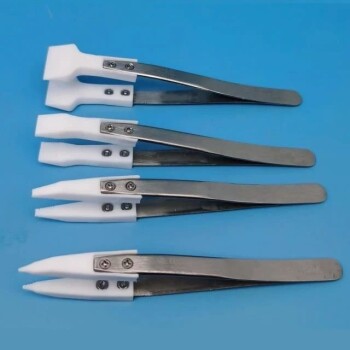
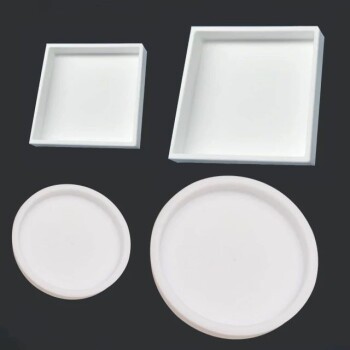
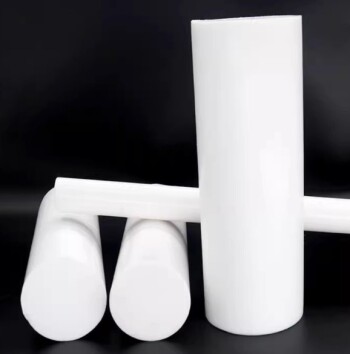
For custom CNC-machined PTFE labware, choose granular PTFE made by suspension polymerization. Suspension polymerization produces coarse, granular resin that can be compression-molded and sintered into dense blocks, rods, billets, or preforms before machining. Emulsion—or dispersion—polymerization produces fine powder or liquid dispersion grades intended mainly for paste extrusion, coatings, membranes, and impregnated products rather than solid machining stock.
The key difference is the resin form created by each process: suspension polymerization produces molding-grade granular PTFE for solid billets and CNC machining, while emulsion polymerization produces fine-particle or dispersion PTFE for thin, coated, or paste-processed products.
How the Polymerization Processes Differ
Suspension polymerization uses vigorous agitation
Suspension polymerization takes place in high-purity water with vigorous agitation and little or no surfactant. As TFE polymerizes, the PTFE precipitates from the water as relatively large polymer particles or reactor beads.
The resulting resin is processed into controlled granular molding powders. These powders are compression-molded and sintered into solid stock suitable for subsequent machining.
Emulsion polymerization stabilizes fine particles
Emulsion polymerization uses gentler agitation and a higher concentration of surfactant or other stabilizing agents. The polymer remains distributed in the aqueous phase as very small particles rather than rapidly precipitating into coarse granules.
This process yields either a liquid PTFE dispersion or a fine powder recovered from a coagulated dispersion. The particle size and morphology are suited to specialized forming and coating processes.
How the Resin Forms Affect Manufacturing
Suspension PTFE is designed for compression molding
Granular suspension-grade PTFE can be compacted into dense preforms and then sintered. This produces homogeneous solid sections with enough thickness and structural integrity to machine complex geometries.
Typical stock forms include:
- Blocks and billets
- Rods
- Thick-walled tubes or preforms
- Heavy sections for machined components
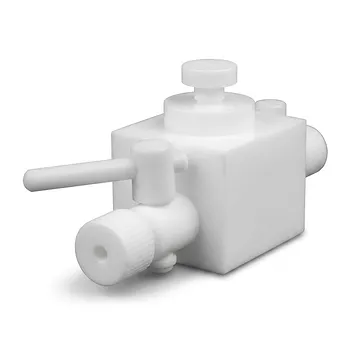
The material can then be turned, milled, drilled, or otherwise CNC-machined into laboratory vessels, manifolds, valve bodies, electrochemical cells, and custom fittings.
Emulsion PTFE is designed for other forming methods
Fine-powder PTFE is commonly associated with paste extrusion, where it is combined with an extrusion aid to produce thin-walled tubing, liners, and similar products. Liquid dispersions are used for coatings, impregnated materials, and other surface-treatment applications.
These grades are not generally the appropriate starting material for machining a thick, solid laboratory vessel. The issue is not that emulsion PTFE lacks chemical resistance; it is that its particle form and processing route are optimized for different product geometries.
Particle morphology influences part quality
Suspension-derived molding powders are processed to provide predictable compaction and sintering behavior. Their morphology affects density, dimensional stability, surface finish, and the uniformity of the finished machined part.
For standard custom labware, a well-characterized molding grade with consistent particle morphology is usually more important than simply choosing PTFE by chemical name. The resin must be appropriate for compression molding before it is appropriate for CNC machining.
Which Resin Form Is Suitable for CNC-Machined Labware?
Select granular, molding-grade suspension PTFE
For solid custom labware, the suitable choice is granular PTFE resin produced by suspension polymerization, supplied as compression-molded and sintered stock or as a grade intended to make that stock.
This recommendation applies to components such as:
- Custom beakers and reaction vessels
- Digestion vessels
- Valve bodies and manifolds
- Electrochemical cells
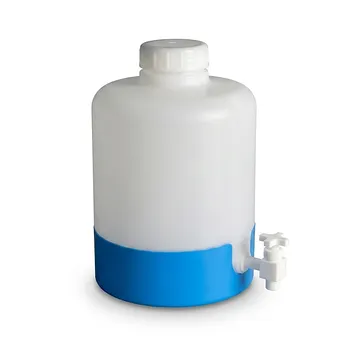
- Thick-walled storage containers
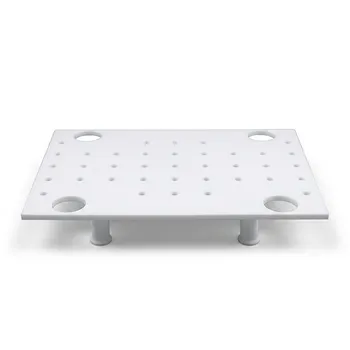
- Machined blocks, plates, and fittings
The preferred material should also meet the application’s requirements for purity, porosity, dimensional stability, and thermal history.
Match the grade to the laboratory duty
Not every suspension-grade PTFE is identical. A supplier should confirm that the selected grade is appropriate for:
- Trace-analysis or high-purity service
- Contact with aggressive chemicals
- Pressure or vacuum exposure
- Repeated heating and cooling
- Required dimensional tolerances
- Machining of deep holes, thin walls, or complex features
For sensitive analytical work, also request information about processing aids, extractables, and cleaning or certification practices. Polymerization route matters, but the finished material’s formulation and processing history matter as well.
Understanding the Trade-offs
Emulsion grades are not inherently inferior
Emulsion or dispersion PTFE is not a lower-quality material in general. It is the correct form for applications such as coatings, thin liners, flexible tubing, membranes, and other products made through paste or dispersion processing.
The mistake is using a resin designed for those processes as though it were a compression-molding billet material.
Suspension molding stock still requires careful machining
PTFE has a high coefficient of thermal expansion and relatively low stiffness compared with metals and many engineering plastics. Machining can therefore produce dimensional changes from cutting heat, residual stress release, tool pressure, and temperature variation.
For tight-tolerance labware, the machining plan should account for:
- Part temperature during measurement
- Stress relief and stabilization
- Sharp, properly supported tooling
- Thin-wall deformation
- Post-machining dimensional inspection
Purity claims require verification
The absence of intentionally added surfactant in suspension polymerization can reduce concern about certain processing residues, but it does not by itself prove that a finished part is contamination-free.
For high-purity applications, verify the complete supply chain, including resin grade, molding compound, sintering process, machining lubricants, cleaning method, packaging, and certificates of analysis.
Do not confuse resin form with finished geometry
The polymerization process determines the starting resin morphology, but the finished laboratory component is created through several additional steps. Compression molding, sintering, machining, cleaning, and inspection all influence the final performance.
A correctly selected suspension resin can still produce a poor part if it is molded with voids, machined while unstable, or contaminated during fabrication.
Making the Right Choice for Your Goal
Choose the resin form based on the manufacturing route and the required laboratory performance.
- If your primary focus is custom CNC-machined solid labware: Specify granular, suspension-polymerized PTFE that is suitable for compression molding into dense billets, rods, or preforms.
- If your primary focus is thin tubing or liners: Consider an emulsion-derived fine-powder PTFE grade designed for paste extrusion.
- If your primary focus is coatings or impregnated materials: Select a stable aqueous PTFE dispersion rather than granular molding resin.
- If your primary focus is trace-analysis purity: Specify a high-purity grade and obtain documentation on processing aids, extractables, cleaning, and contamination control.
For custom CNC-machined laboratory equipment, start with the correct suspension-grade granular PTFE molding stock, then control molding, machining, cleaning, and inspection as one integrated process.
Summary Table:
| Aspect | Suspension Polymerization | Emulsion Polymerization |
|---|---|---|
| Agitation | Vigorous | Gentle |
| Surfactant | Little or none | High concentration |
| Resin Form | Granular powder | Fine powder or dispersion |
| Typical Use | Compression molding, sintering | Paste extrusion, coatings, membranes |
| Suitability for CNC Machining | High - can be molded into solid stock | Low - not for thick solid parts |
Ready to source high-performance PTFE labware? As a leading manufacturer of custom PTFE/PFA components, KINTEK offers end-to-end CNC machining services. From complex non-standard parts to high-volume orders, we transform granular PTFE into precise laboratory solutions. Our expertise ensures your custom labware meets the highest standards of purity and durability. Contact us today to discuss your specific requirements and benefit from our tailored manufacturing capabilities.
Related Products
- Custom PTFE Filtration System Acid Resistant High Purity Semiconductor Grade Chemical Processing Filter
- High Corrosion Resistant PTFE Faucet Polytetrafluoroethylene Valve for Chemical Storage Drums and Fluid Transfer Systems Customizable Industrial Grade
- PTFE PFA Vacuum Filtration System Corrosion Resistant Customizable Shatterproof Laboratory Device
- PTFE Corrosion Resistant Filter with PFA Valve Connections and Integrated Sieve Plate
- High Temperature Chemical Resistant 50ml PTFE Syringe Customized Teflon Injector with Threaded Seal for Trace Analysis
People Also Ask
- What makes PTFE filtration systems advantageous for industrial and scientific use? Unmatched Chemical & Thermal Stability
- What sizes and pore options are available for PTFE filters? Choose the Right Filter for Your Application
- What steps are involved in selecting the proper PTFE filter? A 4-Step Guide to Optimal Filtration
- How does the hydrophobicity of PTFE filters benefit their use? Ensure Uninterrupted Gas Flow and Solvent Filtration
- What temperature resistance do PTFE filters offer? Unmatched Thermal Stability from -200°C to +260°C