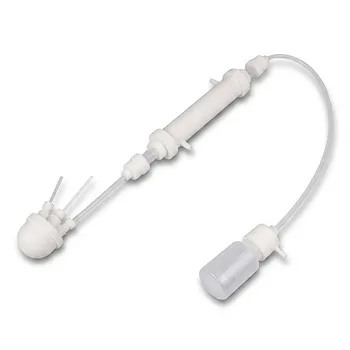
Polytetrafluoroethylene (PTFE) connectors face significant engineering hurdles due to their inherent lack of structural rigidity and a physical phenomenon known as "cold flow" or creep. To manage these limitations, engineers must utilize mechanical reinforcements, specific load-compensating hardware, and precise torque-management protocols to ensure long-term seal integrity and dimensional stability.
While PTFE provides unmatched chemical inertness and thermal stability, it lacks the mechanical strength of metals or structural polymers. Engineers must treat PTFE as a dynamic material that requires external support to prevent deformation and failure under load.
The Challenge of Dimensional Stability
The Phenomenon of Cold Flow
PTFE is highly susceptible to creep, also known as cold flow, where the material permanently deforms under sustained compressive loads. This means that a connector under constant pressure will eventually "move" away from the seal point, leading to potential leaks.
Low Tensile Strength and Rigidity
Compared to engineering plastics like nylon or metallic fittings, PTFE has a low tensile yield strength and modulus. It is a soft material that does not return to its original shape once deformed, making it difficult to reshape or reuse after the initial installation.
High Wear and Abrasion Sensitivity
In its unfilled state, PTFE exhibits high wear behavior and is sensitive to abrasion. This makes it unsuitable for applications where the connector is subjected to frequent mechanical rubbing or high-velocity particulate flow without additional reinforcement.
Thermal and Environmental Constraints
Pressure-Temperature Interdependency
PTFE's ability to hold pressure drops significantly as temperatures rise toward its 326°C melting point. Engineers must derate the pressure capacity of PTFE connectors at elevated temperatures to prevent catastrophic structural failure.
Radiation and Chemical Vulnerability
While famous for its inertness, PTFE has low resistance to high-energy radiation, which causes the molecular structure to break down. It is also susceptible to attack by alkali metals and highly reactive fluorinating agents, which can compromise the connector's integrity.
Toxicity at Extreme Temperatures
When PTFE is exposed to temperatures exceeding 260°C (500°F), it can release toxic fumes. This necessitates strict environmental controls and limits the material's use in specific high-heat industrial or laboratory settings.
Manufacturing and Assembly Limitations
Difficulty in Joining and Welding
PTFE is non-melt processable, meaning it cannot be conventionally welded or cemented like other polymers. This makes joining PTFE components a complex task that usually requires mechanical fastening or specialized bonding techniques.
Challenges in Mass Production
The material is relatively costly compared to other polymers and is difficult to mass-produce efficiently. Most PTFE components require precise CNC machining rather than high-speed injection molding, increasing the overall cost per unit.
Inelastic Installation
Because PTFE is inelastic, it cannot be "stretched" over a fitting and expected to snap back into place. This lack of memory means every connection must be designed with tight tolerances and external mechanical assistance to maintain a seal.
Engineering Strategies for Management
Incorporating Mechanical Reinforcements
To overcome low mechanical strength, engineers often use filled PTFE, incorporating glass fiber, carbon fiber, or metallic powders. These additives significantly improve the material's wear resistance and reduce the rate of creep.
Utilizing Live-Loading Hardware
To compensate for cold flow, engineers employ Belleville washers (disc springs) in the assembly. These washers provide "live loading," maintaining a constant compressive force on the seal even if the PTFE material begins to shift or creep over time.
Support and Backup Systems
The use of metal backup rings is a standard practice to prevent the PTFE from extruding through gaps under high pressure. Additionally, providing specific, rigorous torque specifications ensures that the material is compressed enough to seal without being crushed beyond its limits.
Understanding the Trade-offs
Choosing PTFE involves a fundamental trade-off between chemical performance and mechanical stability. While it can survive environments that would destroy most metals, it cannot be used as a primary structural member in a high-pressure system.
The material's high cost and machining requirements must be weighed against the longevity it provides in corrosive environments. Failure to account for its permanent deformation characteristics during the design phase will inevitably lead to maintenance issues, as the material will not "self-heal" or return to its seated position after a thermal or pressure cycle.
How to Apply PTFE to Your Project
Recommendations Based on Your Goals
- If your primary focus is Chemical Inertness: Use pure PTFE but ensure the design includes metal housings or backup rings to provide the necessary structural support.
- If your primary focus is High-Pressure Performance: Transition to a reinforced (filled) PTFE grade and utilize live-loading hardware to maintain seal tension.
- If your primary focus is Cost Efficiency: Limit the use of PTFE to the critical sealing faces only, using more affordable materials for the non-wetted structural components.
- If your primary focus is High-Radiation Environments: Avoid PTFE entirely and seek alternative fluoropolymers or metallic seals that can withstand molecular degradation.
By treating PTFE as a specialized sealing element rather than a rigid fastener, engineers can successfully harness its unique properties while mitigating its physical weaknesses.
Summary Table:
| Engineering Limitation | Key Challenge | Management Strategy |
|---|---|---|
| Cold Flow (Creep) | Permanent deformation under pressure | Use of Belleville washers (live-loading) |
| Low Rigidity | Lack of structural strength and memory | Mechanical reinforcement with glass or carbon fillers |
| Thermal Sensitivity | Pressure capacity drops at high temps | Pressure derating and metal backup rings |
| Assembly Issues | Non-melt processable; hard to weld | Precision CNC machining and torque management |
| Wear Sensitivity | High friction/abrasion in unfilled states | Incorporating metallic powders or composite fillers |
Optimize Your Lab Performance with KINTEK’s Engineering Excellence
Don't let the physical limitations of PTFE compromise your critical systems. KINTEK understands the complex dynamics of fluoropolymers, offering specialized solutions to overcome cold flow and thermal deformation.
From everyday basic labware like beakers, measuring cylinders, and reagent bottles to advanced reaction apparatus such as custom electrochemical cells and microwave digestion vessels, we manufacture virtually every laboratory supply imaginable. Our expertise extends to high-purity trace analysis instruments, comprehensive fluid transfer components (tubing, fittings, valves), and precision sample prep tools.
Why choose KINTEK?
- Custom Fabrication: End-to-end CNC machining for complex, non-standard parts.
- High-Performance Focus: Absolute specialization in PTFE and PFA materials.
- Scalable Solutions: From bespoke laboratory setups to high-volume industrial orders.
Ensure your project’s long-term stability and seal integrity with our high-performance fluoropolymer products. Contact our engineering team today to discuss your specific requirements!
Related Products
- PTFE Corrosion Resistant Filter with PFA Valve Connections and Integrated Sieve Plate
- Custom PTFE Corrosion Resistant White Syringe with Threaded Luer Connector Compatibility
- Corrosion Resistant PTFE Multi Layer Sieve with Threaded Connections for Bio Chemical Laboratory Extraction and Customizable Mesh Size
- High Purity PTFE Filter with PFA Valve Connections and Integrated Sieve Plate for Corrosive Fluid Processing
- High Temperature Resistant PTFE White Screw Plugs Custom T Shaped Sealing Hole Stoppers Waterproof Dustproof Chemical Inert Laboratory Fasteners
People Also Ask
- What sizes and pore options are available for PTFE filters? Choose the Right Filter for Your Application
- What steps are involved in selecting the proper PTFE filter? A 4-Step Guide to Optimal Filtration
- Which chemicals are fully compatible with PTFE filters? Discover Unmatched Chemical Resistance
- How does the hydrophobicity of PTFE filters benefit their use? Ensure Uninterrupted Gas Flow and Solvent Filtration
- What temperature resistance do PTFE filters offer? Unmatched Thermal Stability from -200°C to +260°C