The extreme chemical inertness of PTFE comes from a carbon backbone shielded by exceptionally stable carbon-fluorine bonds. In perfluoropolymers such as PTFE and PFA, hydrogen is absent from the polymer backbone and replaced by fluorine. The resulting fluorine-rich outer sheath makes the carbon chain difficult for acids, bases, solvents, and other reagents to reach or chemically attack, which is why these materials are widely used in laboratory tubing, valves, fittings, vessels, and reaction components.
PTFE is chemically inert because its strong, tightly packed C-F bonds create both an energetic barrier and a physical shield around the polymer backbone. This protects the material from most laboratory chemicals, while its low surface energy helps reduce adhesion, absorption, and carryover.
Why the Molecular Structure Resists Chemical Attack
The carbon backbone is protected by fluorine
PTFE consists of a linear carbon backbone surrounded by fluorine atoms. Rather than leaving the carbon chain directly exposed, the fluorine atoms form a dense outer layer that limits access to the underlying carbon-carbon framework.
This protection is both steric and electronic. The fluorine sheath physically obstructs approaching molecules and presents a chemically unreactive surface with limited ability to participate in ordinary chemical reactions.
Carbon-fluorine bonds are exceptionally strong
Fluorine forms one of the strongest known single bonds to carbon. Reported C-F bond dissociation energies are commonly around 450-485 kJ/mol, or approximately 108-116 kcal/mol, depending on the molecular environment and measurement basis.
Breaking or rearranging these bonds requires substantial energy. Most acids, bases, and organic solvents cannot provide a practical reaction pathway for attacking the PTFE chain under normal laboratory conditions.
Fluorine's atomic properties reinforce the barrier
Fluorine has extremely high electronegativity, a small atomic radius, low polarizability, and tightly held nonbonding electrons. These characteristics produce C-F bonds with strong electronic stability and make the fluorinated surface difficult to polarize or react with.
The result is not simply a strong individual bond. It is a continuous, electron-dense protective sheath extending along the polymer structure.
How This Protects Laboratory Fluid Transfer Components
Tubing and fittings resist chemical degradation
In fluid transfer systems, tubing, valve seats, gaskets, and fittings may contact concentrated reagents for extended periods. PTFE's molecular structure makes it resistant to most common laboratory acids, bases, solvents, and oxidizing or reducing chemicals.
This resistance helps prevent swelling, embrittlement, dissolution, and loss of dimensional stability. Those properties are essential when a component must maintain a seal or preserve a calibrated flow path.
The surface minimizes interaction with samples
PTFE has very low surface energy and a very low coefficient of friction. Its surface therefore has limited affinity for many liquids and solids, reducing wetting, adhesion, and residue retention.
That behavior is valuable in trace analysis and high-purity workflows. It can reduce sample hold-up and carryover, although it does not eliminate them under every operating condition.
Fluoropolymers can avoid additive-related contamination
PTFE is generally processed without the plasticizers commonly used in some other polymer families. Properly selected and manufactured PTFE components can therefore offer low extractables and low risk of additive leaching.
Material purity still depends on the grade, fillers, manufacturing process, machining practices, cleaning procedure, and exposure conditions. The polymer's chemistry establishes a strong baseline, but component qualification remains necessary.
How the Structure Supports Reaction Vessels
The polymer tolerates aggressive reagents
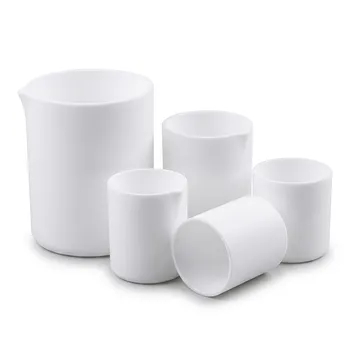
PTFE vessels, liners, beakers, and digestion components are useful when glass or metals could be attacked by the reagent or could introduce extractable ions. The fluorinated surface is broadly resistant to chemical attack across many laboratory processes.
This is particularly important for concentrated acids, strong bases, and organic solvents. The vessel can provide containment without becoming a significant participant in the reaction.
The material reduces contamination pathways
A chemically resistant vessel is less likely to dissolve, corrode, or release reaction products into a sample. Its low-adhesion surface also makes cleaning and rinsing more effective for many applications.
However, chemical inertness is not the same as absolute cleanliness. Trace contamination can still come from handling, machining residues, prior use, seals, external hardware, or chemicals retained in surface imperfections.
Thermal stability complements chemical stability
The same strong covalent structure that limits chemical attack also supports useful high-temperature performance. PTFE can remain stable across demanding laboratory temperature ranges, making it suitable for heated digestion, reagent handling, and reaction-vessel liners.
Its practical temperature limit is still finite. Above its recommended service range, creep, loss of mechanical strength, decomposition, or emission of hazardous degradation products can become concerns.
Why Perfluorination Matters
Replacing C-H bonds changes the surface chemistry
A perfluorinated polymer replaces the hydrogen atoms associated with the carbon framework with fluorine atoms. This creates a surface that is far less chemically accessible than the hydrocarbon surface of many conventional polymers.
The difference is important because exposed C-H-containing structures are generally more susceptible to oxidation, solvent interaction, and other forms of chemical modification than the highly fluorinated PTFE surface.
Molecular regularity improves protection
PTFE is a linear polymer with a relatively uniform fluorinated structure. Its fluorine atoms closely surround the carbon chain, leaving few ordinary reactive sites for chemical agents to exploit.
The polymer's helical chain conformation further contributes to the way fluorine is presented around the backbone. The important engineering result is a consistently protected surface rather than isolated areas of resistance.
PFA uses the same fundamental principle
PFA is also a perfluoropolymer and relies on the same strong C-F chemistry for broad chemical resistance. Its melt-processability can make it useful for seamless tubing, molded vessels, and complex fluid-handling components where PTFE's processing characteristics may be less convenient.
The exact mechanical, thermal, and permeability properties differ between PTFE, PFA, and other fluoropolymers. Material selection should therefore consider the complete service environment, not chemical resistance alone.
Understanding the Trade-offs
“Inert” does not mean resistant to every condition
PTFE is not universally immune to attack. Certain highly reactive fluorinating agents, molten or highly reactive alkali metals, and unusual high-energy chemical environments can damage fluoropolymers.
Elevated temperature can also change the outcome. A chemical that is compatible at room temperature may become more aggressive when heated or held under pressure.
Mechanical performance can limit the design
PTFE has relatively low stiffness compared with metals and many engineering plastics. Under sustained load, it can creep, deform, or lose sealing force, especially at elevated temperature.
For valves, fittings, and reaction vessels, engineers must evaluate pressure, temperature, wall thickness, support, cycling, and seal design alongside chemical compatibility.
Permeation can still occur
Resistance to dissolution does not mean that molecules cannot diffuse through the material. Some solvents and gases can permeate fluoropolymer walls over time, particularly under pressure, elevated temperature, or long exposure periods.
This matters for thin tubing, volatile chemicals, gas handling, and applications requiring strict containment or concentration control.
Surface purity requires process control
PTFE's low surface energy reduces adhesion, but it does not guarantee zero sample retention or zero contamination. Scratches, pores, machining marks, particles, and poorly cleaned components can still affect analytical results.
For demanding work, specify an appropriate virgin or high-purity grade, control fabrication and cleaning, and validate extractables and carryover using the actual chemicals and operating conditions.
Making the Right Choice for Your Goal
Choose the material and component design according to the full combination of chemical, thermal, mechanical, and analytical requirements.
- If your primary focus is broad chemical resistance: Use a properly qualified PTFE or PFA component because its fluorinated surface and strong C-F bonds resist most acids, bases, solvents, and laboratory reagents.
- If your primary focus is trace-level sample integrity: Select a high-purity grade and validate cleaning, extractables, leachables, and carryover rather than assuming chemical inertness alone guarantees contamination-free performance.
- If your primary focus is heated reaction processing: Verify the polymer's temperature rating, pressure conditions, and ventilation requirements because chemical stability does not remove the risks of thermal degradation or mechanical creep.
- If your primary focus is reliable fluid transfer: Evaluate permeability, dimensional stability, flexing, sealing force, and connection design in addition to the polymer's chemical compatibility.
The molecular design of perfluoropolymers gives laboratory components an unusually strong foundation of chemical resistance, but reliable performance comes from matching that chemistry to the actual operating environment.
Summary Table:
| Feature | Description |
|---|---|
| Carbon backbone | Protected by a dense fluorine sheath, limiting access to reactive sites. |
| C-F bond strength | Very strong (~485 kJ/mol), requiring high energy to break. |
| Fluorine properties | High electronegativity, low polarizability, and small size enhance stability. |
| Surface energy | Low, reducing adhesion and sample retention. |
| Additive purity | Typically no plasticizers, reducing contamination risk. |
| Thermal stability | Complements chemical resistance for high-temperature use. |
| Limitations | Not immune to all conditions; permeation and mechanical creep possible. |
Enhance your lab's chemical resistance and purity with KINTEK's high-performance PTFE and PFA components. From tubing and valves to custom reaction vessels, our precision-machined fluoropolymers are designed for demanding applications. Contact us today to discuss your requirements and experience the KINTEK advantage.
Related Products
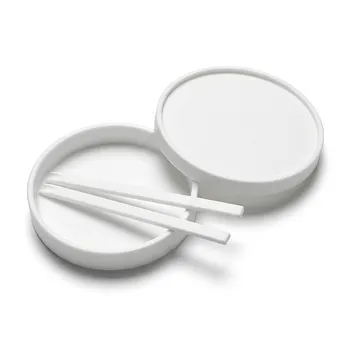
- Custom Polytetrafluoroethylene PTFE Petri Dishes 60mm Corrosion Resistant Low Background Labware
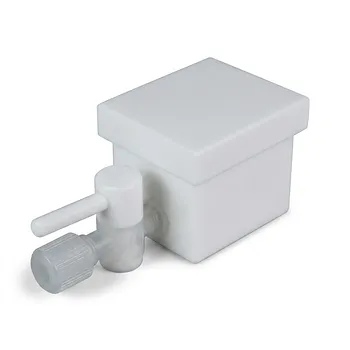
- Custom PTFE Laboratory Apparatus Corrosion Resistant Low Background Reaction Cells Precision CNC Fabrication
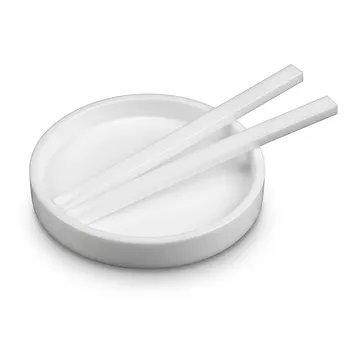
- Custom PTFE Petri Dishes Corrosion Resistant High Purity Low Background Labware
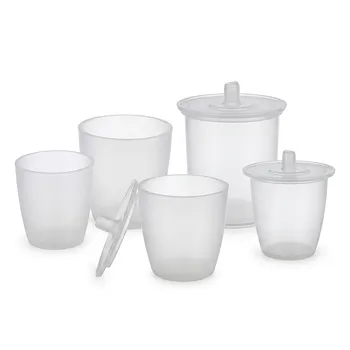
- High Purity PFA Crucible and Corrosion Resistant PTFE Beaker for Trace Analysis and Custom Laboratory Applications
- Custom PTFE Petri Dish 120mm Diameter Corrosion Resistant Low Background High Purity Labware
People Also Ask
- Why are PTFE or PFA Petri dishes preferred for membrane casting? Ensure Damage-Free Recovery & Chemical Purity
- What types of labware or tools are commonly made from PTFE? Essential Chemically-Resistant Equipment for Your Lab
- What are the considerations for choosing PTFE or glass for Bi2O3/CeO2 synthesis? Ensure Purity and Precision.
- What are the key properties of PTFE that make it suitable for labware applications? Ensure Lab Integrity with Superior Material
- What types of PTFE labware are commonly available? Find the Right Tools for Your Lab