Wet reactor bead comminution is a key purification and consistency-control step for PTFE labware. By cutting freshly polymerized PTFE beads in cold water, the process helps wash away residual initiators and surfactant fragments before they become embedded contaminants. This reduces the risk of discoloration and thermal degradation during sintering, while also improving control over powder behavior during molding.
Wet comminution supports PTFE purity by removing polymerization residues early, before high-temperature processing can convert them into color or contamination problems. Its control over powder bulk density and mold shrinkage also helps produce labware with more consistent appearance and dimensions.
How Wet Comminution Protects PTFE Purity
Removing Residual Polymerization Chemicals
Freshly polymerized PTFE beads can retain traces of chemical initiators and surfactant fragments within or around the polymer matrix. Wet comminution exposes the bead material to cold water while the particles are being reduced in size.
This washing step helps remove those residues before the PTFE proceeds to downstream powder processing and molding. For high-purity labware and trace-analysis instruments, reducing these chemical remnants is essential because even small residues can compromise cleanliness.
Reducing Contamination During Sintering
PTFE labware is typically shaped and then sintered at high temperature. Any residual chemical species that remain in the powder can react, decompose, or thermally degrade during this stage.
By reducing the residue load before sintering, wet comminution lowers the risk that unwanted by-products will remain in the finished material. The result is better suited to applications where chemical purity and low background contamination matter.
Supporting High-Purity Applications
Trace-analysis instruments and laboratory vessels may contact aggressive chemicals or samples present at very low concentrations. Contaminants from the PTFE manufacturing process can therefore be more significant than they would be in ordinary industrial applications.
Wet comminution contributes to a cleaner starting powder, helping manufacturers maintain the material purity expected from PTFE labware used in demanding analytical environments.
How It Maintains Color Consistency
Preventing Residue-Driven Discoloration
Residual initiators and surfactant fragments can discolor when exposed to sintering temperatures. This may produce yellowing, grayness, or other visual variation in the finished PTFE.
Removing these substances during cold-water comminution reduces one important source of discoloration. The process therefore helps preserve the characteristic clean, uniform appearance associated with high-quality PTFE.
Improving Batch-to-Batch Uniformity
Color consistency depends partly on whether each production batch contains similar levels of residual chemicals. A controlled wet comminution and washing step makes the removal of those residues more predictable.
That consistency helps reduce visible differences between molded components, which is valuable when labware must meet a uniform appearance specification or be used alongside other PTFE parts.
Avoiding Thermal Degradation Effects
Color change can indicate more than a cosmetic defect. It may signal that residual materials have degraded during sintering or that processing conditions have produced unwanted changes in the polymer.
Wet comminution reduces the material most likely to cause residue-related thermal effects. It does not replace control of sintering temperature, time, or atmosphere, but it improves the condition of the powder entering that process.
How Particle Processing Affects Manufacturing Consistency
Controlling Powder Bulk Density
Wet comminution in cold water provides more precise control over the resulting PTFE powder's bulk density. Bulk density affects how the powder fills molds and how much material occupies a given volume before compression and sintering.
More predictable powder behavior improves repeatability across production runs. This supports consistent wall thickness, shape, and mass in molded labware.
Managing Mold Shrinkage
PTFE undergoes dimensional changes during compression and sintering. The powder's particle characteristics and bulk density influence how consistently the material packs and shrinks in the mold.
By helping control those properties, wet comminution makes mold shrinkage more predictable. This is important for labware with close dimensional requirements, such as vessels, fittings, and components designed to interface with analytical instruments.
Connecting Process Control to Product Quality
Purity, color, and dimensional accuracy are related through the powder preparation stage. A cleaner and more consistently controlled powder is easier to process reproducibly at high temperature.
Wet comminution therefore has a broader role than simple particle-size reduction. It links early chemical cleanup with later control of molding and sintering behavior.
Understanding the Trade-offs
Wet Comminution Does Not Control Every Source of Color Variation
Cold-water comminution can reduce discoloration caused by polymerization residues, but it cannot eliminate all causes of color variation. Sintering conditions, equipment cleanliness, handling, and contamination introduced later in production also affect the final appearance.
Color consistency still requires an overall controlled manufacturing process.
Washing Effectiveness Depends on Process Control
The removal of initiator and surfactant residues depends on factors such as water contact, particle size, washing conditions, and separation efficiency. Wet comminution should therefore be treated as a controlled purification operation rather than an automatic guarantee of complete residue removal.
Manufacturers still need appropriate material and finished-product testing.
Dimensional Benefits Require Consistent Downstream Processing
Improved control of bulk density and mold shrinkage helps, but it does not eliminate dimensional variation. Compression pressure, mold design, sintering profiles, cooling, and post-processing must also remain consistent.
Wet comminution strengthens process control; it does not substitute for it.
How to Apply This to PTFE Labware
Wet reactor bead comminution is most valuable when the manufacturing objective requires both clean material and repeatable physical processing. Its benefits should be evaluated across purity testing, visual inspection, powder characterization, and dimensional quality control.
- If your primary focus is chemical purity: Use wet comminution to remove residual initiators and surfactant fragments before sintering, then verify the finished PTFE with appropriate contamination and purity testing.
- If your primary focus is color consistency: Control early residue removal through cold-water comminution and combine it with consistent sintering and contamination-control practices.
- If your primary focus is dimensional repeatability: Use the process to improve control of powder bulk density and mold shrinkage, while maintaining stable molding and sintering conditions.
- If your primary focus is trace-analysis performance: Treat wet comminution as an upstream cleanliness measure that helps limit residue-derived contamination in the final labware.
Wet reactor bead comminution helps turn PTFE polymerization into cleaner, more predictable material for high-purity and visually consistent laboratory products.
Summary Table:
| Aspect | Role of Wet Comminution |
|---|---|
| Purity | Removes initiators & surfactant fragments before sintering |
| Color | Prevents residue-driven discoloration; improves batch uniformity |
| Consistency | Controls bulk density & mold shrinkage for dimensional repeatability |
| Applications | Essential for trace-analysis and high-purity labware |
Elevate Your Labware Quality with KINTEK
At KINTEK, we specialize in high-performance fluoropolymers (PTFE and PFA) and offer a comprehensive range of labware designed for maximum purity and consistency. Our wet comminution process ensures superior cleanliness, while our precision CNC machining delivers custom components tailored to your exact specifications.
Why choose KINTEK?
- Ultra-high purity for trace analysis and demanding applications
- Consistent color and dimensional accuracy batch after batch
- Custom solutions from complex parts to high-volume orders
Ready to enhance your lab's performance? Contact us today to discuss your needs and discover how KINTEK can support your success!
Related Products
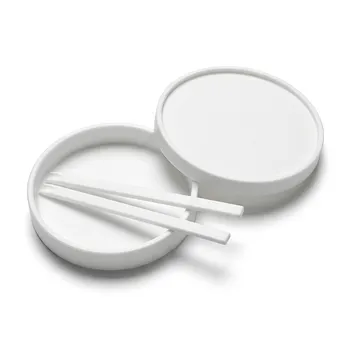
- Custom Polytetrafluoroethylene PTFE Petri Dishes 60mm Corrosion Resistant Low Background Labware
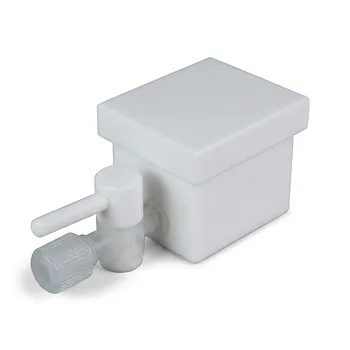
- Custom PTFE Laboratory Apparatus Corrosion Resistant Low Background Reaction Cells Precision CNC Fabrication
- Custom PTFE Petri Dishes Corrosion Resistant High Purity Low Background Labware
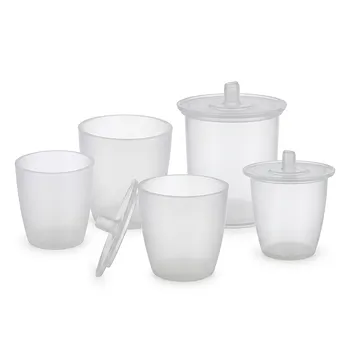
- High Purity PFA Crucible and Corrosion Resistant PTFE Beaker for Trace Analysis and Custom Laboratory Applications
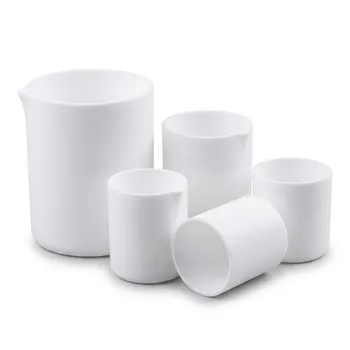
- Large Scale PTFE Beakers and Flasks for High Temperature Corrosion Resistant Laboratory Applications with Custom CNC Fabrication
People Also Ask
- Why are PTFE or PFA Petri dishes preferred for membrane casting? Ensure Damage-Free Recovery & Chemical Purity
- What types of labware or tools are commonly made from PTFE? Essential Chemically-Resistant Equipment for Your Lab
- What are the considerations for choosing PTFE or glass for Bi2O3/CeO2 synthesis? Ensure Purity and Precision.
- What are the key properties of PTFE that make it suitable for labware applications? Ensure Lab Integrity with Superior Material
- What types of PTFE labware are commonly available? Find the Right Tools for Your Lab