Lower SSG generally indicates higher-molecular-weight PTFE resin, which usually produces stronger and more durable laboratory products. Because PTFE cannot be dissolved or conventionally melt-processed for direct molecular-weight testing, SSG is used as an indirect resin-quality indicator. When processing is properly controlled, a lower SSG supports greater tensile strength, flex life, stress-crack resistance, and resistance to creep and stress relaxation.
SSG is a material-selection tool, not a complete performance specification. Lower-SSG, higher-molecular-weight PTFE generally offers better mechanical durability under heat, load, and chemical exposure, but final performance also depends on processing, geometry, temperature, loading, and product design.
Why SSG Is Used for PTFE Resin
PTFE molecular weight is difficult to measure directly
PTFE does not dissolve in conventional solvents and has extremely high melt viscosity. These characteristics make ordinary solution-based molecular-weight measurements and standard melt-processing evaluations impractical.
SSG is therefore measured on a specially molded and sintered PTFE specimen under controlled conditions. The result provides an indirect indication of the resin’s average molecular weight and structure.
Lower SSG generally means higher molecular weight
For comparable PTFE resin grades and standardized test conditions, SSG varies inversely with molecular weight:
- Lower SSG: generally higher average molecular weight
- Higher SSG: generally lower average molecular weight
This relationship is useful because longer PTFE polymer chains tend to improve the material’s ability to carry load and resist damage.
SSG is not simply the density of a finished component
SSG is a standardized property of a molded and sintered test specimen. It should not be treated as an exact prediction of the density or performance of a finished vessel, seal, tube, or fitting.
The final product is also affected by compaction, sintering, cooling, machining, porosity, crystallinity, wall thickness, and design stress.
How Lower SSG Supports Mechanical Performance
Tensile strength and toughness
Higher-molecular-weight PTFE generally provides improved tensile strength and toughness. Longer polymer chains can better transfer stress through the material before failure.
This is important for laboratory products exposed to clamping, pressure differences, repeated assembly, handling, or thermal expansion.
Flex life and resistance to cracking
Lower-SSG resin is typically associated with better flex life and stress-crack resistance. These properties matter in tubing, seals, valve components, and thin-walled parts that experience repeated bending or localized stress.
A product may be chemically compatible yet still fail mechanically if its material is prone to cracking around threads, corners, holes, or sealing surfaces.
Stress relaxation
PTFE is viscoelastic, meaning it gradually deforms and loses contact stress while under constant load. Higher-molecular-weight resin generally exhibits longer stress relaxation times, helping seals and compression components maintain their function for longer periods.
This is especially relevant to gaskets, valve seats, and closures that must remain sealed during extended exposure.
Thermal creep under load
PTFE can slowly deform under sustained load, particularly at elevated temperatures. This behavior is commonly called creep or cold flow.
Higher-molecular-weight PTFE generally offers improved resistance to thermal creep, helping components retain their shape and dimensions during heated chemical processing or prolonged service.
What This Means for Fluoropolymer Laboratory Products
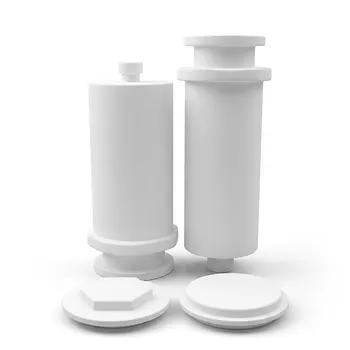
Reaction vessels and digestion vessels
Reaction and digestion vessels may experience aggressive chemicals, elevated temperatures, pressure changes, and mechanical handling. Lower-SSG PTFE can provide a stronger material foundation for maintaining wall integrity and resisting deformation.
However, resin selection must be combined with appropriate wall thickness, closure design, temperature limits, and pressure controls. SSG alone cannot make an unsuitable vessel design safe.
Seals, gaskets, and valve components
Seals must preserve elasticity, contact pressure, and dimensional accuracy over repeated use. Higher-molecular-weight PTFE can help resist permanent deformation, stress relaxation, and crack initiation.
The practical benefit is more consistent sealing and potentially longer service life, particularly where components are compressed for long periods or exposed to heat.
Tubing and fluidic fittings
Tubing and fittings may experience bending, tightening forces, vibration, thermal cycling, and internal or external chemical exposure. A suitably selected lower-SSG resin can improve resistance to flex damage and dimensional change.
This supports reliable connections and reduces the risk of leakage or mechanical failure in high-purity fluid-transfer systems.
Chemical containment and trace-analysis components
PTFE’s chemical resistance is already a major reason for its use in laboratory equipment. The molecular-weight indication provided by SSG adds a mechanical-quality screen, helping manufacturers select resin capable of maintaining structural integrity under severe service conditions.
That distinction matters in trace-analysis equipment: chemical compatibility does not eliminate the need for mechanical durability, low permeability, and dimensional stability.
The Link Between Durability and Molecular Structure
Longer chains improve resistance to deformation
A higher-molecular-weight PTFE resin contains longer polymer chains that are more effective at resisting chain movement under stress. This helps explain its improved performance in tensile loading, flexing, stress relaxation, and creep.
The relationship is not absolute, but it is sufficiently useful for comparing suitable PTFE resin grades under controlled conditions.
Crystallinity and processing also influence results
SSG is affected by the specimen’s molded and sintered structure, including the balance of crystalline and amorphous regions and the presence of voids. Sintering and cooling conditions can therefore influence the measured result and the final product’s properties.
Manufacturers should control both resin selection and processing history rather than assuming that a favorable SSG automatically guarantees maximum performance.
Understanding the Trade-offs
Lower SSG does not solve every design problem
A lower SSG generally supports better mechanical performance, but it does not compensate for excessive temperature, pressure, poor geometry, inadequate support, or incorrect assembly.
For example, a sharp internal corner can concentrate stress even when the underlying PTFE resin is high quality.
Material selection involves more than molecular weight
Other factors may be equally important depending on the application, including:
- Operating temperature and thermal cycling
- Sustained mechanical load
- Chemical exposure and permeation requirements
- Wall thickness and component geometry
- Surface finish and machining quality
- Porosity and sintering consistency
- Need for filled versus unfilled PTFE
- Regulatory and contamination-control requirements
SSG should therefore be considered alongside tensile, elongation, creep, permeation, dimensional, and chemical-resistance requirements.
Higher density is not automatically better
Because SSG is a specific-gravity measurement, it can be tempting to interpret a higher value as a universally superior or denser product. That is misleading in this context.
For comparable PTFE resins, the important selection relationship is that lower SSG generally indicates higher molecular weight. The performance objective is not simply to maximize density, but to obtain the molecular structure and processed morphology appropriate for the application.
Test-method consistency is essential
SSG values are meaningful only when measured using comparable standardized procedures and suitable resin classifications. Mold preparation, sintering schedule, cooling conditions, and the applicable test standard can affect the result.
A credible material specification should identify the test method and acceptance range rather than relying on an unexplained SSG number.
Making the Right Choice for Your Goal
Use SSG as an initial resin-screening criterion, then confirm it against the actual operating and design requirements.
- If your primary focus is mechanical strength: Prefer an appropriately low-SSG, higher-molecular-weight PTFE grade and verify tensile and elongation performance on the processed material.
- If your primary focus is long-term sealing: Evaluate lower-SSG resin together with stress relaxation, compression behavior, temperature, and sustained-load requirements.
- If your primary focus is dimensional stability at elevated temperature: Favor a resin with suitable molecular weight and validate creep performance under the actual load and temperature.
- If your primary focus is chemical containment or trace analysis: Use SSG to support structural and permeability requirements, but also verify purity, porosity, processing consistency, and chemical compatibility.
- If your primary focus is tubing or repeated flexing: Consider lower-SSG resin for improved flex life, while checking wall design, bend radius, and repeated-cycle performance.
Selecting PTFE by SSG helps connect resin molecular structure to real-world durability, but reliable laboratory products result from combining the right resin with disciplined processing and application-specific design.
Summary Table:
| SSG Level | Molecular Weight | Typical Mechanical Properties | Impact on Labware Durability |
|---|---|---|---|
| Lower | Higher | Higher tensile strength, better flex life, improved stress-crack resistance, lower creep | Longer lasting, more durable components under stress, heat, and chemical exposure |
| Higher | Lower | Reduced tensile strength, lower flex life, higher creep susceptibility | Could deform, crack, or fail under demanding conditions |
Need durable labware that withstands demanding conditions? At KINTEK, we use high-quality PTFE and PFA resins to manufacture labware that lasts. Contact us today to discuss your specific application and find the right fluoropolymer solution for your lab. Get in touch with our experts to ensure your labware delivers the mechanical strength and chemical resistance you need.
Related Products
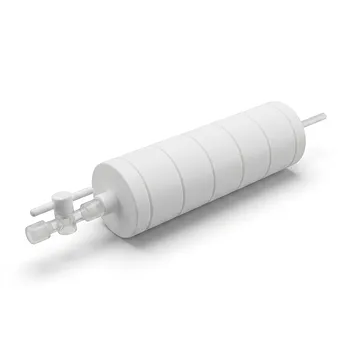
- Custom PTFE Filtration System Acid Resistant High Purity Semiconductor Grade Chemical Processing Filter
- PTFE Corrosion Resistant Filter with PFA Valve Connections and Integrated Sieve Plate
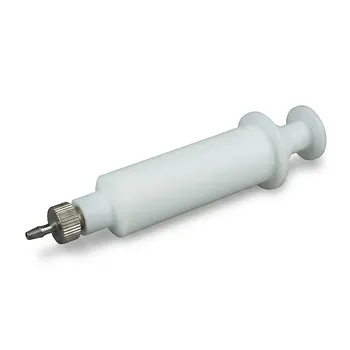
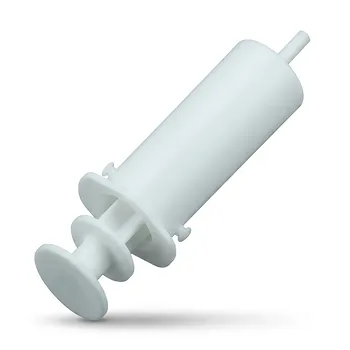
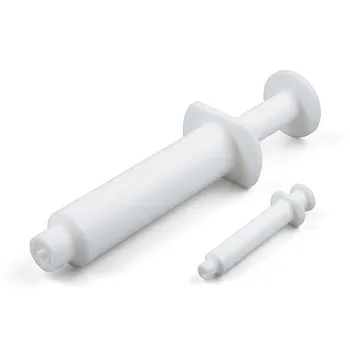
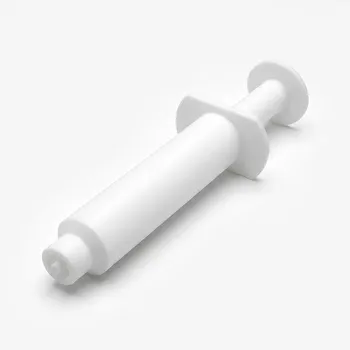
- High Temperature Chemical Resistant 50ml PTFE Syringe Customized Teflon Injector with Threaded Seal for Trace Analysis
- Custom PTFE Insulating Gaskets and Corrosion Resistant Fluoropolymer Seals for Industrial Electrical Applications
- Custom PTFE Teflon Balls for Advanced Industrial Applications
People Also Ask
- What makes PTFE filtration systems advantageous for industrial and scientific use? Unmatched Chemical & Thermal Stability
- What steps are involved in selecting the proper PTFE filter? A 4-Step Guide to Optimal Filtration
- What sizes and pore options are available for PTFE filters? Choose the Right Filter for Your Application
- How does the hydrophobicity of PTFE filters benefit their use? Ensure Uninterrupted Gas Flow and Solvent Filtration
- What temperature resistance do PTFE filters offer? Unmatched Thermal Stability from -200°C to +260°C