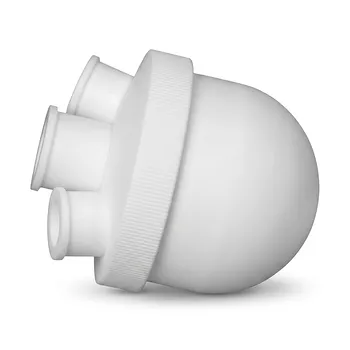
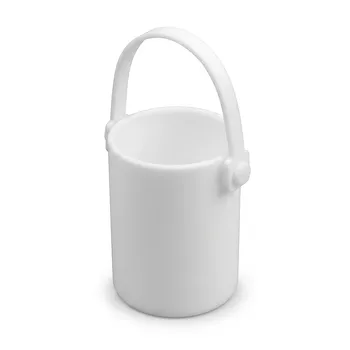
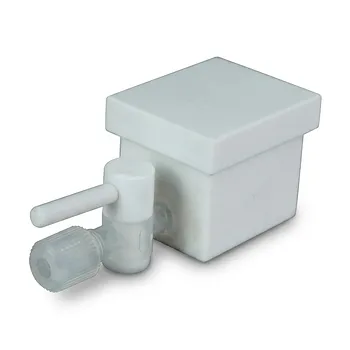
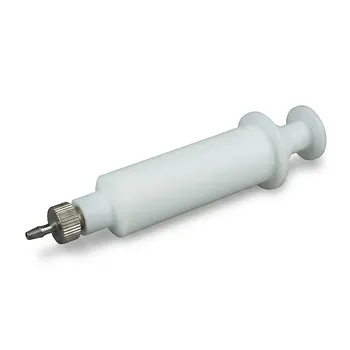
Modified PTFE is conventional PTFE refined at the molecular level. Small amounts of a comonomer—commonly PPVE—are introduced during polymerization to disrupt PTFE’s highly crystalline structure. The result retains PTFE’s chemical inertness, thermal stability, non-stick behavior, and low friction while providing lower creep, reduced micro-porosity, better permeation resistance, and improved dimensional stability.
Modified PTFE is generally the better choice when a machined laboratory seal or valve component must maintain tight tolerances under pressure, repeated cycling, or prolonged chemical exposure. Conventional granular PTFE remains highly capable, but modified grades reduce the deformation and permeability limitations that can compromise long-term sealing.
How Modified PTFE Differs from Conventional Granular PTFE
The polymer structure is less perfectly crystalline
Conventional PTFE consists of extremely high-molecular-weight chains with a highly crystalline structure. This gives it exceptional chemical and thermal resistance, but also contributes to high melt viscosity, difficult particle coalescence during sintering, and residual microvoids.
Modified PTFE incorporates a small concentration of a comonomer, often perfluoropropyl vinyl ether (PPVE). These molecular interruptions suppress crystallization and allow the material to consolidate more effectively during processing.
Conventional granular PTFE is more susceptible to cold flow
Under continuous compressive or tensile stress, conventional PTFE can slowly deform. This behavior, known as creep or cold flow, may reduce contact pressure in a gasket, alter a valve-seat geometry, or cause a seal to lose its designed interference fit.
Modified PTFE has improved resistance to this deformation. It is not creep-free, but it maintains its dimensions and sealing load more effectively over time.
Modified PTFE contains fewer effective pathways for permeation
The improved consolidation of modified PTFE reduces the density of microvoids and other microscopic pathways through the material. This produces a smoother, less porous structure with better resistance to liquid, vapor, and gas permeation.
That distinction matters in laboratory systems where even small amounts of chemical migration, vapor release, or fluid entrapment can affect safety, purity, or measurement accuracy.
Why This Matters for Custom-Machined Laboratory Parts
More stable dimensions under pressure
CNC-machined components are manufactured to specific dimensions, clearances, and surface geometries. If a PTFE valve seat or gasket creeps after installation, the original machining accuracy no longer guarantees the original seal.
Modified PTFE better preserves its shape under sustained compression. This supports more consistent valve operation, contact pressure, and sealing performance.
Tighter sealing integrity
A seal depends on more than chemical compatibility. It must also maintain sufficient contact pressure and conform reliably to mating surfaces.
The combination of lower creep, reduced porosity, and improved dimensional stability helps modified PTFE reduce micro-leakage and gradual loss of sealing force, particularly in high-purity fluid-handling assemblies.
Reduced fluid entrapment and cross-contamination
Microvoids and surface irregularities can retain small amounts of process fluid. This is especially undesirable in analytical equipment, trace-fluid systems, and reusable laboratory hardware.
Modified PTFE’s lower micro-porosity and smoother surface can reduce fluid entrapment, making it a stronger choice where cleaning validation and sample integrity are important.
Better performance in flexible components
Modified grades can provide improved stress-crack resistance and flex durability compared with standard homopolymer PTFE. This benefits components that repeatedly flex or cycle, such as pump diaphragms, valve diaphragms, dynamic seals, and flexible connectors.
The advantage is not simply greater strength. It is improved resistance to damage and permanent deformation during repeated pressure, motion, and thermal cycles.
Advantages in Fluid Valves and Sealing Components
Valve seats maintain geometry longer
A valve seat must remain dimensionally stable while exposed to compression, pressure changes, and chemical contact. Excessive PTFE creep can produce seat distortion, inconsistent shutoff, or increased leakage.
Modified PTFE’s lower cold flow helps the seat retain its sealing profile and operating characteristics for longer periods.
Diaphragms tolerate repeated cycling
Diaphragms experience cyclic flexing rather than only static compression. Improved elongation, flex durability, and stress-crack resistance can extend service life in pumps and actuated fluid valves.
This is valuable where a diaphragm must repeatedly isolate fluid from the drive mechanism without developing fatigue-related leakage.
Gaskets retain compressive performance
A conventional PTFE gasket may gradually relax under load, particularly at elevated temperature or in a high-pressure assembly. Modified PTFE reduces this tendency, helping the gasket maintain contact with the mating surfaces.
Correct design and installation remain essential, but the material provides a more stable foundation for long-term sealing.
Fluid barriers become more effective
Modified PTFE provides a substantially stronger barrier against liquid, vapor, and gas permeation than unmodified PTFE. This can reduce chemical migration, vapor emissions, and contamination of ultrapure fluids.
The improvement is especially relevant to aggressive solvents, high-purity reagents, and systems where external gas or vapor ingress must be minimized.
Preserved PTFE Properties
Chemical inertness remains central
The addition of a small modifier does not remove PTFE’s defining chemical-resistance advantage. Modified PTFE remains suitable for demanding contact with many aggressive laboratory chemicals, subject to the specific chemical, temperature, pressure, and exposure conditions.
Material compatibility should still be checked for the actual service environment rather than assumed from the polymer name alone.
Thermal stability is retained
Modified PTFE continues to provide the high thermal stability expected from fluoropolymer components. This supports use in laboratory equipment exposed to elevated temperatures and thermal cycling.
The exact operating limit depends on the grade, design, loading, and exposure duration.
Low friction and non-stick behavior remain available
Modified PTFE retains PTFE’s low coefficient of friction and non-stick surface characteristics. These properties support smooth valve movement, reduced adhesion of residues, and easier cleaning.
The modification primarily addresses structural and barrier limitations; it does not turn PTFE into a fundamentally different class of material.
Understanding the Trade-offs
Modified PTFE does not eliminate design requirements
Lower creep does not mean that a component can be undersized or exposed beyond its pressure and temperature limits. Seal geometry, compression, support, tolerances, surface finish, and installation remain decisive.
A material upgrade cannot compensate for poor gland design, inadequate mechanical support, or excessive unsupported PTFE.
Machining still requires process control
Modified PTFE is machinable, but its thermal expansion, elasticity, and tendency to deform during machining still require appropriate tooling and technique. Tight-tolerance parts should be manufactured with controlled cutting conditions and dimensional inspection.
The final result depends on both the resin grade and the machining process.
Cost and availability may be higher
Modified PTFE grades can cost more than conventional granular PTFE and may not be available in every form, color, or specification. For simple, low-stress, non-critical seals, the additional performance may not justify the premium.
Selection should be based on the consequences of creep, leakage, permeation, or contamination—not on material sophistication alone.
“Modified PTFE” is not one universal specification
Different manufacturers use different comonomers, modifier concentrations, processing methods, and grade designations. Properties such as creep resistance, elongation, permeability, and shrinkage can therefore vary between products.
For critical laboratory components, request the supplier’s grade-specific data and confirm that it supports the intended chemical, pressure, temperature, and purity requirements.
Making the Right Choice for Your Goal
Modified PTFE is most valuable when the component’s long-term mechanical or barrier performance matters as much as its chemical resistance.
- If your primary focus is dimensional stability: Choose modified PTFE for valve seats, gaskets, and seals exposed to sustained compression or pressure.
- If your primary focus is fluid purity: Choose modified PTFE to reduce micro-porosity, fluid entrapment, chemical migration, and cross-contamination.
- If your primary focus is permeation control: Specify a modified grade with documented liquid, vapor, or gas barrier performance for the actual service fluid.
- If your primary focus is repeated flexing: Consider modified PTFE for diaphragms and dynamic seals that experience pressure cycling or mechanical movement.
- If your primary focus is basic chemical resistance at low mechanical stress: Conventional granular PTFE may be sufficient and more economical.
- If your primary focus is tight-tolerance CNC machining: Select a grade with documented creep, shrinkage, and machining characteristics rather than relying only on the generic PTFE designation.
For custom laboratory sealing parts and fluid valves, modified PTFE provides a more stable, lower-permeability version of PTFE that better preserves sealing performance over time.
Summary Table:
| Property | Conventional Granular PTFE | Modified PTFE |
|---|---|---|
| Crystalline structure | Highly crystalline | Less crystalline due to comonomer (e.g., PPVE) |
| Creep resistance | Lower; prone to cold flow | Higher; more dimensionally stable |
| Micro-porosity | Higher; more microvoids | Lower; improved consolidation |
| Permeation resistance | Lower; more pathways for chemicals | Higher; smoother, less porous barrier |
| Dimensional stability | Less stable under pressure | Better retention of shape and tolerances |
| Flex fatigue resistance | Lower; less durable under cyclic stress | Higher; improved stress-crack resistance |
| Chemical & thermal resistance | Excellent | Excellent (retained) |
| Typical applications | Low-stress, basic seals | High-pressure, dynamic, high-purity lab components |
Upgrade your lab components with modified PTFE. At KINTEK, we specialize in custom-machined PTFE and PFA parts—from valve seats and diaphragms to complex fluid systems. Our modified PTFE solutions reduce creep, porosity, and permeation, ensuring longer-lasting, high-purity performance. Contact us today to discuss your specific requirements and discover how we can enhance the reliability of your lab equipment.
Related Products
- Customizable PTFE Heat Insulation Plate High Temperature Corrosion Resistant Laboratory Support Layered Multi Tier Stand
- PTFE Anti Scald Heat Insulation Sleeve Hot Plate Support Feet Laboratory Benchtop Protection Customizable Thermal Barrier
- Custom Machined PTFE Conical Sample Cell Corrosion Resistant Triangular Fluoropolymer Container for Trace Analysis
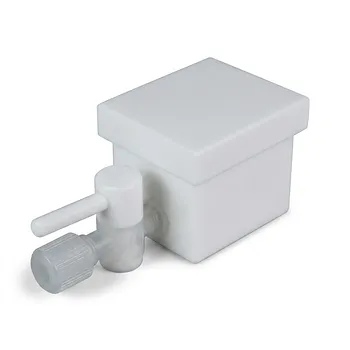
- Custom Polytetrafluoroethylene PTFE Constant Pressure Dropping Funnel Corrosion Resistant Fluid Control Assembly with Conversion Stopper Compatibility
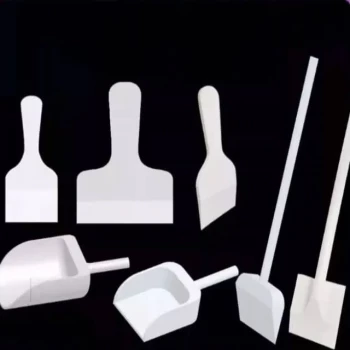
- Customizable PTFE Scrapers and Shovels for Demanding Applications
People Also Ask
- What customization options are available for PTFE materials? Tailor Performance for Your Application
- What are the limitations of pure PTFE in high temperature applications? Understanding the 200°C Ceiling
- How does PTFE behave in terms of chemical inertness? Unmatched Resistance for Demanding Applications
- Why is PTFE considered an ideal substitute for other plastics in high-temperature applications? Superior Thermal Stability & Performance
- What are common uses of PTFE in laboratory and industrial settings? Unlock Chemical and Thermal Resistance