PTFE’s unusual melt behavior is the reason specialized laboratory components are usually sintered and machined rather than injection molded. Near its melting transition, generally reported around 327–340°C depending on grade and measurement method, PTFE becomes a stiff, extremely high-viscosity gel rather than a freely flowing liquid. As a result, manufacturers typically compact PTFE powder, sinter it into a solid billet or near-net shape, and then use precision CNC machining to produce reaction vessels, fluid fittings, electrochemical cells, and other custom components.
PTFE does not process like a conventional thermoplastic. Its exceptionally high melt viscosity prevents standard injection molding, so dimensional accuracy and complex geometries are achieved through controlled powder processing, sintering, and machining rather than ordinary melt flow.
Why PTFE Melt Characteristics Change the Manufacturing Process
PTFE forms a gel instead of a flowable melt
Conventional thermoplastics become sufficiently fluid above their melting point to fill a mold under pressure. PTFE instead retains an interconnected, highly viscous structure, with melt viscosity reported in the approximate range of 10^10 to 10^12 Pa·s.
This behavior is associated with PTFE’s exceptionally high molecular weight. Heating changes the material’s state, but does not provide the fluidity required for ordinary injection molding or conventional melt extrusion.
Standard injection molding is generally unsuitable
Injection molding depends on rapid, predictable melt flow through gates, runners, and thin sections. PTFE’s resistance to flow makes it impractical to fill complex molds using that process.
Manufacturers therefore use non-melt or limited-flow techniques, including cold powder compaction, compression molding, sintering, and ram extrusion. These processes create solid stock, tubing, or rough component forms that can be finished to specification.
Sintering converts compacted powder into usable stock
During sintering, compacted PTFE particles are heated sufficiently to consolidate the structure without treating the material like a low-viscosity liquid. Process control is important because incomplete consolidation can leave microscopic voids within the part.
For laboratory vessels and high-purity fluid-handling components, minimizing void volume helps reduce chemical permeation, sample entrapment, and susceptibility to stress cracking. It also improves the reliability of parts exposed to pressure, aggressive reagents, or repeated thermal cycling.
How Melt Behavior Affects Custom Machining
Machining becomes the primary route to complex geometry
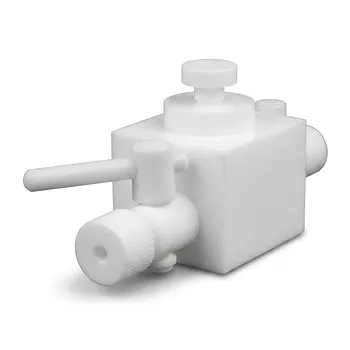
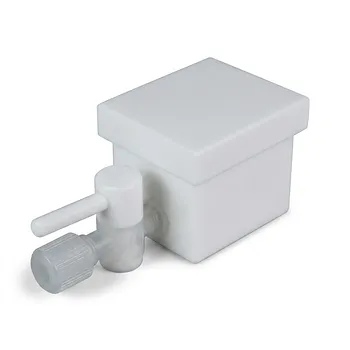
After sintering, PTFE can be supplied as blocks, rods, plates, or tubes and then shaped using turning, milling, drilling, boring, and other precision operations. CNC machining is especially valuable when a laboratory component has non-standard ports, internal channels, sealing surfaces, or unusual vessel geometry.
This approach supports one-off and low-volume production without requiring an expensive injection mold. It is well suited to custom reaction vessels, electrochemical cells, trace-analysis containers, and specialized fittings.
Dimensional control requires compensation for PTFE movement
PTFE is relatively soft and can deform under cutting forces or clamping pressure. Its thermal expansion and dimensional response also require attention, particularly when tight tolerances or mating seals are involved.
Machinists commonly work from slightly oversized stock and remove material gradually. Inspection after the part has stabilized is important because dimensions measured immediately after machining may change as residual stresses and temperature effects relax.
Heat management is essential during cutting
Although PTFE tolerates high service temperatures, localized machining heat can soften the material and cause smearing, distortion, or loss of dimensional accuracy. Excessive heat can also damage fine features and produce an inconsistent surface.
Controlled cutting conditions, sharp tooling, suitable feeds and speeds, intermittent cutting where appropriate, and adequate cooling or chip evacuation help limit thermal buildup. The objective is to remove material cleanly while keeping the workpiece below the point where it loses machining stability.
Surface quality affects laboratory performance
A properly machined PTFE surface provides low friction, non-adhesive behavior, and strong resistance to chemical attack. These properties are valuable in fluid paths, seals, vessel interiors, and components that must release samples easily.
However, machining marks, burrs, or poorly finished transitions can create locations for contamination or retained material. Internal corners, threaded features, sealing faces, and fluid-contact surfaces therefore require particular attention during design and inspection.
Why This Matters for Laboratory Components
Chemical resistance is preserved through the fabrication route
PTFE is used in aggressive chemical environments because it offers broad chemical resistance, high thermal stability, low friction, and strong antiadhesive properties. Powder compaction and sintering allow these material characteristics to be retained while producing solid, chemically durable components.
The manufacturing route must still be controlled carefully. Voids, contamination, incomplete consolidation, or damaged surfaces can undermine the performance expected from the base polymer.
Custom machining supports application-specific designs
Laboratory equipment often requires geometries that are not available as standard catalog items. A custom-machined PTFE component can incorporate specialized port arrangements, narrow fluid passages, electrode interfaces, pressure features, or vessel dimensions tailored to a particular analytical method.
This flexibility is particularly useful when chemical purity and material compatibility matter more than high-volume production efficiency.
Thermal performance does not eliminate processing limits
PTFE has a continuous-use temperature commonly cited around 260°C, while its melting transition occurs substantially higher. That difference provides a useful operating margin, but it does not make PTFE immune to machining-related deformation.
The material can still soften locally during fabrication, and sintering conditions must be selected to consolidate the part without compromising its structure or dimensional requirements.
Understanding the Trade-offs
The process is slower and more expensive than conventional molding
Compression molding, sintering, and CNC machining require more individual processing steps than injection molding. For large production runs, the cycle time, material waste, machining labor, and inspection requirements can make PTFE components more expensive.
The trade-off is justified when the design requires PTFE’s chemical resistance, purity, low friction, or custom geometry. For very high volumes, another fluoropolymer may provide a more economical manufacturing route.
Complex shapes are possible, but not without design constraints
Machining can produce intricate features, but deep narrow cavities, unsupported thin walls, sharp internal corners, and difficult-to-access passages increase cost and manufacturing risk. PTFE’s softness also limits how aggressively delicate features can be handled.
Designs should therefore account for tool access, minimum wall thickness, clamping, sealing strategy, and the material’s tendency to deform under load or heat.
PFA may be better when molding efficiency is the priority
PFA has a lower melt-viscosity range, reported approximately as 4×10^3 to 3×10^4 Pa·s, and can be processed using conventional methods such as injection molding as well as precision machining. PTFE’s melt viscosity is many orders of magnitude higher, which explains the difference in manufacturing options.
Both materials can provide high chemical resistance and comparable upper continuous-use temperatures, commonly around 260°C. The choice therefore depends on the balance between geometry, production volume, purity requirements, mechanical behavior, and the need for efficient molding.
“PTFE does not melt” is an oversimplification
PTFE does undergo a melting transition, but it does not become a freely flowing liquid in the way standard thermoplastics do. Describing it as a non-melt-processable fluoropolymer is more accurate than saying it never melts.
This distinction matters because PTFE can still be shaped through controlled powder-based and sintering processes. The limitation is not the absence of a thermal transition; it is the lack of practical melt flow.
How to Apply This to Your Project
The best fabrication route depends on the part’s geometry, quantity, tolerance, chemical exposure, and required purity.
- If your primary focus is chemical resistance and high-purity fluid contact: Use sintered PTFE with carefully controlled consolidation and precision finishing to minimize voids, contamination, and sample retention.
- If your primary focus is complex custom geometry: Design around CNC machining access, staged material removal, thermal control, and post-machining dimensional inspection.
- If your primary focus is tight dimensional tolerances: Specify stabilized machining conditions, suitable tolerances for PTFE’s thermal expansion and deformation, and inspection after the component reaches temperature equilibrium.
- If your primary focus is high-volume production: Compare PTFE with a more melt-processable fluoropolymer such as PFA, especially when injection molding can reduce production cost without violating performance requirements.
- If your primary focus is pressure or structural reliability: Give sintering quality and micro-void control the same importance as nominal material selection, because internal defects can promote permeation and stress cracking.
PTFE’s difficult melt behavior limits conventional molding, but it also drives a fabrication method capable of producing chemically durable, low-friction, and highly specialized laboratory components.
Summary Table:
| Aspect | Impact on Manufacturing |
|---|---|
| Melt Behavior | Extremely high viscosity (10^10–10^12 Pa·s) prevents injection molding; forms a gel-like state, not a free-flowing liquid. |
| Primary Process | Powder compaction, sintering, and machining are used instead of conventional melt processing. |
| Machining Role | CNC machining is essential for complex geometries, custom designs, and tight tolerances. |
| Challenges | Dimensional control, heat management, and surface quality require careful technique. |
| Material Choice | PFA offers moldability for high-volume parts; PTFE is chosen for its chemical resistance and low friction in custom applications. |
Looking for custom PTFE lab components? At KINTEK, we specialize in high-performance fluoropolymers, offering end-to-end CNC machining and sintering services. Whether you need standard labware, electrochemical cells, or custom machined parts, our expertise ensures precision, purity, and reliability. Contact us today to discuss your project and get a tailored solution. Get in touch now.
Related Products
- Custom PTFE Filtration System Acid Resistant High Purity Semiconductor Grade Chemical Processing Filter
- High Corrosion Resistant PTFE Faucet Polytetrafluoroethylene Valve for Chemical Storage Drums and Fluid Transfer Systems Customizable Industrial Grade
- PTFE PFA Vacuum Filtration System Corrosion Resistant Customizable Shatterproof Laboratory Device
- PTFE Corrosion Resistant Filter with PFA Valve Connections and Integrated Sieve Plate
- High Temperature Chemical Resistant 50ml PTFE Syringe Customized Teflon Injector with Threaded Seal for Trace Analysis
People Also Ask
- What makes PTFE filtration systems advantageous for industrial and scientific use? Unmatched Chemical & Thermal Stability
- What sizes and pore options are available for PTFE filters? Choose the Right Filter for Your Application
- What steps are involved in selecting the proper PTFE filter? A 4-Step Guide to Optimal Filtration
- How does the hydrophobicity of PTFE filters benefit their use? Ensure Uninterrupted Gas Flow and Solvent Filtration
- What temperature resistance do PTFE filters offer? Unmatched Thermal Stability from -200°C to +260°C