PVDF generally provides higher mechanical strength, flexural modulus, hardness, and creep resistance than PTFE or PFA, while remaining substantially lighter. Its density is approximately 1.78 g/cm³, compared with roughly 2.14–2.20 g/cm³ for PTFE and 2.12–2.17 g/cm³ for PFA. PTFE and PFA retain the advantage in broad chemical inertness and high-temperature capability, so the best choice depends on whether the component must primarily carry load or withstand the most aggressive chemical environment.
PVDF is the stronger and more rigid material for weight-sensitive, load-bearing fluid-handling and laboratory components. PTFE and PFA are heavier and mechanically softer, but they provide a wider chemical safety margin and higher temperature capability.
Why PVDF Is Mechanically Stronger
Interchain Forces Increase Rigidity
PVDF contains alternating -CF₂- and -CH₂- groups. The resulting dipolar interactions between polymer chains strengthen the material compared with fully fluorinated polymers whose backbones are dominated by carbon-fluorine shielding.
PVDF is also typically 40–60% crystalline. This semicrystalline structure contributes to its tensile strength, hardness, flexural rigidity, and resistance to deformation.
PTFE and PFA Are Mechanically Softer
PTFE and PFA are fully fluorinated perfluoropolymers. Their fluorine-rich structures provide exceptional chemical protection, but they also produce relatively low mechanical hardness and modulus compared with PVDF.
PTFE is particularly known for creep and cold flow under sustained load. PFA generally offers better processability and dimensional performance than PTFE, but it remains less mechanically rigid than PVDF in comparable component designs.
Strength Matters Under Pressure and Load
For fittings, valve bodies, rigid piping parts, supports, and structural laboratory housings, PVDF is more likely to preserve its shape under pressure or sustained mechanical loading.
Its higher strength and resistance to cyclic deformation can also improve performance in components exposed to vibration, repeated actuation, abrasion, or pressure cycling.
How Flexural Modulus Compares
PVDF Provides Greater Bending Resistance
Flexural modulus describes how strongly a material resists bending. A higher value generally means that a fitting, tube, housing, or support will deflect less under the same load.
PVDF typically has a higher flexural modulus than PTFE or PFA, giving it a more rigid feel and better dimensional stability in structural laboratory components.
PTFE Requires More Structural Support
PTFE's relatively low modulus makes it useful where compliance, low friction, and sealing behavior are valuable. However, a PTFE component may bend, deform, or cold-flow more readily when it is used as a thin wall, unsupported span, threaded fitting, or pressure-bearing part.
PFA offers improved fabrication characteristics and can be a good choice for transparent or high-purity components, but it does not generally match PVDF's rigidity for load-bearing designs.
Grade and Temperature Affect the Result
The exact modulus depends on grade, crystallinity, processing history, temperature, wall thickness, and reinforcement. PVDF is not a single fixed material specification, and comparisons should use supplier data for the specific grade and operating temperature.
All thermoplastics become less stiff as temperature rises. The practical difference between PVDF and PTFE or PFA can therefore narrow under elevated-temperature service, even though PVDF normally remains the more rigid option within its usable range.
Density and Weight Implications
PVDF Is Approximately 15–20% Lighter
At about 1.78 g/cm³, PVDF is significantly less dense than PTFE and PFA. The density difference is typically in the range of 15–20%, depending on the grades being compared.
For components with equal volume, a PVDF part will therefore weigh less than a PTFE or PFA part.
Lower Weight Supports Larger Assemblies
The weight advantage can matter in valve manifolds, movable laboratory assemblies, instrument enclosures, suspended tubing systems, and larger structural components.
PVDF can also provide more useful stiffness per unit mass because it combines lower density with higher mechanical rigidity. This is valuable when a design must limit both deflection and overall assembly weight.
Density Does Not Determine Chemical Suitability
A lower-density material is not automatically the better containment material. Wall thickness, pressure rating, permeability, joining method, and chemical compatibility must still be evaluated for the complete component.
Performance in Fluid Handling
PVDF Suits Rigid, Wear-Exposed Components
PVDF is well suited to rigid piping components, valve bodies, fittings, pump parts, filtration housings, and high-abrasion fluid-handling components where mechanical stability is important.
Its higher abrasion resistance and resistance to long-term creep help maintain sealing surfaces, threads, and dimensional tolerances under repeated or sustained loading.
PTFE Suits Sliding and Sealing Applications
PTFE remains highly effective for gaskets, valve seats, liners, seals, low-friction parts, and chemically aggressive fluid paths. Its low friction and chemical inertness can be more important than its lower stiffness.
Designers often compensate for PTFE's mechanical softness with thicker walls, external supports, inserts, or a mechanically stronger backing material.
PFA Suits High-Purity and High-Temperature Transfer
PFA is frequently selected for high-purity tubing, vessels, fittings, and fluid-transfer systems where chemical resistance, low contamination risk, transparency, and elevated-temperature performance are important.
It is generally more dimensionally manageable than PTFE because it can be melt processed, but it still does not provide the same structural rigidity as PVDF.
Understanding the Trade-offs
PVDF Has Lower Chemical and Thermal Headroom
PVDF offers good resistance to many chemicals and solvents, but it is not as universally inert as PTFE or PFA. Certain strong bases, aggressive solvents, and highly polar chemicals can attack PVDF or limit its service life.
Its typical maximum operating temperature is also lower, around 150°C, whereas fully fluorinated polymers can support substantially higher temperatures, with some applications reaching approximately 260°C depending on grade and service conditions.
PTFE and PFA Are Heavier and More Prone to Deformation
The higher density of PTFE and PFA increases component weight. Their lower modulus and greater tendency toward creep can also create dimensional or sealing problems in unsupported, highly loaded, or long-term applications.
These limitations are manageable, but they must be addressed through geometry, support, preload control, and temperature-aware design.
PVDF Is Not Always the Best Choice for Ultra-Trace Work
PTFE and PFA are generally preferred for ultra-trace analysis, severe chemical digestion, and applications requiring maximum chemical immunity or minimal extractables.
PVDF may be appropriate for general chemical processing and structural labware, but its partially fluorinated structure provides a smaller chemical compatibility margin and may introduce greater risk with especially aggressive media.
Do Not Compare Datasheet Values Without Matching Conditions
Tensile strength and flexural modulus values can vary significantly with test method and conditions. A valid comparison should match temperature, specimen orientation, grade, moisture exposure, loading duration, and whether the material is reinforced.
For pressure components, creep data and long-term stress limits are often more informative than a single room-temperature tensile or flexural value.
Making the Right Choice for Your Goal
The material selection should begin with the component's dominant failure risk: deformation and wear, or chemical and thermal attack.
- If your primary focus is mechanical strength and rigidity: Choose PVDF for structural fittings, valve bodies, rigid piping parts, and laboratory housings that must resist bending, abrasion, creep, or cyclic loading.
- If your primary focus is low component weight: Choose PVDF because its approximately 1.78 g/cm³ density is lower than the roughly 2.1–2.2 g/cm³ density of PTFE and PFA.
- If your primary focus is maximum chemical inertness: Choose PTFE or PFA, particularly for concentrated acids, strong bases, aggressive solvents, or uncertain chemical exposure.
- If your primary focus is high temperature: Favor PTFE or PFA when the operating temperature exceeds PVDF's practical service range.
- If your primary focus is ultra-pure fluid transfer or trace analysis: Favor PFA or PTFE after confirming extractables, permeability, and contamination requirements for the specific process.
- If your primary focus is balanced structural and chemical performance: Evaluate PVDF first, then verify its compatibility with the exact fluid, temperature, pressure, and exposure duration.
The practical rule is simple: use PVDF when structural integrity and low weight dominate, and use PTFE or PFA when chemical and thermal limits dominate.
Summary Table:
| Property | PVDF | PTFE | PFA |
|---|---|---|---|
| Density (g/cm³) | ~1.78 | ~2.14–2.20 | ~2.12–2.17 |
| Mechanical Strength | High | Low | Moderate |
| Flexural Modulus | High | Low | Moderate |
| Chemical Resistance | Good | Excellent | Excellent |
| Max Continuous Temp | ~150°C | ~260°C | ~260°C |
Choose the ideal fluoropolymer for your application. Contact KINTEK today for expert guidance and custom PTFE/PFA components.
At KINTEK, we specialize in high-performance fluoropolymers like PTFE and PFA. Whether you need standard labware, custom machined parts, or high-purity fluid handling systems, our team ensures precision and reliability. With full CNC machining capabilities and a commitment to quality, we deliver tailored solutions for your lab's toughest challenges.
Get a quote or discuss your requirements now — Contact Us and let's engineer the right solution together.
Related Products
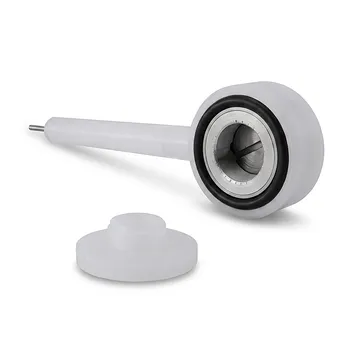
- PVDF Sample Support Body for Corrosion Testing and Electrochemical Analysis
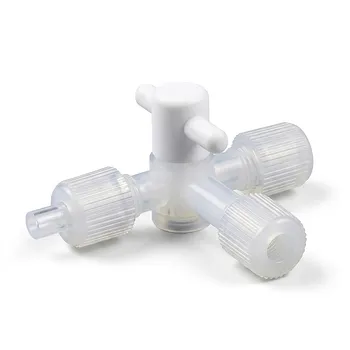
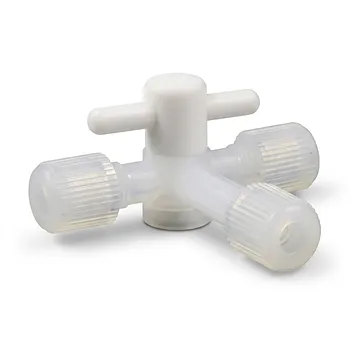
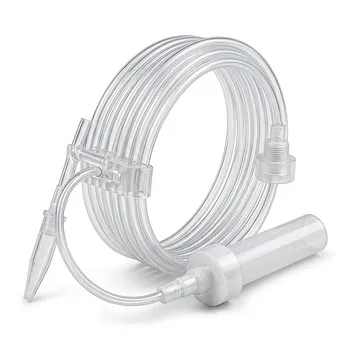
- Corrosion Resistant High Purity PFA Valve and Weldable Transparent Tubing for Semiconductor Fluid Transfer
- High Purity PFA Chromatography Column with Collection Bottle Corrosion Resistant Fluoropolymer Filtration System for Trace Analysis
- High Purity PFA Valves and Weldable Corrosion Resistant Transparent Tubing for Semiconductor Sensor Manufacturing Fluid Transfer
- Custom PFA Tubing 1/4 Inch High Purity Corrosion Resistant Fluoropolymer Tube with Welding and Machining Services
People Also Ask
- How does the gas permeability of PVDF compare with PTFE and PFA? Discover lower gas ingress for sensitive fluids
- How do PVDF, PTFE, and PFA compare in thermal resistance and chemical solubility for lab apparatus?
- How do the mechanical properties and creep resistance of PVDF compare to perfluorinated polymers like PTFE for structural fluoropolymer components? Discover PVDF's superior strength and lower creep, while PTFE excels in extreme environments.
- How do PVDF, PTFE, and PFA compare for chemical process and filtration applications?
- What are the chemical compatibility capabilities and key limitations of PVDF? Discover Critical Data for Safe Fluid Handling