PVDF is a strong general-purpose fluoropolymer for acids, oxidants, halogens, hydrocarbons, and many chlorinated solvents, but it is not chemically universal. It can support continuous fluid transfer, valve, tubing, and containment service across a wide temperature range, commonly up to approximately 90°C to 150°C depending on grade and chemical exposure. Its principal limitations are strong caustics, amines, ketones, esters, and certain highly reactive or fuming acids, where swelling, softening, dissolution, or loss of mechanical strength may occur.
PVDF is best suited to aggressive inorganic and oxidizing chemistry that does not involve strong bases or vulnerable polar organic solvents. When the process includes concentrated caustics, primary or secondary amines, ketones, esters, ammonia, or highly reactive acids, PTFE or PFA generally provides a more reliable compatibility margin.
Where PVDF Performs Well
Acids and Acid Mixtures
PVDF provides excellent resistance to many inorganic acids, acid mixtures, and acidic process streams. It is commonly considered for hydrochloric, nitric, sulfuric, hydrofluoric, and similar acid service, subject to concentration, temperature, grade, and exposure duration.
This resistance is not unlimited. Highly concentrated, fuming, or unusually reactive acids require specific compatibility data rather than a general “acid resistant” classification.
Oxidizing Agents and Halogens
PVDF has strong oxidative and electrochemical stability, making it suitable for many oxidizing agents and halogen-containing environments. It also resists a wide range of halogens and halogenated process chemicals.
The actual limit depends on the oxidant’s concentration and temperature. Oxidizing acid mixtures, such as aqua regia, should be treated as special cases and verified against application-specific data.
Hydrocarbons and Chlorinated Solvents
PVDF generally performs well with hydrocarbon solvents, fuels, aliphatic solvents, aromatic solvents, and many apolar chlorinated solvents. This makes it useful for transfer lines, fittings, valve bodies, and containment components exposed to numerous nonpolar organic fluids.
Compatibility should still be assessed for permeation and dimensional change, particularly when the fluid is hot, pressurized, or present continuously.
Alcohols and Weak Bases
PVDF is typically compatible with many alcohols and weakly basic solutions. It can therefore cover applications where a material must tolerate a mixed environment of acids, alcohols, salts, and moderate oxidants.
The distinction between a weak base and a strong caustic is critical. A compatibility result for a dilute or weakly basic solution should not be extended to concentrated sodium hydroxide, potassium hydroxide, ammonia, or strong organic bases.
Why Temperature and Concentration Matter
Chemical Resistance Is Not a Single Rating
PVDF compatibility is governed by the combined effect of chemical identity, concentration, temperature, pressure, and exposure time. A material that performs well at room temperature may soften, swell, or lose strength when the same chemical is heated.
For this reason, “compatible with PVDF” is incomplete unless the service conditions are also specified.
Practical Temperature Range
Depending on the formulation and chemical environment, PVDF systems may support service from approximately -60°C to 200°C, but these are broad material or formulation ranges rather than universal operating limits for every chemical.
For many chemical containment and transfer applications, practical continuous exposure is more conservatively described as approximately 90°C to 150°C, with the upper limit dependent on the homopolymer grade and the fluid.
Acid-Specific Limits Can Change Significantly
Acetic acid illustrates why concentration matters. PVDF may tolerate approximately 110°C at 10% concentration, 95°C at 50%, 80°C at 80%, and only about 50°C for glacial acetic acid, based on the cited compatibility data.
Acetic anhydride is listed as not recommended, demonstrating that a chemically related compound cannot automatically be treated like acetic acid.
Special Acid Mixtures Need Verification
Chromic acid service may be limited to approximately 80°C at concentrations up to 40%, falling to about 50°C at 50% concentration. Aqua regia is restricted to ambient conditions in the cited data.
Highly reactive acids, including chloroacetic acid and chlorosulfonic acid, may be listed as not recommended. Some sources report resistance to particular hot acid exposures, but those claims conflict with more restrictive application data and should not override the specific manufacturer’s rating for the exact grade and concentration.
Where PVDF Has Important Limitations
Strong Bases and Caustics
PVDF is generally unsuitable for continuous exposure to strong bases, especially solutions with a pH above approximately 12. Sodium hydroxide and potassium hydroxide can cause swelling, softening, or chemical degradation, particularly at elevated temperature or concentration.
For concentrated alkaline service, fully fluorinated materials such as PTFE or PFA are usually the safer selection.
Amines and Ammonia
Primary and secondary amines are among PVDF’s most important compatibility limitations. Compounds such as ethylenediamine and hexamethylenediamine may receive poor compatibility ratings even near ambient temperature.
Ammonia and strong organic bases should likewise be treated cautiously. If the application involves amine handling, PTFE or PFA is generally more appropriate where chemical integrity and sample purity are critical.
Ketones and Esters
PVDF is vulnerable to many polar organic solvents, including ketones such as acetone and methyl ethyl ketone, as well as esters. Depending on conditions, exposure can produce swelling, softening, loss of mechanical strength, or complete dissolution.
This limitation is especially important for tubing, thin-wall components, seals, and containment vessels, where even moderate swelling can affect dimensions, connections, and leak tightness.
Fuming and Highly Reactive Acids
PVDF should not be selected for fuming or highly reactive acid service solely because it resists ordinary mineral acids. Chemical mixtures containing powerful oxidizing or sulfonating species can behave differently from their individual components.
Where the data is contradictory or the chemistry is unusually aggressive, the correct approach is to obtain a written rating for the specific PVDF formulation and operating envelope.
Choosing Between PVDF, PTFE, and PFA
PVDF: Structural Strength and Broad Compatibility
PVDF is often selected when the system needs a balance of chemical resistance, mechanical strength, corrosion resistance, and practical fabrication. It is a strong candidate for acid lines, valve bodies, reactor fittings, storage components, and assemblies exposed to many oxidizing or chlorinated fluids.
It may also be preferable when the application values rigidity and structural stability rather than maximum chemical inertness.
PTFE and PFA: Greater Chemical Inertness
PTFE and PFA are fully fluorinated polymers with a broader chemical resistance profile. They are preferred for strong caustics, amines, ketones, esters, and other polar organic solvents that can attack PVDF.
PFA is often useful where a more processable or transparent fully fluorinated material is needed, while PTFE is widely used where maximum inertness and low friction are central requirements.
Purity and Contamination Considerations
Material selection affects more than component life. Swelling, dissolution, or chemical attack can introduce extractables, particles, or contaminants into the fluid and may compromise the process before visible failure occurs.
For high-purity laboratory or semiconductor applications, compatibility should therefore include chemical purity, permeation, extractables, and surface requirements.
Understanding the Trade-offs
Broad Resistance Does Not Mean Universal Resistance
PVDF performs well across many chemical families, but its resistance is narrower than that of PTFE or PFA. The most common selection error is treating a general fluoropolymer classification as evidence of compatibility with every aggressive reagent.
The material must be evaluated against the actual fluid, not merely its broad category.
Temperature Reduces the Compatibility Margin
Heating often accelerates chemical attack and increases swelling or permeation. Pressure and mechanical loading can amplify the consequences by turning softening into deformation or leakage.
A room-temperature compatibility result is not sufficient for hot transfer lines, heated reactors, or pressurized containment.
Component Design Matters
The same resin can behave differently in a thick valve body, a thin tube, a molded fitting, or a stressed threaded connection. Geometry, wall thickness, residual stress, sealing materials, and joining methods all influence service performance.
The weakest component in the wetted path determines the reliability of the complete system.
Compatibility Tables Have Defined Boundaries
Published ratings are typically based on particular concentrations, temperatures, grades, and test conditions. They should be treated as engineering guidance, not as a guarantee for untested combinations.
When the application is safety-critical or the chemical is concentrated, mixed, heated, or pressurized, supplier confirmation and qualification testing are warranted.
How to Apply This to Your Project
Use the fluid’s exact identity and operating conditions to make the selection:
- If your primary focus is acid, oxidizer, halogen, hydrocarbon, or chlorinated-solvent service: PVDF is a strong candidate, provided the concentration, temperature, and mixture-specific limits are verified.
- If your primary focus is strong caustics or solutions above approximately pH 12: Prefer PTFE or PFA unless application-specific testing demonstrates that PVDF is suitable.
- If your primary focus is ketones, esters, primary or secondary amines, ammonia, or other polar organic solvents: Select a fully fluorinated polymer such as PTFE or PFA to avoid swelling, softening, dissolution, and contamination.
- If your primary focus is heated or pressurized chemical containment: Confirm the exact PVDF grade, fluid concentration, maximum continuous temperature, pressure, permeation behavior, and wetted sealing materials before specifying the system.
- If your primary focus is high-purity fluid handling: Evaluate extractables and contamination risk in addition to basic chemical resistance.
The right choice is determined by the complete chemical and operating envelope, with PVDF used for broad but defined resistance and PTFE or PFA reserved for the most chemically demanding service.
Summary Table:
| Chemical Class | Compatibility | Max Temp (°C) | Notes |
|---|---|---|---|
| Inorganic acids (HCl, H2SO4, HNO3) | Excellent | Up to 120–150°C (concentration-dependent) | Avoid fuming/reactive acids (e.g., aqua regia limited to RT) |
| Oxidizing agents/halogens | Excellent | Up to 150°C (concentration-dependent) | Verify specific oxidant limits |
| Hydrocarbons/chlorinated solvents | Good | Up to 100–150°C | Monitor permeation and swelling |
| Alcohols/weak bases | Good | Up to 100°C | Not for strong caustics |
| Strong bases (pH>12) | Poor | Not recommended | Swelling/degradation; use PTFE/PFA |
| Amines/ammonia | Poor | Not recommended | Especially primary/secondary amines |
| Ketones/esters | Poor | Not recommended | Swelling/dissolution; use PTFE/PFA |
| Hot/pressurized service | Variable | Derate 90–150°C typical | Confirm grade and conditions |
Ensure absolute chemical integrity in your fluid systems. With KINTEK's high-performance PTFE and PFA products, you can handle even the most aggressive chemicals—caustics, amines, ketones, esters—without compromise. Our full line of tubing, fittings, valves, and custom-machined parts is engineered for purity and reliability. Contact us today to discuss your application and get the right material solution. Get in touch with our experts.
Related Products
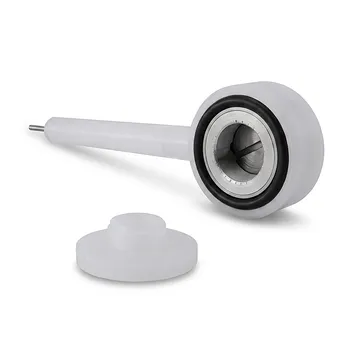
- PVDF Sample Support Body for Corrosion Testing and Electrochemical Analysis
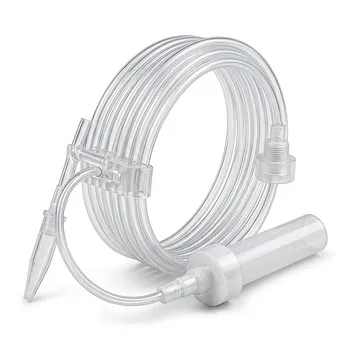
- Custom PFA Tubing 1/4 Inch High Purity Corrosion Resistant Fluoropolymer Tube with Welding and Machining Services
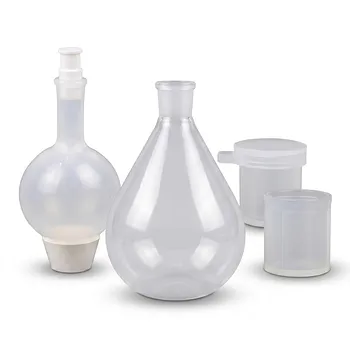
- PFA Eggplant Flask Custom Molded Pear Shaped Laboratory Flask Corrosion Resistant Glass Alternative
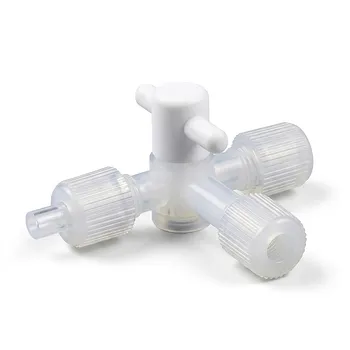
- Corrosion Resistant High Purity PFA Valve and Weldable Transparent Tubing for Semiconductor Fluid Transfer
- High Purity PFA Sample Vials Acid Resistant Trace Analysis Digestion Cups with Lids
People Also Ask
- How does the gas permeability of PVDF compare with PTFE and PFA? Discover lower gas ingress for sensitive fluids
- How do PVDF, PTFE, and PFA compare in thermal resistance and chemical solubility for lab apparatus?
- How do the mechanical properties and creep resistance of PVDF compare to perfluorinated polymers like PTFE for structural fluoropolymer components? Discover PVDF's superior strength and lower creep, while PTFE excels in extreme environments.
- How do PVDF, PTFE, and PFA compare for chemical process and filtration applications?
- How do PVDF's mechanical strength and density compare to PTFE/PFA? Key differences explained