PTFE’s high melting point and non-flowing melt make conventional thermoplastic fabrication unsuitable. At roughly 327–340°C, PTFE does not become a freely flowing liquid; it forms an extremely high-viscosity gel. As a result, custom laboratory fluid-transfer components are typically made by powder compaction and sintering, followed by precision CNC machining from solid PTFE stock rather than standard injection molding.
The key consequence is that PTFE components are shaped mechanically or through specialized powder-processing methods, not by relying on melt flow. This adds fabrication time and cost, but enables chemically resistant, low-friction, thermally stable components with precise dimensions for demanding laboratory fluid-handling systems.
Why PTFE Cannot Be Processed Like Standard Thermoplastics
The Melt Does Not Flow Normally
Conventional thermoplastics become sufficiently fluid above their melting temperatures to fill a mold, pass through an extrusion die, or form around complex features. PTFE instead develops an exceptionally high-viscosity gel, with reported melt viscosity many orders of magnitude higher than ordinary thermoplastics.
This lack of flow prevents the polymer from filling intricate mold cavities through standard pressure-driven processing.
High Heat Is Required for Processing
PTFE’s melting behavior occurs at a temperature far above that of many engineering plastics. Depending on grade and measurement method, its principal melting range is commonly described as approximately 327–340°C.
The material also has excellent thermal stability and a continuous-use temperature around 260°C, but the fabrication process still requires careful control of temperatures above its melting range.
Powder Processing Replaces Melt Molding
Manufacturers generally begin with granular or fine PTFE powder, which is compacted into a preliminary shape and then sintered. Sintering consolidates the particles into a dense solid without requiring the polymer to flow through a mold like a conventional thermoplastic.
The resulting blanks, tubes, rods, or blocks can then be trimmed and machined into the final component.
How Fabrication Changes the Design and Manufacturing Process
CNC Machining Becomes the Primary Customization Method
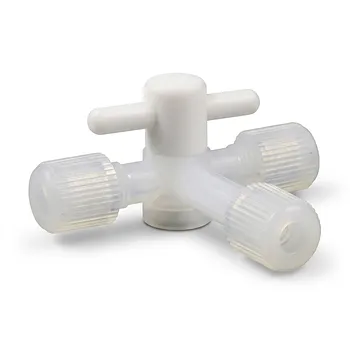
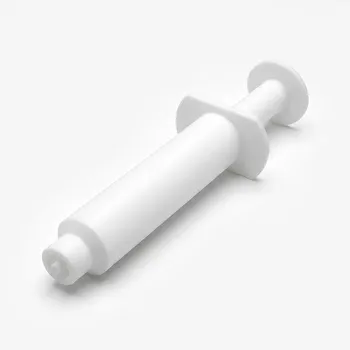
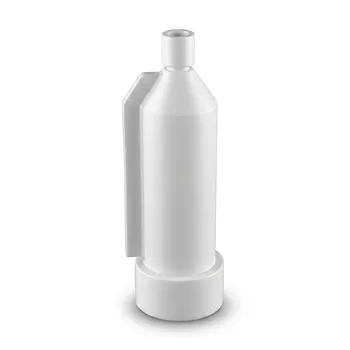
For non-standard laboratory fittings, valve bodies, adapters, manifolds, reaction vessels, and electrochemical cells, precision CNC machining provides the necessary geometric control. Features such as bores, grooves, threads, sealing faces, and fluid channels are cut directly into pre-formed PTFE stock.
This approach is particularly useful for low-volume or highly customized components where creating dedicated molding tools would not be economical.
Dimensional Control Requires Thermal Management
Although PTFE is readily machinable, it can soften and deform when machining temperatures are not controlled. Cutting forces, tool friction, and insufficient chip evacuation can all affect the final geometry.
Manufacturers therefore need appropriate tooling, controlled cutting conditions, sharp edges, and inspection after machining. Critical sealing dimensions may require additional allowance for trimming and final finishing.
Thermal History Affects Final Dimensions
PTFE changes structurally when it is heated and cooled. Its crystallinity and dimensions can differ between the original compacted material and the finished part, particularly after thermal cycling.
For fluid-transfer components, this matters because small dimensional changes can affect seal compression, leakage, thread engagement, tubing fit, and internal flow paths. Designs should account for the material’s thermal behavior rather than treating PTFE as dimensionally inert.
Geometry Must Suit Subtractive Fabrication
Machining allows substantial design freedom, but the process still imposes practical limits. Deep narrow channels, inaccessible internal cavities, thin unsupported walls, and complex enclosed geometries may be difficult or expensive to produce from a solid blank.
Designers should consider tool access, minimum wall thickness, chip removal, inspection access, and the need for assembly from multiple parts.
What This Means for Laboratory Fluid Components
Chemical Purity Is Preserved Through Material Selection and Processing
PTFE is highly resistant to aggressive chemicals and has low surface adhesion, making it valuable for high-purity fluid paths and analytical equipment. Using virgin PTFE and controlled powder-processing and machining practices can help preserve these properties.
However, fabrication does not automatically guarantee purity. Tool cleanliness, handling, packaging, and the prevention of embedded machining debris must also be controlled when contamination could compromise an experiment.
Fluid Paths Have Low Friction and Low Adhesion
The low coefficient of friction reduces resistance at sliding interfaces, valve components, and threaded assemblies. PTFE’s antiadhesive surface also helps limit the retention of some materials within tubing fittings and fluid channels.
These advantages are useful in applications involving corrosive reagents, difficult-to-clean fluids, and systems where minimizing interaction with the transported material is important.
Sealing Features Need Careful Engineering
PTFE’s softness and tendency to deform under load can be beneficial for conformable seals, but it can also cause creep or dimensional change under sustained compression. Machined sealing faces, threads, and gasket grooves must therefore be designed around the actual pressure, temperature, and chemical conditions.
A dimensionally precise part can still leak if the sealing method does not account for PTFE’s mechanical behavior.
Custom Fabrication Supports Specialized Apparatus
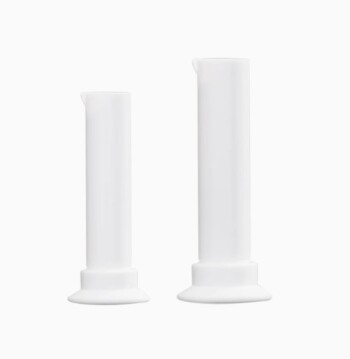
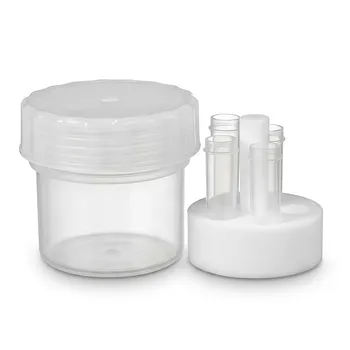
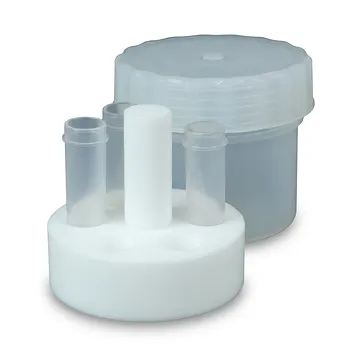
Because components can be machined from standard pre-formed stock, manufacturers can produce bespoke reaction vessels, electrochemical cells, digestion vessels, non-standard fittings, and integrated fluid-handling parts without relying on a standard mold.
This is a major advantage for research systems, pilot equipment, and low-volume laboratory hardware that requires unusual dimensions or interfaces.
Understanding the Trade-offs
The Process Is Slower Than Injection Molding
Powder compaction, sintering, machining, inspection, and cleaning generally require more individual processing steps than injection molding. Lead times and unit costs can therefore be higher, especially for complex parts or small production runs.
The trade-off is justified when chemical resistance, purity, temperature performance, or custom geometry matters more than high-volume production efficiency.
Material Waste Can Increase
CNC machining removes material from a solid block or pre-form. Complex components may therefore generate more scrap than a near-net-shape molded part.
This is one reason to optimize the starting blank, simplify unnecessary features, and reserve machining for geometries that genuinely require it.
Tight Tolerances Require More Process Control
PTFE’s thermal expansion, softening behavior, and post-processing dimensional changes complicate the achievement of tight tolerances. Parts may need to be machined under controlled conditions and measured after they have stabilized.
Designers should distinguish between non-critical external dimensions and functional dimensions such as sealing diameters, bore sizes, and mating interfaces.
PTFE May Not Be the Best Choice for Every Geometry
PFA has a lower melting range and substantially lower melt viscosity, allowing it to be processed using conventional methods such as injection molding while retaining strong chemical and thermal performance. For high-volume parts or geometries that depend on melt flow, PFA may be a more practical alternative.
The choice should be based on the required purity, chemical exposure, temperature, geometry, production volume, and tolerance—not on PTFE’s chemical resistance alone.
Making the Right Choice for Your Goal
The fabrication method should be selected together with the component geometry and operating requirements.
- If your primary focus is chemical purity and aggressive-fluid compatibility: Specify virgin PTFE and controlled powder-processing, machining, cleaning, and packaging practices.
- If your primary focus is complex low-volume geometry: Use sintered PTFE stock with precision CNC machining, while designing channels and cavities for tool access and inspection.
- If your primary focus is dimensional accuracy and leak prevention: Control machining temperature, allow for PTFE’s thermal and mechanical behavior, and verify critical sealing features after stabilization.
- If your primary focus is high-volume production or flow-dependent molding: Evaluate PFA or another processable fluoropolymer before committing to a fully machined PTFE design.
PTFE’s non-flowing melt makes fabrication more specialized, but that same material behavior supports highly reliable, chemically resistant laboratory fluid components when powder processing, machining, and thermal control are designed as one system.
Summary Table:
| Aspect | Influence | Implication for Custom Machining |
|---|---|---|
| Melt behavior | High-viscosity gel instead of flowing melt | CNC machining from solid stock is preferred over injection molding |
| Processing temperature | ~327–340°C melting range | Requires powder compaction and sintering followed by machining |
| Thermal expansion | High thermal expansion and post-processing dimensional changes | Tight tolerances need careful thermal management and stabilization |
| Chemical purity | Excellent chemical resistance and low adhesion | Virgin PTFE and clean processing preserve purity for sensitive applications |
| Sealing performance | Soft, conformable but prone to creep | Sealing designs must account for pressure, temperature, and dimensional stability |
| Production volume | Machining is slower and generates waste | Best for low-volume, custom parts; consider PFA for high-volume molding |
Need precision-machined PTFE fluid handling components for your lab? At KINTEK, we specialize in custom PTFE and PFA parts, from fittings and valves to complex reaction vessels. Our end-to-end CNC machining ensures exact dimensions and chemical purity for your demanding applications. Contact us today to discuss your requirements and get a free quote!
Related Products
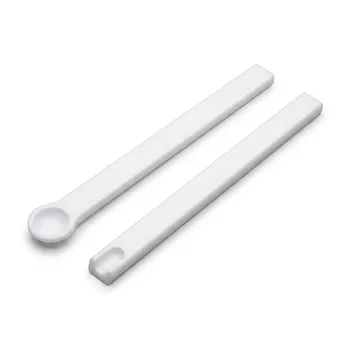
- Corrosion Resistant PTFE Sampling Spoon for High Purity Solid Powder Reagent Handling and Laboratory Chemical Transfer
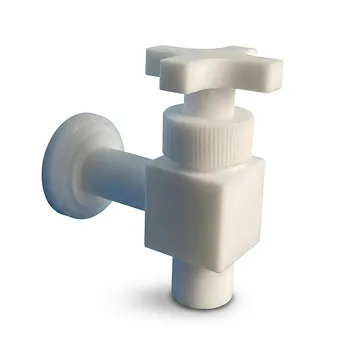
- Corrosion Resistant PTFE Polytetrafluoroethylene Valve and Customizable Laboratory Fluid Dispensing Faucet for Aggressive Chemical Handling in Industrial Storage Tanks and Plastic Drums
- High Corrosion Resistant PTFE Faucet Polytetrafluoroethylene Valve for Chemical Storage Drums and Fluid Transfer Systems Customizable Industrial Grade
- Custom PTFE Parts Manufacturer for Teflon Containers and Components
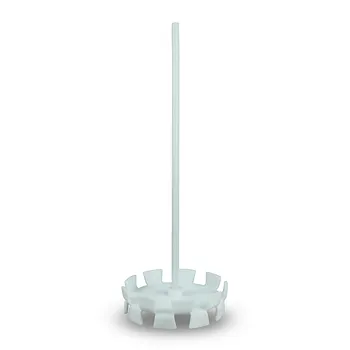
- Corrosion Resistant PTFE Dispersing Disc and High Temperature Propeller Stirring Paddle for Laboratory Chemical Mixing
People Also Ask
- How does PTFE's chemical resistance make it suitable for high-purity lab supplies and transfer systems? Discover its key benefits in handling extreme corrosives.
- How Surface Energy and Friction of PTFE Benefit Fluid Transfer and Labware?
- How do the low surface energy and non-wetting properties of PTFE fluoropolymers benefit precision laboratory fluid transfer components and analytical labware? Discover the advantages for your lab.
- How do fluoropolymers benefit fluid transfer systems and sample prep containers? Non-stick performance for improved recovery, reduced contamination, and easier cleaning.
- What factors should be considered when selecting a PTFE shovel for laboratory use? Ensure Chemical Inertness & Sample Integrity