PVDF is less suitable than ETFE for strong bases and aggressive polar solvents because its molecular structure contains reactive C-H bonds, while ETFE's ethylene-tetrafluoroethylene architecture provides greater resistance to chemical attack and solvent penetration. Under strong alkaline conditions, PVDF can undergo base-promoted dehydrofluorination, potentially releasing fluoride-containing species and damaging the polymer. PVDF can also swell or dissolve in solvents such as ketones, esters, DMF, DMAc, NMP, THF, and acetone, whereas ETFE generally remains dimensionally stable and resists dissolution across a broader range of laboratory chemicals.
The key distinction is partial versus more extensive fluorine shielding. PVDF's hydrogen-containing backbone creates chemically vulnerable sites and stronger interactions with polar solvents; ETFE's alternating ethylene and tetrafluoroethylene structure gives better protection and chain packing, making it the more dependable choice for aggressive alkaline or solvent-handling duties, although PTFE or PFA remains preferable when near-universal resistance is required.
Why the Polymer Backbones Behave Differently
PVDF Contains Chemically Vulnerable C-H Bonds
PVDF is formed from vinylidene fluoride units and contains repeating -CH2-CF2- segments. The carbon-fluorine bonds provide substantial chemical resistance, but the remaining hydrogen atoms create sites that can participate in base-induced reactions.
Strong bases, particularly at elevated temperature or concentration, can promote dehydrofluorination. This process removes hydrogen fluoride from the chain and can produce unsaturation, discoloration, embrittlement, loss of mechanical performance, or other forms of chemical degradation.
The practical concern is not simply whether PVDF immediately dissolves. A component may first swell, lose strength, become permeable, or contaminate the handled fluid before obvious failure occurs.
ETFE Provides More Effective Chain Protection
ETFE is an alternating copolymer of ethylene and tetrafluoroethylene, with a backbone containing both hydrocarbon and highly fluorinated segments. Its tetrafluoroethylene-derived groups provide substantial fluorine shielding, while the bulky fluorinated portions and chain packing reduce access by many reagents.
ETFE is not a fully fluorinated polymer, so it should not be described as chemically inert to every reagent. However, its structure gives it substantially better resistance than PVDF to strong bases and many organic solvents used in laboratory fluid handling.
Fluorination Is Important, but It Is Not the Only Factor
Chemical suitability depends on more than the percentage of fluorine. Chain architecture, crystallinity, polarity, free volume, temperature, reagent concentration, and exposure time all affect compatibility.
PVDF's polar backbone and interchain dipolar attractions contribute to useful strength and rigidity, but they also increase its interaction with strongly polar aprotic solvents. ETFE combines fluorinated segments with a less polar overall surface and a tightly packed structure, limiting solvent uptake and polymer-chain mobility.
How Strong Bases Affect Fluid-Handling Components
PVDF Can Undergo Base-Induced Degradation
Concentrated alkalis and strong organic bases are among the more important chemical limitations of PVDF. At sufficiently severe conditions, they can attack the hydrogen-containing backbone and initiate dehydrofluorination.
The risk increases with higher temperature, longer exposure, greater reagent concentration, mechanical stress, and thin-wall geometry. Tubing, valve seats, diaphragms, and containers may therefore fail before a large bulk sample of resin appears visibly damaged.
ETFE Offers a Wider Alkaline Operating Window
ETFE generally tolerates strong alkaline reagents better than PVDF because its molecular structure is less susceptible to the same dehydrofluorination pathway. It is often appropriate for alkaline transfer lines, fittings, containers, and structural components where PVDF would require more conservative limits.
Compatibility still requires checking the specific chemical and operating conditions. Hot concentrated bases, strong nucleophiles, radiation, and combined chemical and mechanical stress can exceed the useful range of any partially fluorinated polymer.
Fully Fluorinated Materials Provide the Highest Margin
PTFE and PFA have carbon backbones that are extensively shielded by fluorine and lack the hydrogen-containing repeat-unit structure found in PVDF and ETFE. This gives them a higher level of chemical inertness, particularly for concentrated alkalis and difficult combinations of temperature and exposure time.
For critical containment, high-purity transfer, or processes where a small amount of degradation would compromise the sample, PFA or PTFE should be evaluated before PVDF or ETFE.
How Polar Solvents Affect the Materials
PVDF Interacts Strongly with Polar Aprotic Solvents
PVDF's polar -CF2-CH2- sequences can interact with solvents containing carbonyl, sulfoxide, or amide groups. Depending on the solvent and conditions, this interaction can cause swelling, plasticization, loss of dimensional stability, or complete dissolution.
Reported problem solvents include DMF, DMAc, NMP, DMSO, ketones, and esters. Acetone and THF are particularly important examples because they can make PVDF unsuitable for fluid lines, containers, or solvent-contact components under conditions where structural stability is required.
ETFE Usually Resists Dissolution More Effectively
ETFE is generally resistant to dissolution in common organic solvents and maintains its shape more reliably than PVDF. This makes it a stronger candidate for laboratory tubing, fittings, vessels, and pressurized components exposed to many polar or organic liquids.
“Resistant” does not mean “universally compatible.” Some solvents, especially at elevated temperature, can cause reversible plasticization or changes in mechanical behavior even when they do not permanently dissolve the polymer.
PTFE and PFA Are Better for Broad Solvent Coverage
PFA and PTFE provide the most reliable resistance to aggressive polar solvents, including applications involving ketones, esters, THF, DMF, and DMSO. PFA is especially useful where chemical inertness must be combined with melt-processable fabrication and good dimensional stability.
When the solvent list may change, when temperature excursions are possible, or when contamination cannot be tolerated, choosing a fully fluorinated material reduces uncertainty.
What the Difference Means in Laboratory Design
Tubing and Transfer Lines
PVDF tubing can be attractive where rigidity, abrasion resistance, and mechanical strength are important. It is less appropriate when the line will carry concentrated alkalis, amines, ketones, esters, or strongly polar aprotic solvents.
ETFE tubing provides a broader chemical operating range while retaining useful mechanical strength. PFA or PTFE tubing is the more conservative specification for aggressive solvent service, high-purity transfer, or extended exposure.
Bottles, Liners, and Reaction Vessels
A PVDF container may remain mechanically sound with many aqueous or inorganic chemicals, but solvent-induced swelling or slow degradation can alter dimensions and introduce extractables. This is especially consequential in trace analysis and reagent storage.
ETFE improves resistance to these effects. PFA is generally the safer choice for long-term storage or reaction service involving harsh polar solvents and concentrated alkaline reagents.
Valves, Fittings, and Seals
In a valve or fitting, localized chemical attack can be more serious than bulk material loss. Swelling can change sealing forces, while embrittlement or plasticization can cause leakage under pressure.
Material selection must therefore include the entire wetted assembly. A chemically resistant ETFE or PFA body does not compensate for an incompatible PVDF insert, elastomer, adhesive, or gasket.
Understanding the Trade-offs
PVDF Provides Mechanical Advantages
PVDF is often stronger, more rigid, and more abrasion-resistant than PTFE or PFA. Its crystallinity and interchain dipolar attractions provide useful dimensional and mechanical performance in structural fluid-handling components.
Those benefits explain why PVDF remains valuable for many laboratory applications. They do not remove its limitations with strong bases and aggressive polar solvents.
ETFE Is More Resistant but Not Fully Inert
ETFE offers a stronger balance between mechanical durability and chemical resistance than PVDF for many demanding applications. Nevertheless, it still contains ethylene-derived hydrocarbon segments and therefore does not match PTFE or PFA across every chemical and temperature condition.
A generic statement that ETFE is safe with “all organic solvents” is too broad. The exact solvent, temperature, pressure, concentration, and exposure duration must be checked against a compatibility table or supplier data.
Compatibility Data Can Be Misapplied
A rating measured at room temperature for intermittent contact may not apply to continuous service at elevated temperature. Likewise, a bulk immersion test may not predict the behavior of a stressed, thin-wall tube or a molded seal.
Selection should evaluate chemical exposure and mechanical duty together, including pressure cycling, bending, thermal cycling, cleaning procedures, and sterilization if relevant.
Making the Right Choice for Your Goal
The material should be selected from the complete chemical and operating envelope, not from fluorine content alone.
- If your primary focus is strong-base handling: Prefer ETFE over PVDF for many alkaline transfer components, and specify PTFE or PFA when the base is concentrated, hot, or operational failure would be unacceptable.
- If your primary focus is polar-solvent handling: Avoid PVDF where swelling or dissolution is possible, particularly with DMF, DMAc, NMP, DMSO, ketones, esters, THF, or acetone; evaluate PFA or PTFE first.
- If your primary focus is mechanical rigidity: PVDF may be advantageous for compatible aqueous or moderately aggressive chemicals, but confirm that the application does not include strong bases or solvent classes known to attack it.
- If your primary focus is broad chemical coverage and sample purity: Use fully fluorinated PFA or PTFE for the wetted path, and verify the compatibility of every secondary component.
Understanding how backbone structure controls chemical interaction allows laboratory engineers to choose PVDF, ETFE, PTFE, or PFA according to actual risk rather than relying on the general label “fluoropolymer.”
Summary Table:
| Property | PVDF | ETFE |
|---|---|---|
| Chemical Resistance to Strong Bases | Poor (can undergo dehydrofluorination) | Good (more resistant) |
| Resistance to Polar Solvents (e.g., ketones, DMF, THF) | Poor (swells or dissolves) | Good (generally resistant) |
| Fluorine Content | Lower (contains C-H bonds) | Higher (more fluorine shielding) |
| Mechanical Strength | High | Moderate |
| Suitable Applications | Aqueous chemicals, moderate pH | Aggressive bases, organic solvents |
| Best Use Cases | Structural parts, abrasion resistance | Tubing, fittings, vessels for harsh chemicals |
Need high-performance fluoropolymer labware that withstands aggressive chemicals? KINTEK offers a full range of PTFE and PFA products, from tubing and fittings to custom machined parts. Our materials provide superior chemical resistance for your most demanding applications. Contact us today for expert guidance and reliable supply!
Related Products
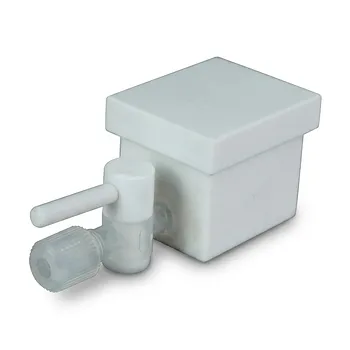
- Corrosion Resistant PTFE Evaporation Cell Electrophoresis Tank 400ml Flame Retardant Insulated Reaction Vessel Customizable
- Custom PTFE Acid Resistant Support Rack for PFA Hydrogen Absorption Systems Multi Hole Configurations
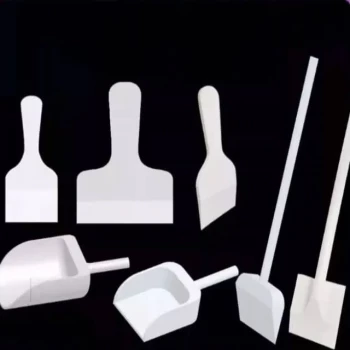
- Customizable PTFE Scrapers and Shovels for Demanding Applications
- Large Capacity PTFE Reaction Bottle 2L Wide Mouth Fluoropolymer Extraction Vessel Compatible with Rotary Agitators
- Corrosion Resistant PFA Reaction Tank High Purity Laboratory Reaction Bottle Wide Mouth PTFE Jar Multiple Specifications
People Also Ask
- What reaction vessel and fluid handling considerations are necessary for living cationic polymerization of fluorinated monomers involving Lewis acid catalysts? Key design and safety tips
- How do perfluorinated solvent environments influence the selection of reaction vessels and fluid handling components in nonaqueous emulsion polymerizations? Choose fluoropolymer materials.
- Why are high-purity PTFE or PFA reaction vessels recommended for the synthesis of PANI-TiC hybrid materials? - Guide
- Why is a high-quality PTFE reaction vessel required for the etching preparation of Ti3C2Tx MXene? Ensure Pure Synthesis.
- Why are fluoroplastic (PTFE) reaction vessels recommended for Methylene Blue (MB) adsorption kinetic experiments?