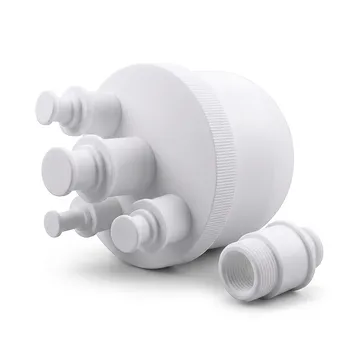
Perfluorinated solvent environments require fluoropolymer-based wetted hardware, especially when the reaction also contains nonpolar organic solvents. PTFE and PFA are generally the preferred materials for reaction vessels, tubing, fittings, valves, and other wetted components because they resist swelling, dissolution, and extractables that can compromise nonaqueous emulsion polymerizations. Seal materials require separate evaluation: standard elastomers may fail even when the main vessel material remains stable.
In these polymerizations, materials selection is part of reaction control. Use PTFE or PFA for wetted surfaces wherever practical, then verify seals, mechanical performance, permeability, temperature limits, and catalyst compatibility for the specific solvent mixture.
Why the Solvent Environment Changes Materials Selection
Perfluorinated and Nonpolar Solvents Attack Conventional Materials Differently
Nonaqueous fluorous emulsion polymerizations use a perfluorinated continuous phase, such as perfluoromethylcyclohexane, together with unpolar organic solvents. This combination can interact unfavorably with common laboratory plastics, adhesives, tubing, and rubber components.
A material may appear stable in the perfluorinated solvent alone but swell or soften in the combined solvent system. Compatibility therefore needs to be assessed against the actual formulation, not just one solvent listed in isolation.
Water-Sensitive Catalysts Increase the Cost of Contamination
These reactions can use early transition metal catalysts, including metallocenes, that are highly sensitive to moisture and impurities. Extractables from tubing, seals, plastics, or adhesives can interfere with catalyst activity or alter polymerization behavior.
The fluid path must therefore preserve both chemical purity and the intended solvent composition. Material-derived contamination is not merely a maintenance problem; it can change conversion, particle formation, molecular weight, or reproducibility.
Heterophase Reactions Magnify Interfacial Effects
Emulsion polymerizations depend on controlled interfaces between dispersed and continuous phases. Swelling products, leached additives, or surface residues can affect nucleation, stabilization, and particle growth.
A vessel or transfer line that introduces a small amount of incompatible material may have an outsized effect because the reaction is sensitive to interfaces and phase behavior.
Selecting Reaction Vessels
Use PTFE or PFA for Wetted Surfaces
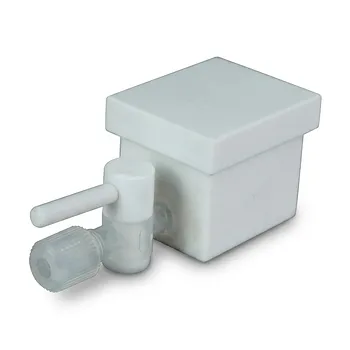
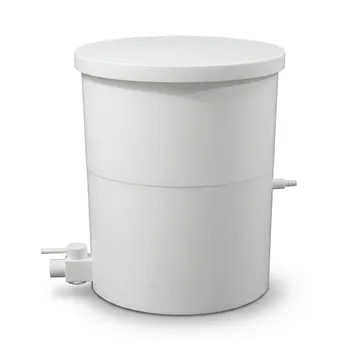
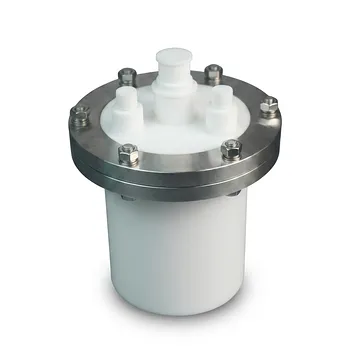
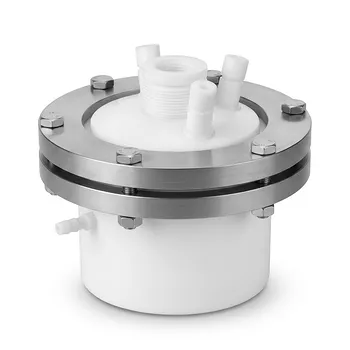
PTFE and PFA are strong default choices for vessel interiors, liners, dip tubes, stirrer components, and other wetted parts. Their highly fluorinated structures provide broad resistance to perfluorinated media and many unpolar organic solvents.
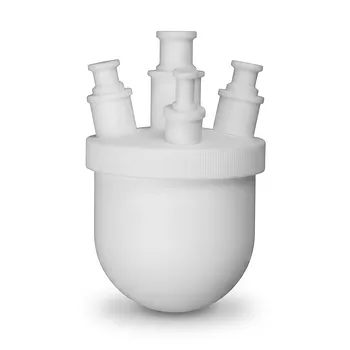
PFA is often useful where a transparent, weldable, or more easily fabricated fluoropolymer vessel is needed. PTFE is widely used for liners, seals, valve bodies, stirrer parts, and custom-machined components.
Match the Vessel to Pressure and Temperature
Chemical compatibility alone does not establish vessel suitability. The design must also account for pressure, vacuum, agitation, thermal cycling, wall thickness, and the mechanical behavior of fluoropolymers.
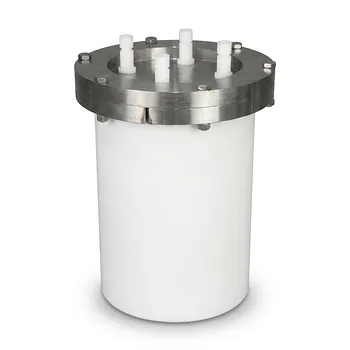
PTFE and PFA can experience creep or deformation under sustained load, particularly at elevated temperature. A fluoropolymer liner may therefore require a mechanically robust support vessel, depending on the operating conditions.
Minimize Unnecessary Wetted Materials
A practical vessel design keeps the wetted path simple. Reduce exposed metal, elastomer, adhesive, and general-purpose plastic surfaces unless each has been qualified for the solvent system.
Joints, probes, windows, and agitation hardware deserve the same scrutiny as the vessel wall. These smaller components often become the actual source of contamination or leakage.
Selecting Fluid Handling Components
Tubing and Fittings
PTFE and PFA tubing are appropriate starting points for transferring the continuous phase, monomers, catalyst solutions, and reaction mixtures. Fluoropolymer fittings reduce the number of non-fluorinated surfaces exposed to the solvents.
Tubing should be selected for the required flexibility, pressure rating, bend radius, and connection method. A chemically resistant tube can still fail through kinking, fatigue, permeation, or mechanical damage.
Valves and Pumps
Valves should use fluoropolymer wetted bodies and seats where possible. Diaphragm or bellows designs can reduce exposure of moving seals to the process fluid, but the diaphragm or bellows material still requires compatibility verification.
Pump selection must consider solvent viscosity, flow stability, pressure, shear, and the possibility of catalyst or polymer deposits. The pump's internal lubricants, dynamic seals, and tubing should be treated as part of the wetted system.
Seals and O-Rings
Seals are often the most vulnerable components because elastomers absorb solvents more readily than dense fluoropolymers. Swelling can cause dimensional changes, increased friction, valve failure, leakage, or particle shedding.
Fluorocarbon elastomers can resist hydrocarbons and many chlorinated solvents, but their performance is not universal. Standard grades may swell in polar solvents such as ketones, esters, and ethers, while amines, alkalis, and strong acids can create additional failure risks.
For demanding service, higher-fluorine terpolymers or specialized materials such as FEPM or FFKM may provide better dimensional stability. The correct choice depends on the complete solvent, catalyst, additive, temperature, and pressure profile.
Preserving Reaction Purity
Control Extractables and Leachables
Fluoropolymer components are valuable because they generally contribute fewer solvent-soluble contaminants than many conventional plastics and rubbers. This helps protect sensitive catalysts and reduces unexplained changes in polymerization performance.
However, “chemically inert” does not mean that every component is contaminant-free. Manufacturing residues, machining debris, pigments, fillers, lubricants, and cleaning agents must still be controlled.
Precondition the Fluid Path
Clean and, where appropriate, pre-rinse or condition new tubing, vessels, and fittings with a compatible solvent before introducing catalyst or monomer. The procedure should be validated so that it removes residues without adding water or new contaminants.
Drying is particularly important when using water-sensitive catalysts. Moisture can enter through improperly dried components, open handling, permeable auxiliary materials, or repeated vessel access.
Avoid Unqualified Auxiliary Materials
Thread sealants, pipe dopes, pressure-sensitive adhesives, ordinary syringe components, and general-purpose tubing can introduce incompatible substances into the reaction. Their small size does not make them low risk.
Every material that contacts the solvent, vapor, condensate, or pressurized headspace should be included in the compatibility review. Vapor-phase exposure can also cause swelling or permeation in components that are not directly wetted.
Understanding the Trade-offs
Fluoropolymers Are Resistant but Not Indestructible
PTFE and PFA provide excellent resistance to many perfluorinated and organic solvent environments, but they are not suitable for every chemical or operating condition. Strong bases, amines, certain reactive species, and hot anhydrous hydrofluoric acid can challenge fluorinated materials and associated seals.
Compatibility must be checked for the exact chemical mixture, concentration, temperature, exposure time, and mechanical stress. A general fluoropolymer compatibility label is not a substitute for an application-specific assessment.
Mechanical Performance Can Limit the Design
PTFE is soft and can creep under load, while PFA may require careful evaluation for pressure, temperature, and fabrication constraints. Fluoropolymer tubing can also be less flexible or less mechanically robust than some elastomeric alternatives.
The right design may combine a fluoropolymer wetted liner with an external structural shell or support. This preserves chemical resistance without asking the fluoropolymer to provide more mechanical strength than it can reliably deliver.
Higher-Grade Seals Increase Cost
FEPM and FFKM seals can improve reliability in aggressive or high-purity applications, but they are more expensive and may have longer procurement times. Using them everywhere without considering the actual exposure can add unnecessary cost.
Conversely, choosing a low-cost seal without testing can lead to swelling, leaks, batch contamination, and repeated downtime. The economic decision should include failure consequences, not just purchase price.
“Zero Absorption” Is an Overstatement
PTFE and PFA have low chemical uptake compared with many conventional materials, but no material should be assumed to have literally zero absorption or zero permeation in every solvent. Long exposure, temperature, pressure, and thin-wall geometry can still matter.
For critical transfer steps, perform gravimetric, dimensional, or extractables testing under representative conditions. This is especially important when solvent purity and catalyst activity are tightly coupled.
Making the Right Choice for Your Goal
Material selection should follow the reaction's sensitivity, operating conditions, and acceptable failure risk.
- If your primary focus is catalyst protection: Use PTFE or PFA throughout the wetted path, qualify all seals separately, and control moisture, residues, and extractables.
- If your primary focus is long-term leak prevention: Select seals based on the complete solvent mixture and temperature profile, considering FEPM or FFKM for demanding service.
- If your primary focus is vessel integrity: Combine chemically resistant fluoropolymer wetted surfaces with structural support designed for pressure, vacuum, agitation, and thermal cycling.
- If your primary focus is process reproducibility: Evaluate the complete fluid path, including valves, pumps, fittings, probes, adhesives, and vapor-exposed components rather than inspecting only the main vessel.
- If your primary focus is cost control: Reserve premium fluoropolymer grades for components with meaningful exposure or failure consequences, while validating every proposed substitute before use.
A disciplined materials-compatibility review protects both the equipment and the chemistry, making the reaction more reproducible and easier to scale.
Summary Table:
| Component | Recommended Material | Key Considerations |
|---|---|---|
| Reaction Vessel (liner/wetted) | PTFE/PFA | Chemical resistance, mechanical support for pressure/temperature |
| Tubing & Fittings | PTFE/PFA | Flexibility, pressure rating, avoid non-fluorinated surfaces |
| Valves & Pumps | Fluoropolymer wetted parts | Seal compatibility, pump internals, lubricants |
| Seals & O-Rings | FEPM/FFKM (for demanding) | Swelling resistance, dimensional stability, cost trade-offs |
Ensure the purity and reliability of your nonaqueous emulsion polymerizations. At KINTEK, we specialize in high-performance PTFE and PFA components, from custom reaction vessels to complete fluid handling systems. Our end-to-end CNC machining capabilities allow us to deliver bespoke solutions tailored to your exact specifications, protecting your sensitive catalysts and ensuring reproducible results. Contact us today to discuss your requirements and benefit from our expertise in fluoropolymer applications. Get in touch with our specialists now.
Related Products
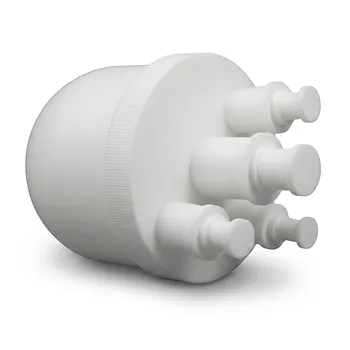
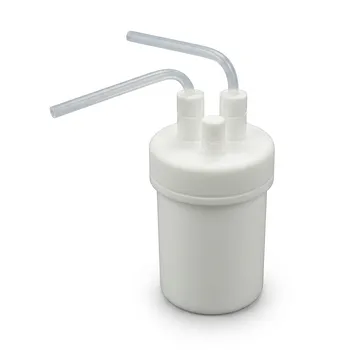
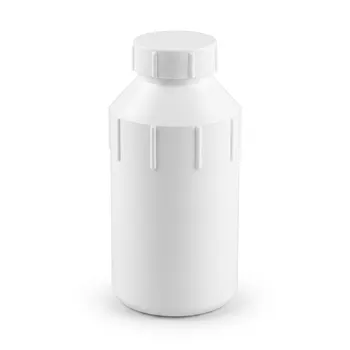
- High Purity PTFE Corrosion Resistant Reaction Vessel with Luer Fittings and Caps for Trace Analysis
- PTFE 10L Reaction Vessel with Stirring Paddle Customizable Corrosion Resistant High Temperature Reactor for Biopharmaceutical and Chemical Processing
- High Purity PTFE Reaction Vessel Polyfluortetraethylene Cylindrical Tank Petrochemical Reaction Container
- High Purity PTFE Reaction Vessel with Electric Stirring System and Customizable 5L Tank including Buchner Funnel Filtration Assembly
- High Performance Customizable PTFE Reaction Vessel and Corrosion Resistant Polytetrafluoroethylene Flask for Chemical Laboratory Use
People Also Ask
- Why is a PTFE reaction vessel required for Ti3C2Tx MXene synthesis? Ensure Safe HF Etching & High Purity
- What reaction vessel and fluid handling considerations are necessary for living cationic polymerization of fluorinated monomers involving Lewis acid catalysts? Key design and safety tips
- Why are high-purity PTFE or PFA reaction vessels recommended for the synthesis of PANI-TiC hybrid materials? - Guide
- Why are fluoroplastic (PTFE) reaction vessels recommended for Methylene Blue (MB) adsorption kinetic experiments?
- Ion Activation Reaction Vessel Requirements: Why PTFE is Critical for Membrane Performance