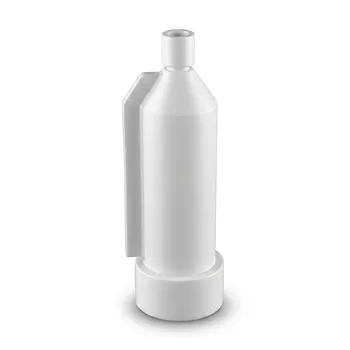
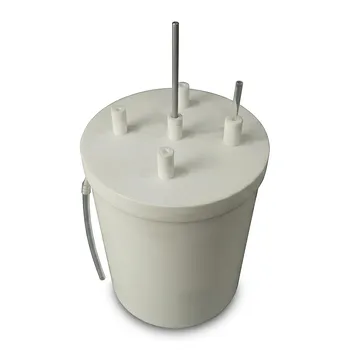
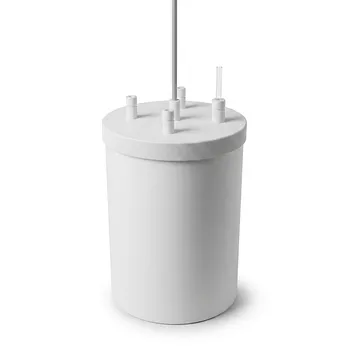
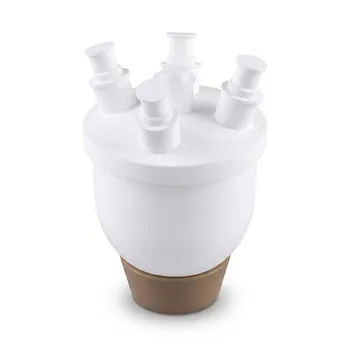
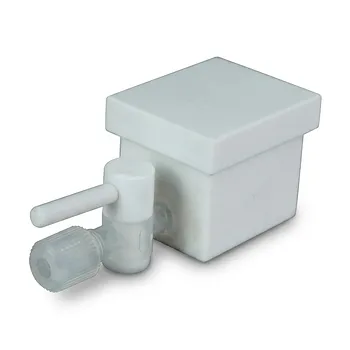
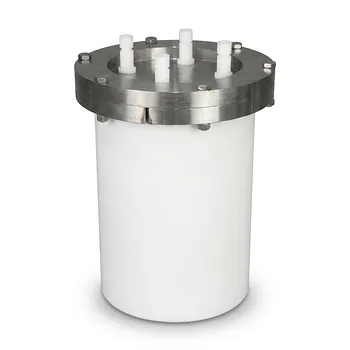
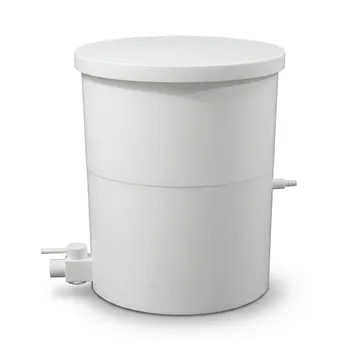
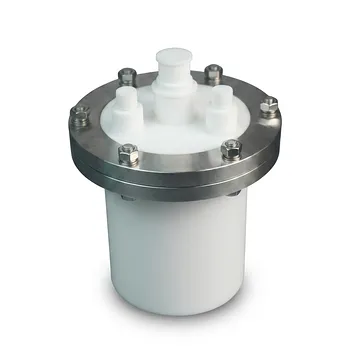
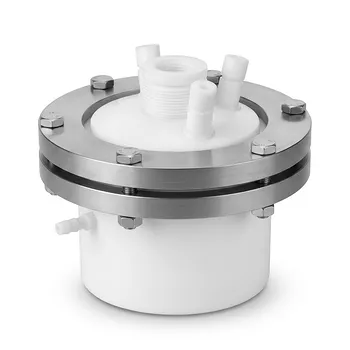
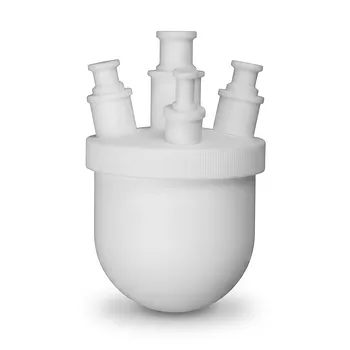
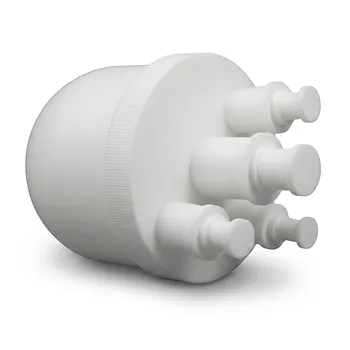
The requirement for Polytetrafluoroethylene (PTFE) vessels in MXene synthesis is driven by the extreme corrosivity of Hydrofluoric acid (HF). The etching process selectively removes aluminum layers from the MAX phase using HF—often generated in situ by mixing lithium fluoride (LiF) and hydrochloric acid (HCl)—which rapidly dissolves glass and corrodes most metallic containers. PTFE provides the essential chemical inertness and thermal stability to safely contain this reaction while ensuring the resulting $Ti_3C_2T_x$ remains free of contaminants.
Core Takeaway: PTFE is the industry-standard material for MXene synthesis because it is one of the few polymers capable of withstanding the aggressive chemical attack of fluoride ions and strong acids over the long durations required for aluminum etching.
The Corrosive Nature of the Etching Environment
The Attack on Conventional Materials
The synthesis of $Ti_3C_2T_x$ requires a "clay-like" etching method involving a mixture of 9 M Hydrochloric acid (HCl) and Lithium Fluoride (LiF).
This combination generates Hydrofluoric acid (HF), a substance notorious for reacting with the silicon dioxide ($SiO_2$) in laboratory glassware, leading to the structural failure of the container.
Standard metallic vessels are equally unsuitable, as the acidic fluoride environment triggers rapid oxidation and dissolution of the metal walls.
Maintaining Stability Under Heat
The etching process is not instantaneous and typically requires maintaining a temperature of approximately 60 °C for 48 hours.
PTFE exhibits exceptional thermal stability, ensuring the vessel does not deform or degrade during these long-duration, high-temperature cycles.
This structural integrity is vital for maintaining a controlled environment, preventing leaks of hazardous acid fumes into the laboratory space.
Ensuring High-Purity MXene Production
Eliminating Ion Leaching
One of the primary goals in MXene synthesis is achieving high purity for applications in electronics, energy storage, or catalysis.
If a less stable polymer or a coated metal were used, the aggressive etchant would cause the leaching of impurity ions from the container walls into the solution.
PTFE’s chemical inertness ensures that no foreign elements are introduced, preserving the specific surface chemistry ($T_x$) of the resulting MXene flakes.
Protecting Experimental Integrity
The dissolution of even a small amount of container material can alter the concentration of the etching bath.
By using a high-quality PTFE liner or beaker, researchers ensure that the chemical stoichiometry of the LiF/HCl mixture remains focused solely on the aluminum layers of the MAX phase.
This consistency is what allows for the repeatable production of high-quality, delaminated $Ti_3C_2T_x$ nanosheets.
Understanding the Trade-offs
Thermal Conductivity Challenges
While PTFE is chemically superior, it is a poor thermal conductor compared to metals or glass.
This means that heating the reaction mixture requires more time to reach equilibrium, and researchers must use external oil baths or precisely controlled heating mantles to ensure the internal temperature is accurate.
Failure to account for this lag can lead to incomplete etching if the internal temperature remains lower than the required threshold.
Mechanical Limitations and "Cold Flow"
PTFE is a relatively soft fluoropolymer that can be prone to mechanical deformation (cold flow) under extreme pressure.
In standard MXene etching at atmospheric pressure, this is rarely an issue, but it must be considered if using high-pressure hydrothermal setups.
Additionally, the porous nature of some lower-grade PTFE can lead to the "memory effect," where trace chemicals from previous experiments are trapped in the material.
How to Apply This to Your Project
Selecting the Right Equipment
When setting up your MXene synthesis laboratory, your choice of vessel should be dictated by your specific safety and purity requirements.
- If your primary focus is High-Purity Synthesis: Use virgin PTFE vessels to eliminate the risk of trace metal contamination during the 48-hour etching period.
- If your primary focus is Safety and Containment: Utilize a PTFE-lined stainless steel autoclave if the reaction requires pressures higher than atmospheric levels.
- If your primary focus is Scalability: Invest in large-capacity PTFE reaction kettles with integrated stirring to ensure uniform heat distribution across the MAX phase slurry.
The selection of PTFE is not merely a preference but a fundamental technical requirement for the safe and successful transformation of MAX phases into functional MXenes.
Summary Table:
| Feature | Advantage in MXene Synthesis |
|---|---|
| HF Resistance | Prevents vessel dissolution during the selective etching of aluminum layers. |
| Chemical Purity | Eliminates ion leaching to ensure uncontaminated, high-quality $Ti_3C_2T_x$ flakes. |
| Thermal Stability | Endures long 48-hour reaction cycles at 60°C without deformation or leaks. |
| Safety & Integrity | Provides a reliable barrier against hazardous acid fumes and structural failure. |
Optimize Your MXene Synthesis with KINTEK High-Performance Fluoropolymers
Ensure the absolute integrity of your materials with KINTEK’s specialized laboratory solutions. Whether you require everyday basic labware like PTFE beakers, crucibles, and reagent bottles, or high-purity trace analysis instruments, we deliver the chemical inertness your research demands. Our catalog spans from fluid transfer components (tubing, fittings, valves) and sample prep tools (filters, pipettes, tweezers) to advanced reaction apparatus such as standard or custom electrochemical cells, hydrothermal synthesis liners, and microwave digestion vessels.
At KINTEK, we specialize in the absolute focus of high-performance fluoropolymer materials. Backed by end-to-end custom CNC fabrication, we are equipped to deliver everything from complex non-standard machined parts and bespoke laboratory setups to high-volume orders of consumables like stirring bars and seal tapes.
Don’t compromise on safety or purity. Contact us today to discover how our PTFE and PFA expertise can enhance your laboratory efficiency and synthesis outcomes!
References
- T. Jaqulin Jenila, M. Khalid Hossain. Unraveling the role of MXene (Ti3C2Tx) integrated Cu-doped WO3 nanocomposites via co-precipitation technique for enhanced supercapacitor performance. DOI: 10.1038/s41598-025-10174-z
This article is also based on technical information from Kintek Knowledge Base .
Related Products
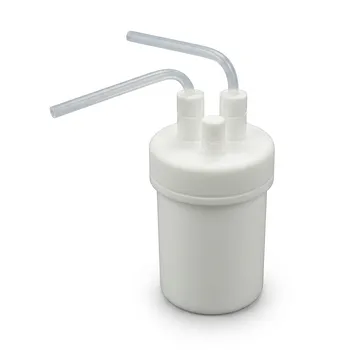
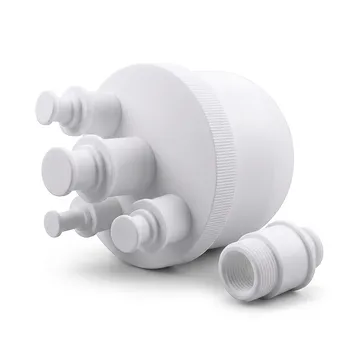
- High Purity PTFE Corrosion Resistant Reaction Vessel with Luer Fittings and Caps for Trace Analysis
- PTFE 10L Reaction Vessel with Stirring Paddle Customizable Corrosion Resistant High Temperature Reactor for Biopharmaceutical and Chemical Processing
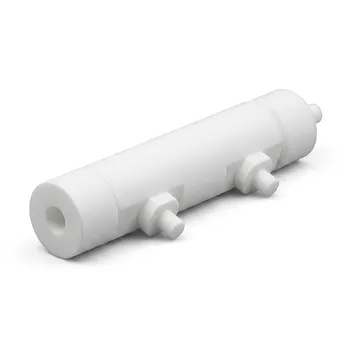
- High Purity PTFE Reaction Vessel Polyfluortetraethylene Cylindrical Tank Petrochemical Reaction Container
- High Purity PTFE Reaction Vessel with Electric Stirring System and Customizable 5L Tank including Buchner Funnel Filtration Assembly
- High Performance Customizable PTFE Reaction Vessel and Corrosion Resistant Polytetrafluoroethylene Flask for Chemical Laboratory Use
People Also Ask
- What reaction vessel and fluid handling considerations are necessary for living cationic polymerization of fluorinated monomers involving Lewis acid catalysts? Key design and safety tips
- Why are high-purity PTFE or PFA reaction vessels recommended for the synthesis of PANI-TiC hybrid materials? - Guide
- Why are fluoroplastic (PTFE) reaction vessels recommended for Methylene Blue (MB) adsorption kinetic experiments?
- Ion Activation Reaction Vessel Requirements: Why PTFE is Critical for Membrane Performance
- What are the key steps for structural integrity in molded PTFE lab reaction vessels? Master fine powder processing.