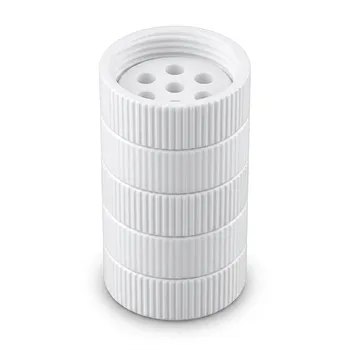
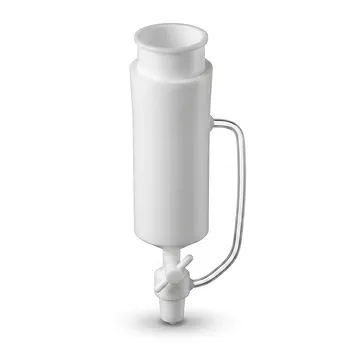
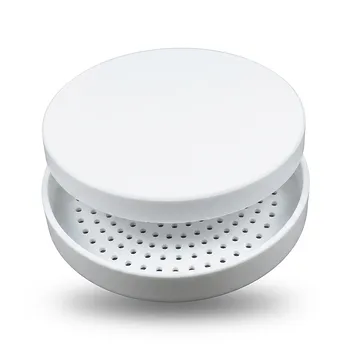
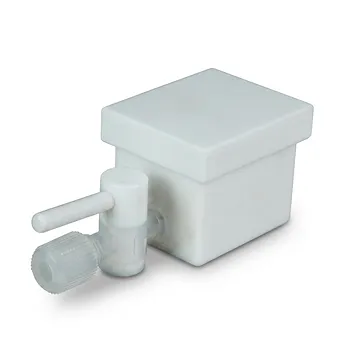
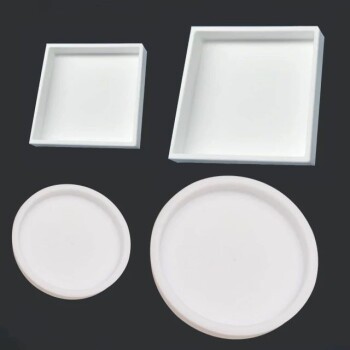
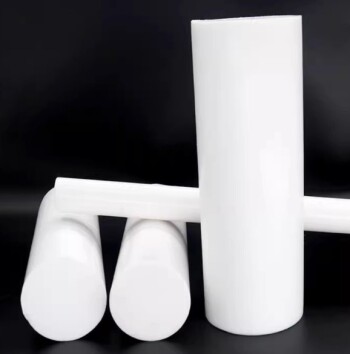
Granular PTFE is the choice for rigid, machinable labware, while emulsion-grade PTFE is the choice for thin, continuous coatings. Granular resin is made by suspension polymerization into coarse particles, then compression-molded and sintered into billets, rods, or blocks for CNC machining. Emulsion-grade PTFE is polymerized in water with surfactants or other polymerization aids, producing stable submicron particles that remain dispersed in a liquid and can be applied by spraying, dipping, or impregnation.
The decisive distinction is not simply chemical composition—it is particle architecture and processing behavior. Granular PTFE forms a dense solid blank that can be machined; emulsion-grade PTFE forms a coating suspension that can spread over and bond to a substrate as a thin fluoropolymer layer.
How the Two PTFE Grades Are Synthesized
Granular PTFE: Suspension Polymerization
Granular PTFE is produced through suspension polymerization, generally without surfactants and with sufficient agitation to keep the growing polymer particles distributed in the reaction medium.
This process yields relatively coarse, irregular, or stringy particles rather than a stable colloidal suspension of submicron spheres. After recovery and classification, the resin is supplied as a granular molding powder.
Emulsion-Grade PTFE: Aqueous Dispersion Polymerization
Emulsion or dispersion-grade PTFE is produced in an aqueous medium with surfactants or polymerization aids. These ingredients stabilize very small PTFE particles in water and help maintain a usable liquid dispersion.
The resulting particles are typically submicron and relatively spherical. Their small size and liquid suspension behavior are valuable for forming uniform films, but they do not provide the free-flowing bulk structure required to make a thick billet by ordinary compression molding.
Why Particle Size Changes the Manufacturing Route
Granular resin is engineered to pack into a mold, consolidate under pressure, and fuse during high-temperature sintering. Emulsion-grade resin is engineered to remain suspended, flow across a surface, and form a thin, continuous deposit during drying and sintering.
In practical terms, granular PTFE is a bulk-forming material, whereas emulsion-grade PTFE is a film-forming material.
Why Granular PTFE Fits CNC-Machined Labware
Compression Molding Creates the Machining Blank
Granular PTFE is first compression-molded and sintered into a solid block, rod, tube, or other semifinished shape. The resulting blank has sufficient thickness and continuity to support turning, milling, drilling, boring, and other CNC operations.
The machining step then creates the final geometry, including ports, internal cavities, threads, grooves, and sealing surfaces.
The Process Supports Structural Geometry
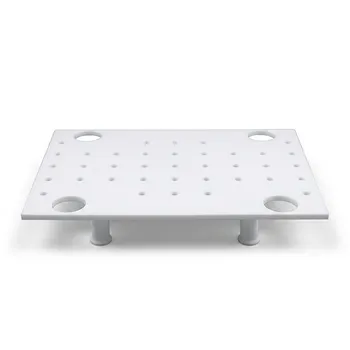
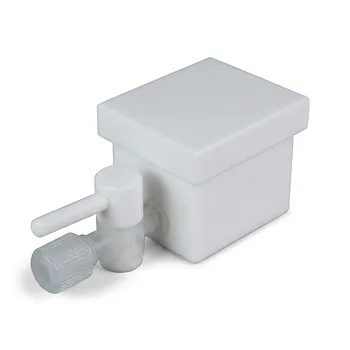
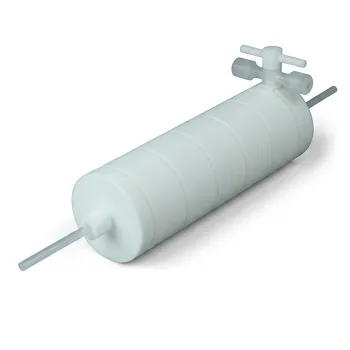
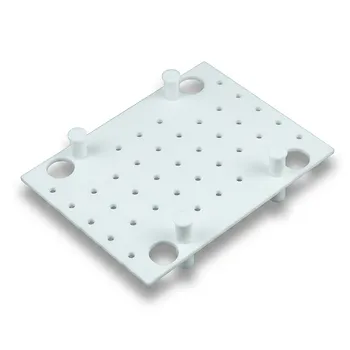
This route is appropriate for thick-walled laboratory components such as:
- Custom beakers and reagent containers
- Electrochemical cell bodies
- Microwave digestion vessels
- Custom manifolds
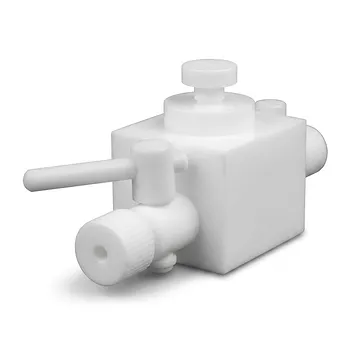
- Valve bodies and fittings
- Reaction vessels and crucibles
These parts need dimensional integrity, wall thickness, and mechanical robustness, not merely a low-friction or non-wetting surface.
Granular Resin Grades Still Require Selection
Not all granular PTFE behaves identically. Fine-cut grades can provide high strength and elongation for demanding machined parts and seals, while free-flow grades can offer easier mold filling and lower shrinkage for repeat production.
Ram-extrusion grades are directed toward continuous thick-walled rods or tubes, and modified PTFE grades can be considered where improved deformation resistance or elongation is important. The correct resin must therefore be selected for the molding method, geometry, shrinkage tolerance, and mechanical load.
Why Emulsion-Grade PTFE Fits Fluid Coatings
Aqueous Dispersion Enables Thin Application
Emulsion-grade PTFE is supplied as a liquid dispersion in which fine PTFE particles are distributed through water. The dispersion can be applied by spray coating, dip coating, or impregnation, depending on the substrate and required film structure.
After application, drying removes the liquid phase, and subsequent heating coalesces the PTFE particles into a continuous fluoropolymer layer.
Coatings Need Surface Coverage, Not Bulk Machinability
A fluid coating must spread evenly over a substrate and produce a consistent, thin protective layer. Submicron particles help the dispersion reach small surface features and form a more uniform film than coarse granular particles would.
Typical objectives include chemical resistance, low surface energy, hydrophobicity, non-wetting behavior, and reduced friction. The coating uses the substrate for structural support; it is not expected to become a self-supporting machined body.
Coatings Are Used Where the Substrate Supplies Strength
Emulsion-grade PTFE is suitable when the underlying material—such as metal, glass, ceramic, or another engineered substrate—already provides the required rigidity and dimensional stability.
This makes it useful for protective and anti-corrosion surfaces, non-stick interfaces, impregnation treatments, and other applications where only a thin fluoropolymer layer is needed.
The Processing Decision: Billet or Dispersion?
Choose the Route That Matches the Final Geometry
A CNC-machined part begins with a solid, oversized blank. Granular PTFE can be consolidated into that blank before machining, making it suitable for complex three-dimensional labware.
A coated part begins with a finished substrate. Emulsion-grade PTFE is deposited onto its surface, then dried and sintered, making it suitable for surface modification rather than structural fabrication.
Why the Grades Are Not Interchangeable
Attempting to use emulsion-grade PTFE as a granular molding resin overlooks its intended colloidal form and processing behavior. It is designed to remain dispersed and form a film, not to consolidate efficiently into a thick, machinable billet.
Conversely, using granular PTFE for a fluid coating would introduce coarse particles that are difficult to distribute uniformly and would not provide the same smooth, thin-film formation behavior.
Keep Fine Powder PTFE Separate From Coating Dispersion
Fine powder PTFE is also associated with dispersion polymerization, but it is not identical to an aqueous coating dispersion. Fine powder is typically recovered, dried, and formulated with a lubricant for paste extrusion into flexible tubing, thin-wall products, or membranes.
Therefore, the practical distinction is:
- Granular PTFE: compression molding, sintering, and CNC machining.
- Fine powder PTFE: paste extrusion and related flexible or porous products.
- Aqueous emulsion-grade PTFE: liquid application, drying, and sintering for coatings.
Understanding the Trade-offs
Granular PTFE Offers Structure but Requires More Manufacturing Steps
Granular PTFE enables robust, custom geometries, but the process involves mold design, compression molding, sintering, shrinkage control, and CNC machining. This can be slower and more material-intensive than applying a coating to an existing component.
It is nevertheless the appropriate route when the PTFE itself must provide the component’s wall thickness, chemical containment, and mechanical form.
Emulsion-Grade PTFE Offers Surface Function but Limited Thickness
A dispersion coating can efficiently add chemical resistance or non-wetting behavior to a substrate. However, it is generally not a replacement for a thick structural PTFE part.
The coating’s performance also depends on surface preparation, application uniformity, drying, sintering, adhesion, and the thermal limits of the substrate.
PTFE Processing Has Important Thermal and Dimensional Considerations
Both routes require controlled thermal processing to develop the final PTFE structure. For molded blanks, shrinkage affects machining dimensions; for coatings, drying and sintering affect film continuity and adhesion.
Designing from the resin grade alone is insufficient. The mold, machining allowance, substrate, coating thickness, and thermal cycle must all be considered together.
How to Apply This to Your Project
Select the PTFE form based on whether you are creating a self-supporting component or modifying an existing surface.
- If your primary focus is CNC-machined laboratory vessels or structural components: Use granular suspension-polymerized PTFE, compression-molded and sintered into a billet or rod before machining.
- If your primary focus is protective, hydrophobic, non-stick, or anti-corrosion fluid coatings: Use an aqueous emulsion-grade PTFE dispersion designed for spray, dip, or impregnation application.
- If your primary focus is flexible PTFE tubing or thin-wall fluid transfer products: Evaluate fine-powder PTFE formulated for paste extrusion rather than either a conventional granular resin or coating dispersion.
- If your primary focus is dimensional precision and repeated production: Match the granular grade to the molding method, shrinkage behavior, particle flow, and required mechanical performance.
Choose granular PTFE when the polymer must become the structure, and emulsion-grade PTFE when it must become the surface.
Summary Table:
| Property | Granular PTFE | Emulsion-grade PTFE |
|---|---|---|
| Synthesis | Suspension polymerization, coarse particles | Dispersion polymerization, submicron particles |
| Processing | Compression molding, sintering, CNC machining | Spraying, dipping, impregnation, drying, sintering |
| Form | Solid billet, rod, block | Liquid dispersion |
| Best For | Machined labware, structural components | Thin, uniform coatings |
| Applications | Beakers, vessels, valve bodies | Anti-corrosion, non-stick, hydrophobic surfaces |
| Thickness | Bulk, self-supporting | Thin film, substrate-supported |
Ready to choose the right PTFE for your project? At KINTEK, we specialize in high-performance fluoropolymers, offering both granular PTFE for precision CNC-machined labware and emulsion-grade PTFE for advanced coatings. Our custom solutions are designed to meet your exact specifications, whether you need robust beakers, bespoke electrochemical cells, or durable protective surfaces. With our end-to-end PTFE/PFA manufacturing capabilities, we ensure quality and reliability. Contact us today to discuss your requirements and experience the KINTEK advantage!
Related Products
- Custom PTFE Filtration System Acid Resistant High Purity Semiconductor Grade Chemical Processing Filter
- High Corrosion Resistant PTFE Faucet Polytetrafluoroethylene Valve for Chemical Storage Drums and Fluid Transfer Systems Customizable Industrial Grade
- PTFE PFA Vacuum Filtration System Corrosion Resistant Customizable Shatterproof Laboratory Device
- PTFE Corrosion Resistant Filter with PFA Valve Connections and Integrated Sieve Plate
- High Temperature Chemical Resistant 50ml PTFE Syringe Customized Teflon Injector with Threaded Seal for Trace Analysis
People Also Ask
- What makes PTFE filtration systems advantageous for industrial and scientific use? Unmatched Chemical & Thermal Stability
- What sizes and pore options are available for PTFE filters? Choose the Right Filter for Your Application
- What steps are involved in selecting the proper PTFE filter? A 4-Step Guide to Optimal Filtration
- What temperature resistance do PTFE filters offer? Unmatched Thermal Stability from -200°C to +260°C
- How does the hydrophobicity of PTFE filters benefit their use? Ensure Uninterrupted Gas Flow and Solvent Filtration