The Invisible Threat in Your Reactor: Why "Good Enough" Stirring Isn't
Imagine you are mid-way through a critical synthesis involving aggressive reagents—perhaps a concentrated acid or a reactive solvent. Your overhead stirrer is humming along, and everything looks stable. But when you analyze the final product, the results are catastrophic: trace metal contamination has skewed your data, or worse, "black specks" of degraded coating have appeared in your high-purity batch.
For many researchers in semiconductor development, battery testing, and trace analysis, this isn't a hypothetical scenario—it’s a recurring nightmare. When the stakes are high, the tools that sit in the "heart" of your reaction shouldn't be the weakest link.
The Common Struggle: The Failure of Coated Solutions
When faced with corrosion, the standard response is often to reach for a "coated" metal stirrer or a generic plastic paddle. At first, these seem to work. However, they frequently lead to a cycle of frustration:
- Delamination under Stress: The mechanical forces required to mix viscous fluids—known as viscous drag—create significant shear. This stress often causes thin polymer coatings to peel or crack, exposing the reactive metal core underneath.
- Chemical Incompatibility: Many standard plastics swell or degrade when exposed to the harsh solvents used in modern chemical research.
- Cross-Contamination: Once a stirrer’s surface is compromised, it becomes a trap for residues, making thorough cleaning impossible and ruining subsequent experiments.
The business cost of these failures is immense: lost weeks of research, wasted high-value precursors, and the constant overhead of replacing "disposable" equipment that was supposed to last.
Revealing the Root Cause: Physics vs. Materials
Why do these common solutions fail? The answer lies in the intersection of fluid dynamics and material science.
In an overhead stirrer, the rotor (or impeller) must generate either axial motion (pushing fluid up or down) or radial motion (pushing fluid outward toward the walls) to achieve a homogenous mix. This motion is created by viscous drag and shear.
If your stirrer is simply "dipped" in a protective layer, that layer is not structurally integrated to handle these mechanical forces. Furthermore, in aggressive reactors, chemicals don't just sit on the surface; they look for any microscopic pore or "pinhole" in a coating to begin the corrosion process from the inside out.
To solve this, you don't need a better coating; you need a tool where the protection is the structural foundation.
The Solution: Precision-Engineered PTFE Rotors
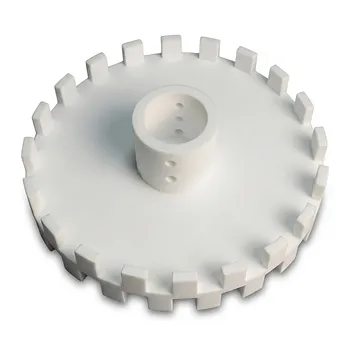
The definitive answer to the contamination crisis is the transition to high-precision PTFE (Polytetrafluoroethylene) rotors. At KINTEK, we design these components not as an afterthought, but as critical engineering solutions.
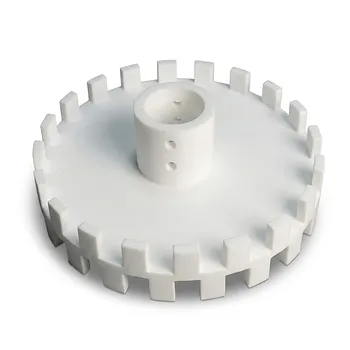
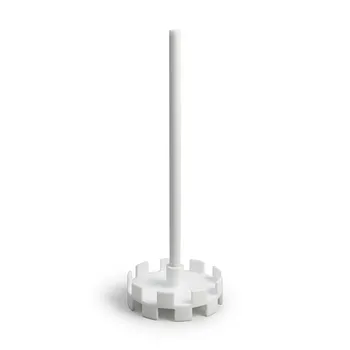
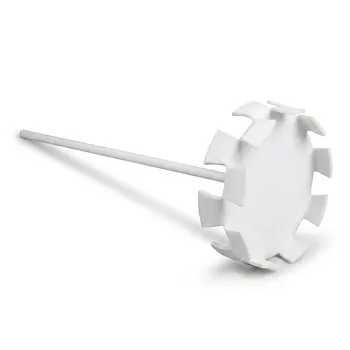
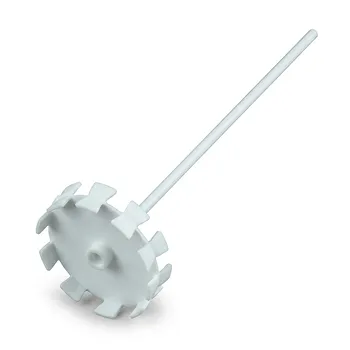
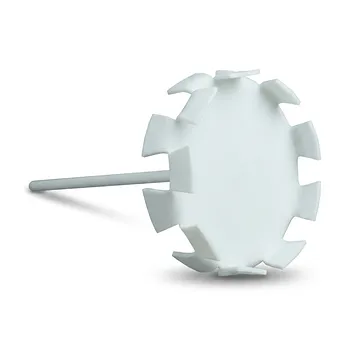
Our PTFE rotors function as high-performance impellers fused to a PTFE-encapsulated shaft. This design addresses the root cause of stirrer failure in three ways:
- Total Inertness: PTFE is almost entirely non-reactive. Whether you are working with hydrofluoric acid or volatile organic compounds, the material remains stable, ensuring that the only thing in your sample is your sample.
- Encapsulation Integrity: By fusing the rotor to an encapsulated shaft, we eliminate the "seams" where chemicals typically penetrate. This creates a solid, impervious barrier that survives high-shear environments.
- Optimized Fluid Dynamics: Because we use custom CNC fabrication, our rotors are not "one size fits all." We can tailor the geometry to provide the exact axial or radial flow your specific fluid viscosity requires, ensuring efficient mixing without over-stressing the motor or the material.
Opening New Doors in Research and Production
When you eliminate the fear of contamination and equipment failure, the horizon of your research expands. With KINTEK’s high-purity PFA and PTFE components, lab teams are moving beyond "just getting by" and into new realms of possibility:
- Ultra-Trace Analysis: Achieve the sub-ppb (parts per billion) detection limits required in semiconductor and environmental testing without interference from labware.
- Accelerated Battery Research: Test aggressive electrolyte formulations at higher temperatures and speeds, knowing your testing fixtures can handle the heat and chemistry.
- Seamless Scaling: Move from a specialized prototype in the lab to high-volume industrial production with components that maintain the same high-purity standards.
Solving the "stirrer problem" is about more than just a piece of plastic; it’s about providing the stability and reliability your innovation deserves.
At KINTEK, we specialize in turning complex material challenges into streamlined laboratory successes. Whether you need a specialized prototype for a new reactor or high-volume components for industrial applications, our engineering team is ready to help you eliminate contamination and optimize your fluid transfer processes. Contact Our Experts today to discuss how our custom PTFE and PFA solutions can safeguard your next breakthrough.
Related Products
- Large Capacity PTFE Reaction Bottle 2L Wide Mouth Fluoropolymer Extraction Vessel Compatible with Rotary Agitators
- Customizable PTFE Rods for Advanced Industrial Applications
- Custom Graphite Filled PTFE Rods for Advanced Industrial Applications
- High Corrosion Resistant PTFE Faucet Polytetrafluoroethylene Valve for Chemical Storage Drums and Fluid Transfer Systems Customizable Industrial Grade
- Custom PTFE Dispersing Disc and Stirring Rod for Chemical Processing and Laboratory Mixing
Related Articles
- The 260°C Illusion: Why Your PTFE Bottle's True Limit is a System, Not a Number
- The Price of Purity: When a Simple Bottle Becomes Mission-Critical
- The Real Reason You're Losing Samples: Why Your Choice of Lab Bottle Matters More Than You Think
- The Phantom Contaminant: Why Your Metal Rotors Are Sabotaging Your ICP-MS Results
- The Anatomy of Precision: Why Your PTFE Rotor Valves Fail and How Understanding Their Structure Fixes It