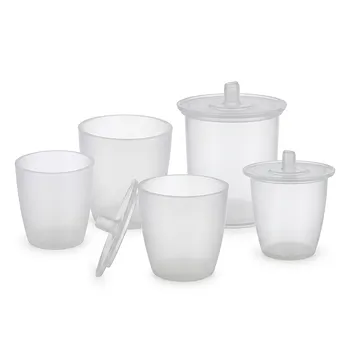
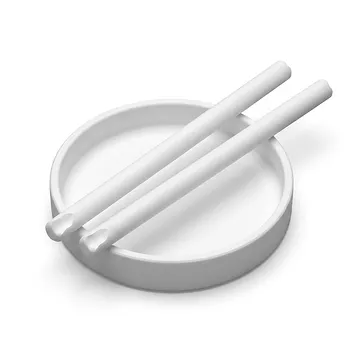
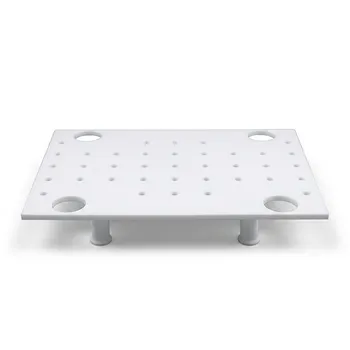
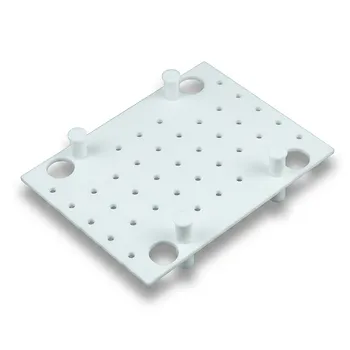
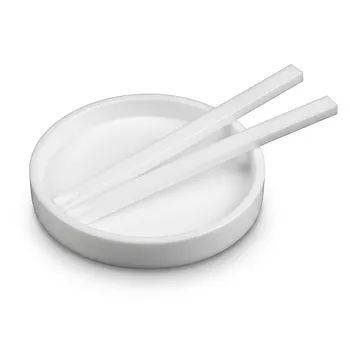
Solid PTFE laboratory supplies must be cold-pressed and sintered because PTFE does not become a freely flowing liquid when heated. Its exceptionally high molecular weight produces a melt viscosity of approximately 10^11 poise at 380°C, more than a million times higher than that of ordinary melt-processable thermoplastics. Above its melting point, PTFE forms a stiff, gel-like phase with virtually no flow, so injection molding cannot force it through runners and into a mold cavity. Instead, manufacturers compact PTFE powder into a preform, sinter it to fuse the particles, and machine the resulting solid stock into the finished component.
PTFE is processed as a powder, not as a conventional melt. Cold pressing provides the initial shape and density; sintering creates a continuous solid structure; precision machining then produces the tolerances and geometries required for laboratory supplies.
Why Conventional Injection Molding Fails
PTFE Has an Exceptionally High Molecular Weight
PTFE commonly has a molecular weight ranging from approximately 10^6 to more than 10^7 g/mol. Its long, unbranched molecular chains become heavily entangled, resisting the movement required for a polymer melt to flow.
By comparison, conventional injection-molding plastics become sufficiently fluid above their processing temperatures to travel through narrow channels and fill a mold. PTFE remains extraordinarily resistant to that movement.
Heating Does Not Create a Usable Liquid
PTFE melts at approximately 327°C, but melting does not produce the low-viscosity liquid associated with ordinary thermoplastics. At temperatures around 380°C, its melt creep viscosity remains approximately 10^11 poise, or about 10^10 Pa·s.
This is why simply increasing the injection pressure or mold temperature does not solve the problem. PTFE has no practical flow window in which it can be injected like polyethylene, polypropylene, or other standard thermoplastics.
The Molecular Structure Restricts Flow
PTFE's fluorine atoms closely shield its carbon backbone, while the polymer's linear structure and high crystallinity further limit chain mobility. The result is a material with outstanding chemical and thermal performance, but extremely poor melt flow.
This trade-off is fundamental: the same molecular structure that gives PTFE its chemical inertness and service temperature also prevents conventional melt processing.
How Cold Pressing and Sintering Work
Cold Pressing Creates a Dense Preform
Granular PTFE resin is first placed into a mold and compacted under pressure, usually near room temperature. This produces a high-density preform or stock shape such as a block, rod, tube, or near-net-shape component.
Cold pressing shapes the powder mechanically. It does not depend on the polymer flowing through the mold.
Sintering Fuses the Particles
The pressed preform is heated above PTFE's melting range, typically above 340°C, under a controlled thermal cycle. The individual particles coalesce and form a continuous solid structure as the material cools.
Sintering therefore replaces the particle-to-particle bonding that injection molding would normally achieve through melt flow. Careful temperature control is important because PTFE's properties depend on its thermal history, crystallinity, and cooling rate.
Machining Produces the Final Geometry
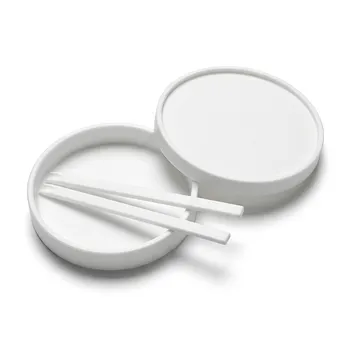
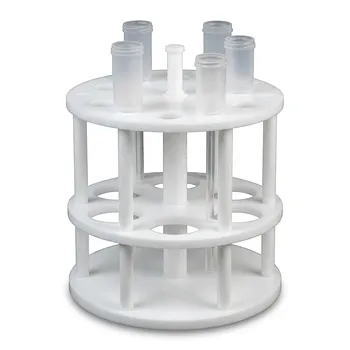
After sintering, the solid PTFE stock is commonly machined using CNC equipment. This enables manufacturers to produce beakers, crucibles, cleaning tanks, reaction-vessel liners, fittings, valves, and other laboratory components with controlled dimensions.
Machining is particularly valuable for custom or low-volume laboratory supplies, where creating dedicated injection molds would be uneconomical or technically unsuitable.
Why This Route Suits Laboratory Supplies
It Preserves PTFE's Performance
The powder-compaction and sintering route produces dense PTFE while retaining the properties that make it useful in laboratories: chemical resistance, low surface energy, thermal endurance, and high purity.
These characteristics matter when components contact aggressive reagents, corrosive vapors, solvents, or high-temperature chemical systems.
It Supports Custom and Complex Components
Laboratory equipment often requires non-standard dimensions, internal channels, sealing surfaces, threaded fittings, or specialized vessel geometries. CNC machining from sintered billets can accommodate these requirements without the fixed geometry of a conventional injection mold.
The process is therefore well suited to prototypes, specialized apparatus, replacement parts, and relatively small production runs.
It Provides Reliable Mechanical Integrity
Sintering produces a unified PTFE body rather than a loose assembly of particles. When the preform is properly compacted and thermally processed, the resulting material provides the density and mechanical reliability required for handling, sealing, and repeated laboratory use.
Understanding the Trade-offs
Machining Can Generate Material Waste
CNC machining removes material from a larger sintered billet or preform. For complex shapes, this can create substantial scrap and increase manufacturing cost.
The waste is an accepted consequence of obtaining accurate custom geometries from a material that cannot be conventionally injection molded.
Production Is Slower Than Standard Injection Molding
Cold pressing, thermal sintering, cooling, and machining generally require more time than a high-volume injection-molding cycle. PTFE parts are consequently more expensive when compared with mass-produced components made from easily melt-processed plastics.
The economics improve when the application requires PTFE's chemical and thermal performance rather than simply a low-cost molded plastic.
Dimensional Control Requires Process Management
PTFE can undergo dimensional changes during sintering and cooling because of changes in crystallinity and thermal contraction. Manufacturers must account for these effects during preform design and machining.
Precision laboratory components may therefore require controlled sintering cycles, machining allowances, and inspection after processing.
Not Every Fluoropolymer Has the Same Limitation
The processing restriction described here applies primarily to high-molecular-weight, unmodified PTFE. Some modified fluoropolymers or PTFE grades are designed to provide improved melt processability, but they may not offer exactly the same combination of purity, molecular structure, chemical resistance, or performance.
Paste extrusion is also used for certain PTFE products, particularly tubing and other continuous profiles. It does not change the central point: conventional melt injection molding is unsuitable for standard high-molecular-weight PTFE.
How to Apply This to Your Project
The appropriate manufacturing route depends on the required geometry, production volume, and performance requirements.
- If your primary focus is chemical resistance and material purity: Specify standard sintered PTFE and confirm the resin grade, thermal-processing controls, and cleanliness requirements.
- If your primary focus is dimensional precision: Use a sintered PTFE preform followed by precision CNC machining and define the required tolerances after sintering.
- If your primary focus is high-volume production: Evaluate a different fluoropolymer or modified PTFE grade only if its melt processability does not compromise the required laboratory performance.
- If your primary focus is custom or low-volume apparatus: Use cold-pressed and sintered PTFE stock machined to the final geometry, since this avoids the cost and constraints of dedicated injection molds.
The essential design principle is simple: PTFE's exceptional performance comes from a molecular structure that prevents ordinary melt flow, so it must be shaped through powder compaction, sintering, and machining rather than conventional injection molding.
Summary Table:
| Aspect | Conventional Injection Molding | Cold Pressing + Sintering |
|---|---|---|
| Melt flow | Unusable (10^11 poise) | N/A (powder compaction) |
| Shaping mechanism | Melt injection into mold | Pressure compaction + thermal fusion |
| Common forms | Pellets, complex molded parts | Billets, rods, tubes, custom-machined parts |
| Dimensional control | Mold-limited | Achieved via CNC machining |
| Suitability for PTFE | Not applicable | Standard for high MW PTFE |
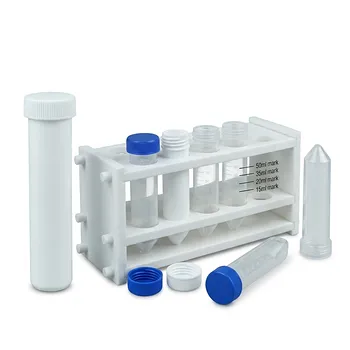
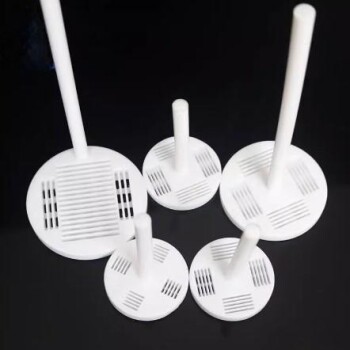
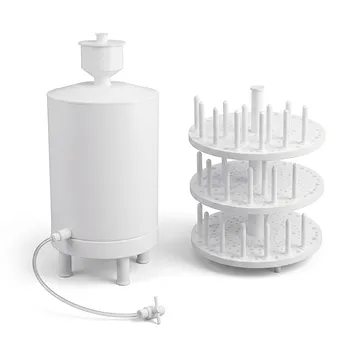
Need precision PTFE labware with exceptional chemical resistance? KINTEK offers custom CNC-machined parts, standard vessels, and high-purity components. Contact us today to discuss your requirements and receive a tailored quote.
Related Products
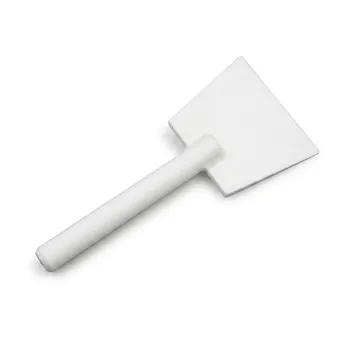
- Corrosion Resistant PTFE Laboratory Material Scoop for Biopharmaceutical Use Non Stick Easy Clean Fluoropolymer Shovel
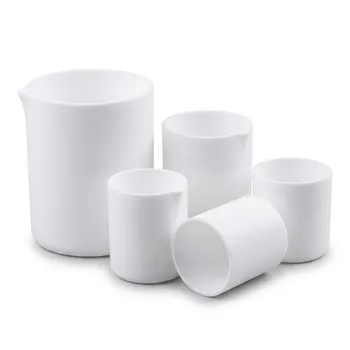
- Large Scale PTFE Beakers and Flasks for High Temperature Corrosion Resistant Laboratory Applications with Custom CNC Fabrication
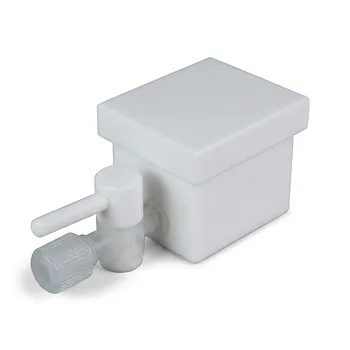
- Custom PTFE Laboratory Apparatus Corrosion Resistant Low Background Reaction Cells Precision CNC Fabrication
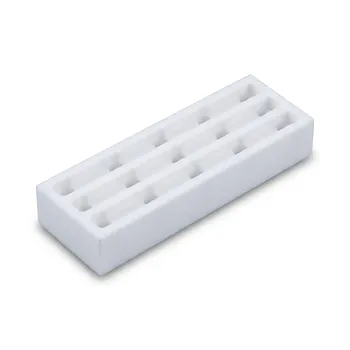
- Custom PTFE Laboratory Cleaning Basket Carrier High Purity Acid Base Resistant Wafer Holder Low Background Contamination Free Chemical Bath Rack
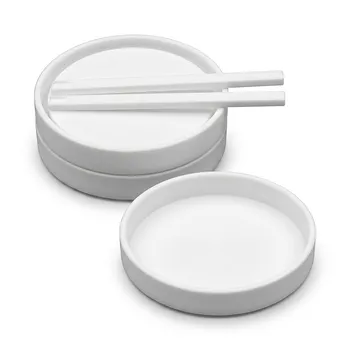
- Custom Polytetrafluoroethylene PTFE Petri Dishes 60mm Corrosion Resistant Low Background Labware
People Also Ask
- What advantages do PTFE's surface properties provide for lab tools? Optimize Sample Recovery and Tool Longevity
- What factors should be considered when selecting a PTFE shovel for laboratory use? Ensure Chemical Inertness & Sample Integrity
- What structural and chemical characteristics give PTFE laboratory products their exceptional thermal stability and flame resistance? Discover the science behind PTFE's outstanding heat resistance.
- What additional advantages does PTFE offer for laboratory use? Maximize Purity and Reliability
- What molecular characteristics provide PTFE laboratory tools with ultra-low surface energy and anti-stick properties for fluid transfer? Discover the science behind PTFE's non-stick performance.