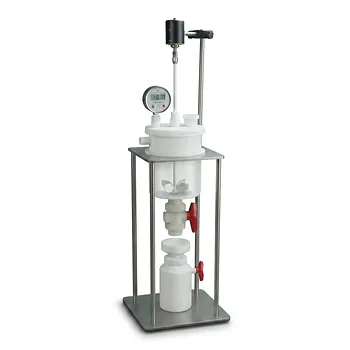
PTFE laboratory products resist heat and flame because their carbon backbone is completely shielded by strong carbon–fluorine bonds. PTFE’s linear, unbranched polymer structure and tightly packed fluorine atoms limit chemical attack, chain movement, oxidation, and thermal breakdown. This combination gives PTFE a typical continuous-use temperature around 260°C, a high melting range near 327–342°C, and exceptionally low flammability compared with ordinary hydrocarbon plastics.
PTFE’s performance comes from both chemistry and geometry: strong C–F bonds protect the carbon chain, while the dense fluorine sheath and rigid helical structure restrict access, movement, and oxidation. PTFE is highly flame resistant, but it is not immune to decomposition at sufficiently high temperatures.
Why PTFE Remains Stable at High Temperatures
Strong carbon–fluorine bonds
PTFE is built from a carbon backbone in which hydrogen has been replaced by fluorine. The resulting carbon–fluorine bonds, with bond energies commonly cited around 490 kJ/mol, are stronger than many bonds found in conventional hydrocarbon polymers.
Breaking these bonds requires substantial energy. As a result, heat is less likely to initiate the chain-scission reactions that cause ordinary plastics to soften, oxidize, or decompose.
A linear, unbranched carbon backbone
PTFE consists primarily of a linear, unbranched carbon–carbon chain. This regular architecture avoids many weak structural sites associated with branching, tertiary carbons, or irregular pendant groups.
The backbone itself is also protected by fluorine atoms. Heat and aggressive chemicals therefore have limited access to the carbon chain, helping PTFE retain its mass, purity, and chemical inertness under demanding laboratory conditions.
A dense fluorine sheath
Fluorine atoms form a nearly continuous protective layer around the carbon backbone. Their size, electronegativity, and dense electron shell create both chemical shielding and steric protection.
This sheath makes it difficult for oxidants, acids, bases, and solvents to reach and react with the underlying carbon structure. The same shielding contributes to PTFE’s resistance to contamination and leaching in vessels, tubing, crucibles, and digestion components.
A rigid helical molecular arrangement
PTFE chains adopt a tightly organized helical conformation, often described as a 13/6 helix. The arrangement places fluorine atoms around the backbone while creating steric interactions that restrict free rotation and chain mobility.
Reduced molecular movement helps limit the physical distortion and internal rearrangement that can accelerate thermal degradation. It is one reason PTFE remains more stable than many common thermoplastics when exposed to sustained heat.
How These Characteristics Produce Flame Resistance
High energy is required to initiate degradation
Combustion begins with thermal decomposition: heat breaks polymer bonds and generates volatile fragments that can serve as fuel. PTFE’s strong C–F bonds and protected backbone make this initial breakdown difficult.
Because less combustible material is generated readily, PTFE generally shows very low flammability and strong resistance to flame propagation compared with hydrocarbon-based polymers.
Fluorine reduces the availability of hydrocarbon fuel
Conventional plastics contain many carbon–hydrogen bonds and can produce flammable hydrocarbon vapors during heating. PTFE contains no hydrogen in its polymer backbone.
Its fluorine-rich composition changes the nature of thermal decomposition products and substantially reduces the formation of ordinary hydrocarbon fuel. This is a central chemical reason PTFE tends to resist sustained burning and often self-extinguishes when an external flame is removed.
The structure suppresses oxidation
Oxidation is a major pathway for polymer damage at elevated temperatures. The fluorine sheath physically and electronically protects the carbon chain, making oxidation more difficult than in less highly fluorinated polymers.
This protection is particularly valuable in laboratory environments where heat may be combined with oxygen, concentrated acids, oxidizing reagents, or solvent vapors.
Flame resistance is not the same as unlimited temperature resistance
PTFE’s flame resistance does not mean it remains unchanged at every temperature. At sufficiently high temperatures, PTFE can thermally decompose and release hazardous fluorinated products.
Therefore, laboratory users must distinguish between continuous operating temperature, melting behavior, short-term exposure, and decomposition conditions.
Why PTFE Performs Well in Laboratory Products
Maintaining sample integrity
PTFE’s chemical inertness reduces the likelihood that the laboratory product will react with process chemicals or contaminate a sample. This is important in trace analysis, digestion, extraction, and high-purity handling.
The same protection that limits thermal and oxidative damage also helps prevent dissolution, swelling, and chemical leaching in many aggressive environments.
Supporting high-temperature digestion and reaction work
Digestion vessels, microwave vessels, crucibles, heating-block components, and tubing may encounter simultaneous heat and severe chemical exposure. PTFE’s strong molecular structure allows these products to retain useful physical and chemical integrity under such conditions.
However, the actual operating limit depends on the product design, pressure, mechanical load, exposure duration, and specific chemical environment—not only on the polymer’s nominal temperature rating.
Comparing PTFE with less highly fluorinated materials
PTFE’s fully fluorinated, unbranched structure generally gives it greater thermal stability than fluoropolymers with less uniform shielding or more vulnerable structural sites. For example, branching and tertiary carbon sites in some related materials can provide locations more susceptible to high-temperature oxidation.
This does not make every PTFE product superior for every application. Other fluoropolymers may offer better melt processing, flexibility, transparency, or sealing performance, even when their continuous-use temperature is lower.
Understanding the Trade-offs
PTFE can soften and creep before it decomposes
High chemical stability should not be confused with high mechanical strength at temperature. PTFE can soften, deform, and undergo creep under load as it approaches its melting range.
A vessel may remain chemically intact while losing dimensional accuracy or mechanical support. Fixtures, pressure conditions, wall thickness, and load must therefore be evaluated separately from chemical compatibility.
Decomposition products can be hazardous
Although PTFE resists ignition, overheating can cause decomposition. Some decomposition products may be harmful if inhaled, so ventilation, temperature control, and manufacturer guidance are essential.
Products should never be deliberately overheated to test their flame resistance or used beyond their specified service conditions.
Bond-energy comparisons require care
Reported bond energies vary with the measurement method and chemical context. It is more accurate to treat values such as approximately 490 kJ/mol for the C–F bond as useful comparative indicators rather than exact universal constants.
PTFE’s performance does not arise from bond strength alone. Its complete fluorine shielding, regular backbone, molecular conformation, and fluorine-rich composition work together.
“Chemically inert” is not absolute
PTFE is exceptionally resistant to many acids, bases, solvents, and reagents, but no material is compatible with every chemical under every combination of temperature, concentration, pressure, and exposure time.
Compatibility data should be checked for the specific reagent and operating condition, especially when high temperature or mechanical stress is involved.
How to Apply This to Your Project
PTFE is most appropriate when thermal exposure and chemical aggressiveness must be handled simultaneously.
- If your primary focus is high-temperature chemical processing: Use PTFE where its continuous-use temperature and mechanical limits are adequate, while accounting for softening and creep near the upper range.
- If your primary focus is flame resistance: PTFE’s fluorine-rich, hydrogen-free structure provides strong resistance to ignition and flame propagation, but it must still be protected from overheating and decomposition.
- If your primary focus is sample purity: Choose PTFE for its shielded carbon backbone and low chemical reactivity, then verify compatibility with the exact reagents and temperatures.
- If your primary focus is mechanical performance under heat: Do not rely on PTFE’s chemical stability alone; evaluate load, pressure, dimensional stability, and creep at the intended operating temperature.
PTFE’s exceptional laboratory performance comes from the combined effect of strong C–F chemistry and a tightly shielded, highly regular molecular structure.
Summary Table:
| Characteristic | Contribution to Thermal Stability & Flame Resistance |
|---|---|
| Strong C-F bonds | High bond energy (~490 kJ/mol) resists thermal breakdown |
| Linear, unbranched backbone | Eliminates weak sites; limits chain scission and oxidation |
| Dense fluorine sheath | Blocks oxidants & chemicals, preventing degradation |
| Rigid helical structure | Restricts chain movement, increasing thermal stability |
| Hydrogen-free composition | Reduces flammable fuel, enhancing flame resistance |
Enhance your lab's safety and precision with high-performance PTFE/PFA labware from KINTEK. Our products are engineered to withstand extreme temperatures and aggressive chemicals, ensuring reliable results in digestion, trace analysis, and high-purity processing. Whether you need standard beakers, custom electrochemical cells, or large-volume machining, our end-to-end CNC capabilities deliver bespoke solutions for your specific needs. Contact us today to discuss your requirements and experience the KINTEK advantage. Get in touch with us.
Related Products
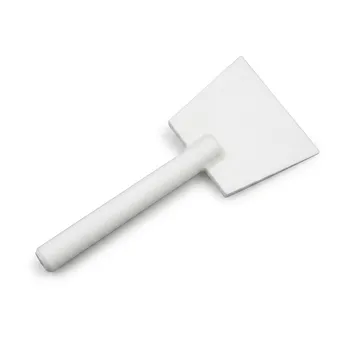
- Corrosion Resistant PTFE Laboratory Material Scoop for Biopharmaceutical Use Non Stick Easy Clean Fluoropolymer Shovel
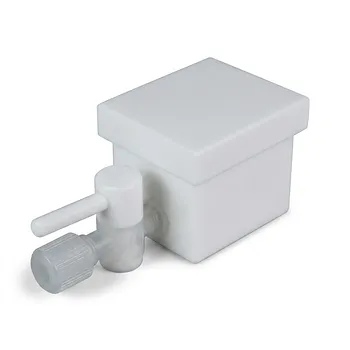
- Custom PTFE Laboratory Apparatus Corrosion Resistant Low Background Reaction Cells Precision CNC Fabrication
- Custom PTFE Petri Dish 30mm Corrosion Resistant Low Background Non Leaching Laboratory Ware
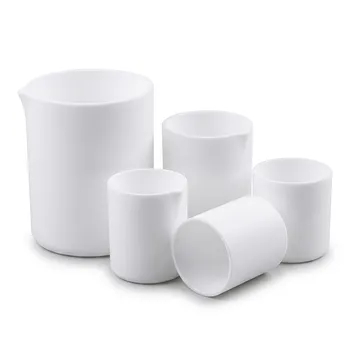
- Large Scale PTFE Beakers and Flasks for High Temperature Corrosion Resistant Laboratory Applications with Custom CNC Fabrication
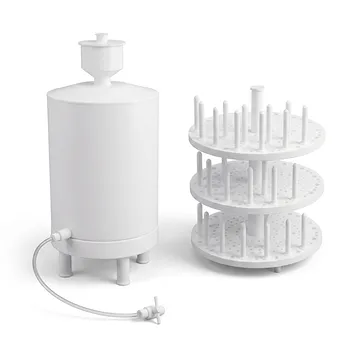
- High Purity Corrosion Resistant PTFE Acid Reflux Cleaning System for Laboratory Trace Analysis
People Also Ask
- What advantages do PTFE's surface properties provide for lab tools? Optimize Sample Recovery and Tool Longevity
- What factors should be considered when selecting a PTFE shovel for laboratory use? Ensure Chemical Inertness & Sample Integrity
- What additional advantages does PTFE offer for laboratory use? Maximize Purity and Reliability
- What molecular characteristics provide PTFE laboratory tools with ultra-low surface energy and anti-stick properties for fluid transfer? Discover the science behind PTFE's non-stick performance.
- What are some specific applications of PTFE shovels in the laboratory? Ensure Sample Purity and Safety