PTFE is selected over polyethylene (PE) when laboratory components must remain chemically stable and structurally reliable at elevated temperatures. Its fully fluorinated carbon backbone creates strong carbon-fluorine bonds and shields the polymer from chemical attack, while PE’s carbon-hydrogen structure is more vulnerable to solvents, heat, and oxidation. PTFE also melts and degrades at substantially higher temperatures, allowing tubing, vessels, gaskets, valves, and fittings to perform where PE would soften, dissolve, or lose strength.
The central advantage of PTFE is its combination of near-universal chemical resistance and high-temperature stability. PE is economical and useful for moderate conditions, but PTFE is the more reliable choice when chemical purity, corrosion resistance, and thermal performance are critical.
Why PTFE Resists Chemical Attack
Stronger Carbon-Fluorine Bonds
PTFE contains carbon-fluorine bonds with a bond energy of approximately 116 kcal/mol, compared with about 99.5 kcal/mol for the carbon-hydrogen bonds associated with PE’s structure.
Higher bond energy makes PTFE’s molecular framework more difficult to break apart during exposure to solvents, acids, bases, and other aggressive chemicals.
Fluorine Shields the Polymer Backbone
Fluorine atoms are highly electronegative and surround the carbon backbone of PTFE. This creates a protective molecular layer that limits access by reactive chemicals.
PE lacks this continuous fluorinated shield. As a result, certain solvents and corrosive substances can penetrate, swell, dissolve, or chemically attack PE more readily.
Near-Universal Chemical Inertness
PTFE is insoluble in virtually all common solvents and resists strong acids, strong bases, oxidizing agents, and many corrosive gases across a broad temperature range.
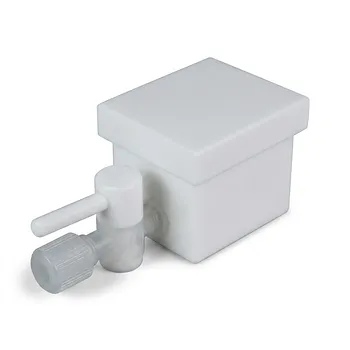
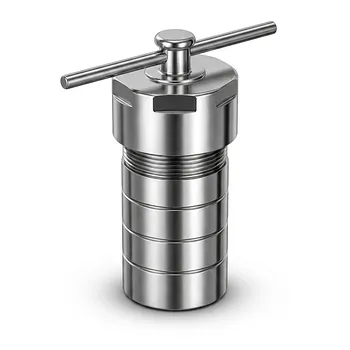
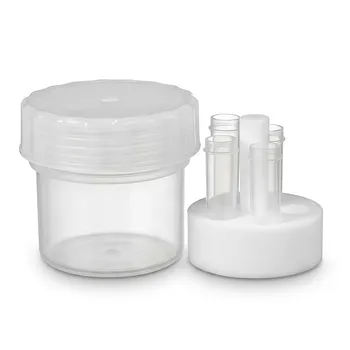
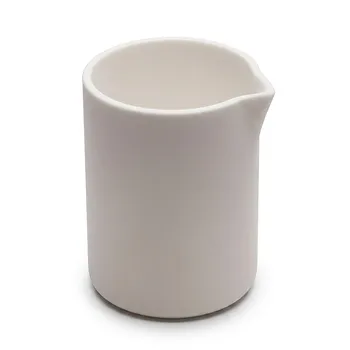
This makes PTFE valuable for digestion vessels, reagent bottles, crucibles, gaskets, seals, tubing, and fluid fittings used in aggressive chemical processing and trace analysis.
Why PTFE Performs Better at High Temperatures
Higher Melting Point
PTFE has a melting range of approximately 327-342 °C, while PE grades typically melt between about 105 and 140 °C.
This difference is decisive in heated laboratory processes. PE can soften or deform at temperatures where PTFE remains dimensionally stable.
Greater Resistance to Thermal Degradation
PTFE has a reported temperature for 50% weight loss of approximately 505 °C, compared with about 404 °C for PE.
The higher degradation resistance helps PTFE components preserve their mechanical and chemical function during prolonged exposure to heat.
High Continuous Service Temperature
Standard PTFE is commonly used for continuous service up to approximately 260 °C, depending on the design, load, pressure, and operating environment.
This makes it suitable for heated reaction systems, high-temperature fluid transfer, chemical digestion, and laboratory equipment exposed to severe thermal cycling.
Low Flammability
PTFE has very low flammability and can achieve a V-0 classification under UL94 in suitable forms and test conditions.
However, low flammability does not mean that PTFE is harmless at every temperature. Severe overheating can cause decomposition products, so ventilation and manufacturer temperature limits remain necessary.
Why Chemical Purity Matters in Laboratory Components
Reduced Contamination Risk
PTFE’s chemical inertness reduces the likelihood that the material will dissolve, swell, or leach substances into a sample.
That property is especially important in high-purity analytical work, where even small levels of contamination can affect trace measurements.
Stable Seals and Fluid Paths
PTFE gaskets, seals, valves, and tubing can maintain chemical compatibility when exposed to aggressive reagents.
A material that remains stable prevents leaks, avoids premature component failure, and protects both the sample and the surrounding equipment.
Reliable Containment
PTFE vessels and bottles can contain reactive chemicals without the material rapidly losing integrity.
This is why PTFE has historically been used in demanding applications involving highly reactive substances, including uranium hexafluoride, although compatibility must always be confirmed for the specific chemical, temperature, pressure, and form involved.
Why PE Still Has an Important Role
Lower Material Cost
PE is substantially less expensive than PTFE. The supplementary reference gives historical approximate prices of $1,500 per ton for HDPE versus $16,000 per ton for PTFE, although actual prices vary by grade, market, quantity, and processing method.
For ordinary bottles, containers, and fluid components operating at moderate temperatures and with compatible chemicals, PE may provide adequate performance at a much lower cost.
Easier Processing
PE is a conventional thermoplastic that can be processed efficiently using methods such as extrusion, injection molding, and blow molding.
This supports high-volume production of inexpensive, lightweight components with practical mechanical performance.
Adequate Moderate-Condition Performance
PE is often appropriate when the application involves low-to-moderate temperatures, nonaggressive chemicals, and limited purity requirements.
Selecting PTFE in these conditions may add cost without delivering a meaningful operational benefit.
Understanding the Trade-offs
PTFE Costs More
The exceptional performance of PTFE comes with a significantly higher material and manufacturing cost than standard PE.
That expense is justified when failure could cause sample loss, contamination, equipment damage, downtime, or safety problems.
PTFE Is Difficult to Process
Standard PTFE cannot be processed like an ordinary melt-flowing thermoplastic. Above its melting point, it forms a stiff, non-flowing gel rather than flowing easily through conventional injection-molding equipment.
Manufacturers therefore commonly use suspension molding, sintering, machining, or other specialized processes, which increases production complexity.
PTFE Has Mechanical Limitations
PTFE has a relatively low coefficient of friction and excellent chemical resistance, but it can exhibit creep or cold flow under sustained mechanical load.
Designers may need to account for pressure, temperature, dimensional tolerances, reinforcement, and sealing loads rather than treating PTFE as a universally superior structural material.
PTFE Is Not Resistant to Every Extreme Condition
PTFE is highly resistant, but not absolutely immune to all environments. Extreme cases can include molten alkali metals, elemental fluorine at elevated temperatures and pressures, and certain specialized fluorinating compounds.
Compatibility must be evaluated against the actual chemical concentration, temperature, pressure, exposure time, and mechanical stresses.
PFA May Be Better for Complex Molded Parts
PFA retains PTFE-like chemical resistance and a similar upper continuous service temperature of approximately 260 °C, but it can be melt-processed using extrusion and injection molding.
For complex high-purity vessels, fittings, and valves, PFA may offer a practical manufacturing advantage while preserving the required chemical and thermal performance.
How to Apply This to Your Project
The correct choice depends on the complete operating envelope rather than on temperature or chemical exposure alone.
- If your primary focus is maximum chemical resistance: Choose PTFE when the component will contact strong acids, bases, organic solvents, oxidizing agents, or other aggressive media.
- If your primary focus is high-temperature operation: Choose PTFE when temperatures approach or exceed PE’s softening and melting range, while remaining within the component’s rated service limits.
- If your primary focus is analytical purity: Choose PTFE when minimizing contamination, leaching, and chemical interaction is essential to reliable trace analysis.
- If your primary focus is low cost and high-volume production: Choose PE when temperatures and chemicals are moderate and its documented compatibility is sufficient.
- If your primary focus is complex molded geometry: Consider PFA when PTFE-level chemical performance is required but conventional melt processing would reduce manufacturing complexity.
PTFE is worth its higher cost when chemical inertness, thermal stability, and laboratory reliability matter more than the lowest initial material price.
Summary Table:
| Property | PTFE | PE |
|---|---|---|
| Carbon-Fluorine Bond Energy | 116 kcal/mol | N/A (C-H bond ~99.5 kcal/mol) |
| Melting Point | 327-342 °C | 105-140 °C |
| Continuous Service Temp | Up to 260 °C | Lower (typical < 80 °C) |
| Chemical Resistance | Excellent (near-universal) | Limited (vulnerable to solvents) |
| Flammability | V-0 (UL94) | Flammable |
| Cost | High | Low |
For durable, high-purity lab equipment that withstands extreme conditions, choose KINTEK's PTFE/PFA products. Our extensive range includes beakers, vessels, tubing, and custom-machined parts—all engineered for superior chemical resistance and thermal stability. Don't compromise on quality; contact us today to find the perfect solution for your laboratory needs.
Related Products
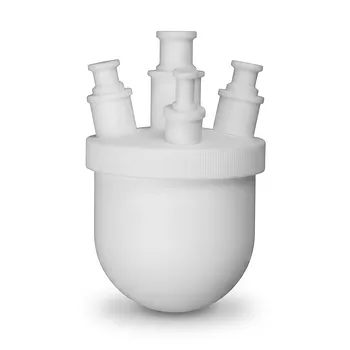
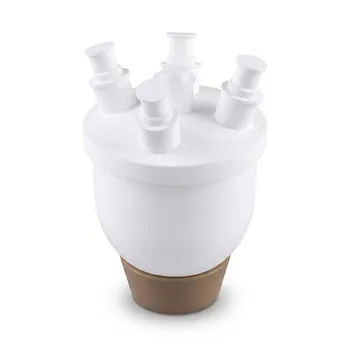
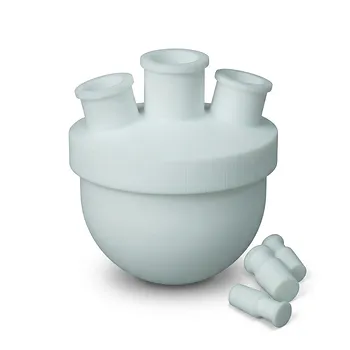
- High Temperature Corrosion Resistant PTFE Reaction Flask Custom Multi Neck Laboratory Vessel with Flat or U Bottom
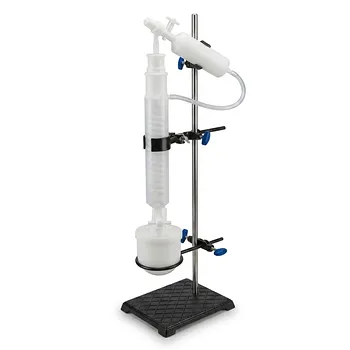
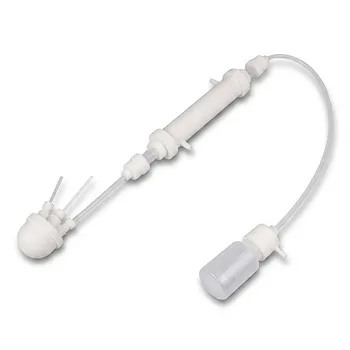
- PTFE Condensation Reflux and Gas Collection Apparatus for Corrosive Biochemical Processing Customizable High Temperature System
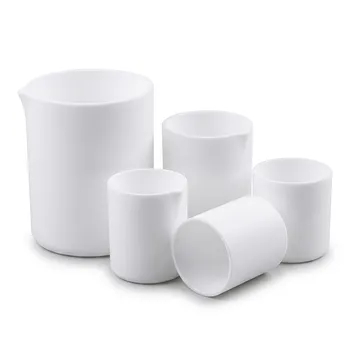
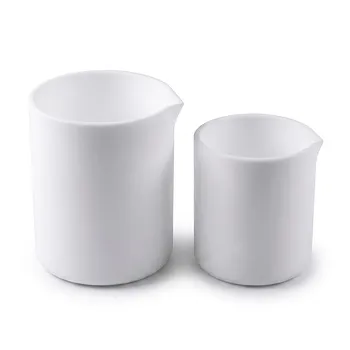
- Large Scale PTFE Beakers and Flasks for High Temperature Corrosion Resistant Laboratory Applications with Custom CNC Fabrication
- Custom PTFE Multilayer Reaction Apparatus High Temperature Corrosion Resistant Threaded Modular Sieve System
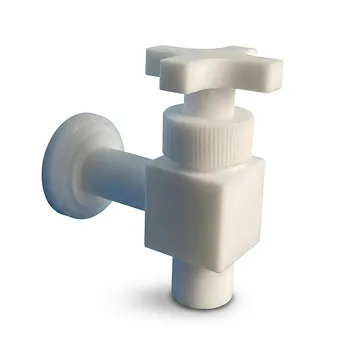
- Corrosion Resistant PTFE Polytetrafluoroethylene Valve and Customizable Laboratory Fluid Dispensing Faucet for Aggressive Chemical Handling in Industrial Storage Tanks and Plastic Drums
People Also Ask
- What are the key steps for structural integrity in molded PTFE lab reaction vessels? Master fine powder processing.
- Why are high-purity PTFE or PFA reaction vessels recommended for the synthesis of PANI-TiC hybrid materials? - Guide
- Why are fluoroplastic (PTFE) reaction vessels recommended for Methylene Blue (MB) adsorption kinetic experiments?
- Why is a PTFE reaction vessel required for Ti3C2Tx MXene synthesis? Ensure Safe HF Etching & High Purity
- What reaction vessel and fluid handling considerations are necessary for living cationic polymerization of fluorinated monomers involving Lewis acid catalysts? Key design and safety tips