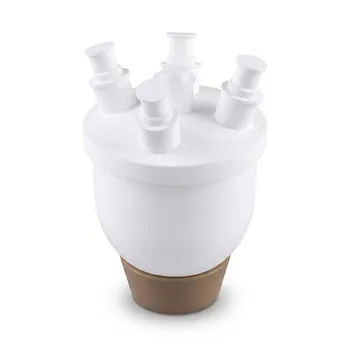
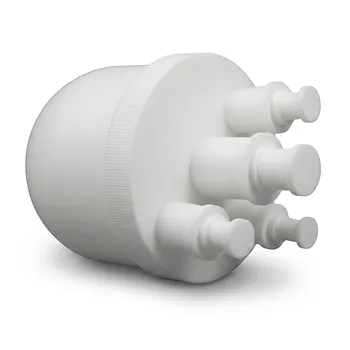
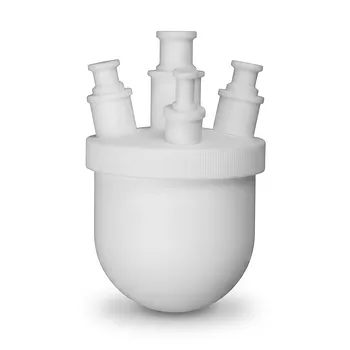
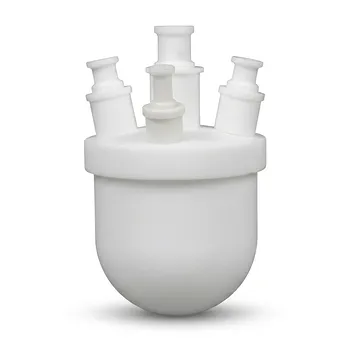
The key to structural integrity in molded PTFE reaction vessels is disciplined powder conditioning from coagulation through sintering. Manufacturers must form uniform agglomerates, separate and dry them without damaging their structure, blend the powder with minimal shear, condition it within the correct temperature range, and carefully control compression molding and sintering. These steps promote uniform density, close internal voids, and reduce the risk of cracks, permeation, and mechanical failure.
Structural integrity depends on preserving the fine-powder structure before molding and then controlling compaction and sintering so the finished PTFE contains as few microscopic voids and density variations as possible.
How Fine PTFE Powder Should Be Prepared
Form Uniform Agglomerates During Coagulation
Raw aqueous PTFE dispersion typically contains 10–20% solids. Coagulation converts the colloidal polymer particles into agglomerates suitable for subsequent powder processing.
Inorganic acids, salts, or organic solvents can be used with controlled shear agitation. The objective is to create uniform agglomerates, not to fracture or fibrillate the polymer particles.
Separate the Polymer From the Liquid Phase
After coagulation, the polymer agglomerates must be separated from the liquid phase. Effective phase separation reduces residual liquid and prepares the material for controlled drying.
Incomplete separation can contribute to inconsistent drying behavior and variations in bulk density, both of which can affect compaction during molding.
Dry Without Deforming the Powder Structure
Drying may use vacuum, high-frequency energy, or heated air. Temperature and friction must remain controlled to prevent premature deformation of the fine-powder structure.
Preserving the powder morphology supports uniform bulk density and helps produce a preform that can be compacted consistently without weak regions.
How Powder Handling Affects Vessel Strength
Use Low-Shear Blending
Dispersion-polymerized PTFE fine powder is highly shear-sensitive. Excessive shear during blending can cause premature fibrillation, making the resin unsuitable for reliable downstream processing.
Low-rpm tumbling, such as blending at approximately 24 rpm, helps distribute the powder and additives while limiting mechanical damage. Resin should be loaded carefully rather than subjected to aggressive mixing.
Prepare Fillers and Lubricants Evenly
Fillers should be pre-screened before blending to reduce agglomerates and improve distribution. Processing lubricants must be distributed evenly so that the powder compacts uniformly.
Uneven lubricant distribution can produce local differences in flow and density, creating weak areas or surface flaws in the molded vessel.
Allow Lubricant Diffusion Before Molding
After lubrication, the sealed mixture should be aged for at least 12 hours at approximately 35°C. This allows the lubricant to diffuse through the powder more completely before extrusion or molding.
Skipping or shortening this conditioning period can leave the mixture insufficiently prepared for uniform compaction.
Condition the Powder Above 19°C
Fine-cut PTFE molding powder should be thermally conditioned above 19°C, typically between 21°C and 27°C. Powder handled below this range can compact poorly and form cracks in the preform.
Excessive handling temperatures should also be avoided because they can promote powder lumping and reduce flowability.
Why Molding and Sintering Must Be Controlled
Use Powder Processing Rather Than Conventional Melt Molding
PTFE has extremely high melt creep viscosity and exhibits virtually no flow when heated. It therefore cannot be processed like a conventional thermoplastic using ordinary melt extrusion or injection molding.
Laboratory reaction vessels are instead produced through powder-processing methods, typically compression molding followed by high-temperature sintering.
Achieve Uniform Preform Compaction
Compression molding must produce a preform with consistent density throughout its volume. Temperature-conditioned powder, controlled blending, and even lubricant distribution all contribute to this result.
Poor compaction can create internal density differences that remain as structural weaknesses after sintering.
Control Sintering for Void Closure
During sintering, PTFE closes internal voids slowly. The thermal cycle must therefore be controlled carefully to promote consolidation throughout the vessel wall and avoid retaining microscopic pores.
Residual voids can increase chemical permeation and reduce flex life. In sufficiently severe cases, they can contribute to mechanical failure.
Understanding the Trade-offs
Shear Must Be Strong Enough but Not Excessive
Some controlled agitation is required during coagulation to produce uniform agglomerates. However, excessive shear during later powder blending can fibrillate the particles and make the resin unprocessable.
The appropriate shear level depends on the processing stage: controlled agitation supports coagulation, while gentle blending protects fine-powder morphology.
Drying Speed Must Not Override Structural Control
Vacuum, high-frequency, and heated-air drying can remove liquid effectively, but excessive friction or temperature can deform the powder before molding.
A faster drying cycle is not automatically better if it creates nonuniform density or damages the structure needed for reliable compaction.
Temperature Requires Both Lower and Upper Limits
Powder below 19°C can produce cracked preforms because it does not compact cleanly. Powder that becomes excessively warm can lump and lose flowability.
The practical conditioning range of 21°C to 27°C provides a controlled window for handling and preforming, while lubricant aging uses a separate elevated condition of approximately 35°C.
Void-Free Molding Requires Process Discipline
Uniform coagulation and drying alone cannot guarantee a structurally sound reaction vessel. The material must also be blended gently, conditioned correctly, compacted evenly, and sintered with sufficient control for void closure.
Weakness at any one stage can compromise the final component even when the other stages are well managed.
Applying This to PTFE Reaction Vessels
The complete process should be treated as a continuous structural-control chain:
- Coagulate the aqueous dispersion using suitable chemistry and controlled agitation.
- Separate the polymer agglomerates from the liquid phase.
- Dry with controlled temperature and friction.
- Blend at low shear and avoid premature fibrillation.
- Pre-screen fillers and distribute lubricants uniformly.
- Age the sealed lubricated mixture for at least 12 hours at approximately 35°C.
- Condition the molding powder between 21°C and 27°C before preforming.
- Compression-mold the powder to achieve uniform density.
- Sinter carefully so internal voids close and the vessel consolidates fully.
Making the Right Choice for Your Goal
The processing emphasis should reflect the performance requirement of the finished laboratory vessel.
- If your primary focus is maximum mechanical strength: Prioritize uniform agglomeration, low-shear blending, consistent powder temperature, even compaction, and controlled sintering for effective void closure.
- If your primary focus is chemical containment: Minimize microscopic voids through controlled drying, uniform preform density, and a carefully managed sintering cycle.
- If your primary focus is reliable molding flow: Maintain powder between 21°C and 27°C, prevent lumping, distribute lubricants evenly, and allow sufficient aging before molding.
- If your primary focus is avoiding processing defects: Control shear, friction, and temperature at every stage, because premature fibrillation, cracked preforms, and retained voids can all compromise the final vessel.
Reliable PTFE reaction vessels result from preserving powder integrity first and controlling consolidation just as carefully afterward.
Summary Table:
| Stage | Key Step | Purpose |
|---|---|---|
| Coagulation | Form uniform agglomerates | Ensure consistent particle size for uniform compaction |
| Separation | Remove liquid phase | Prevent inconsistencies in drying and density |
| Drying | Controlled temperature/friction | Preserve powder structure |
| Blending | Low-shear, ~24 rpm | Avoid premature fibrillation |
| Lubrication | Even lubricant distribution | Promote uniform flow and compaction |
| Aging | ≥12h at ~35°C | Allow lubricant diffusion |
| Conditioning | 21–27°C before molding | Prevent cracked preforms |
| Compaction | Uniform preform density | Eliminate weak spots |
| Sintering | Controlled thermal cycle | Close voids and consolidate |
Achieve flawless PTFE reaction vessels with precision-engineered powders and expert processing support. Our PTFE/PFA labware and custom machining ensure high purity and structural reliability. Contact us today to optimize your molding process and get the most from your materials. Get in touch now!
Related Products
- High Performance Customizable PTFE Reaction Vessel and Corrosion Resistant Polytetrafluoroethylene Flask for Chemical Laboratory Use
- Laboratory PTFE Three Neck Reaction Flask Corrosion Resistant 2000ml Low Background Fluoropolymer Vessel
- High Temperature Corrosion Resistant PTFE Reaction Flask Custom Multi Neck Laboratory Vessel with Flat or U Bottom
- Custom PTFE Flask 250ml High Purity Fluoropolymer Laboratory Vessel for Chemical Research
- PTFE 10L Reaction Vessel with Stirring Paddle Customizable Corrosion Resistant High Temperature Reactor for Biopharmaceutical and Chemical Processing
People Also Ask
- Why is a PTFE reaction vessel required for Ti3C2Tx MXene synthesis? Ensure Safe HF Etching & High Purity
- Why are fluoroplastic (PTFE) reaction vessels recommended for Methylene Blue (MB) adsorption kinetic experiments?
- Ion Activation Reaction Vessel Requirements: Why PTFE is Critical for Membrane Performance
- How do perfluorinated solvent environments influence the selection of reaction vessels and fluid handling components in nonaqueous emulsion polymerizations? Choose fluoropolymer materials.
- What reaction vessel and fluid handling considerations are necessary for living cationic polymerization of fluorinated monomers involving Lewis acid catalysts? Key design and safety tips