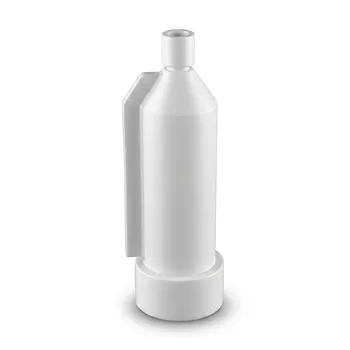
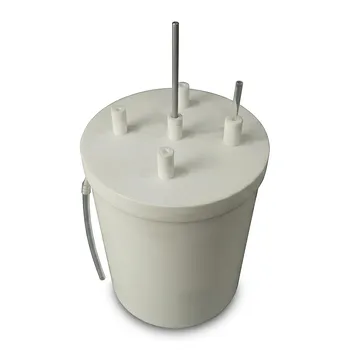
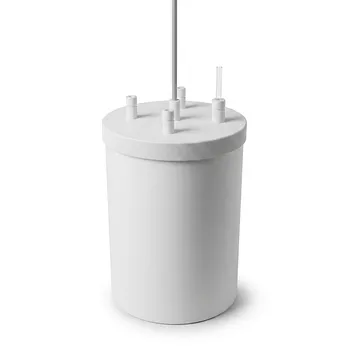
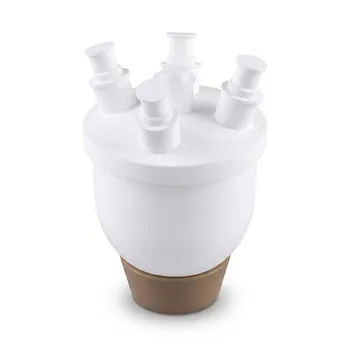
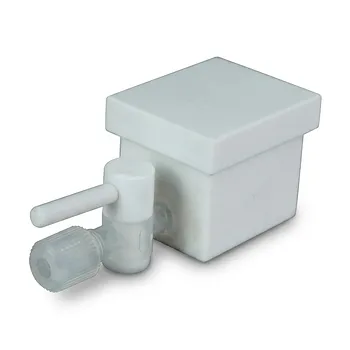
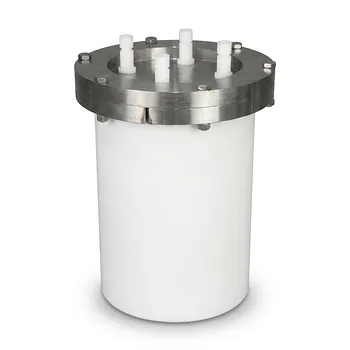
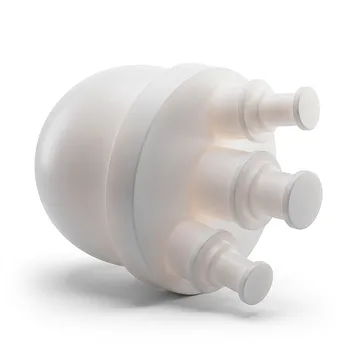
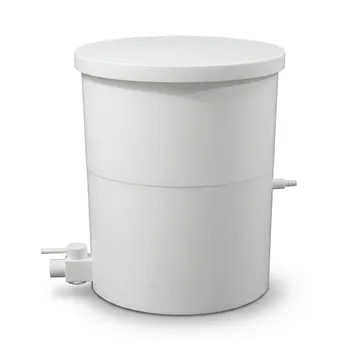
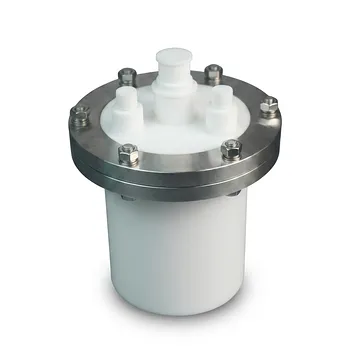
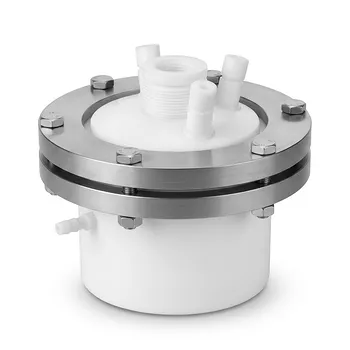
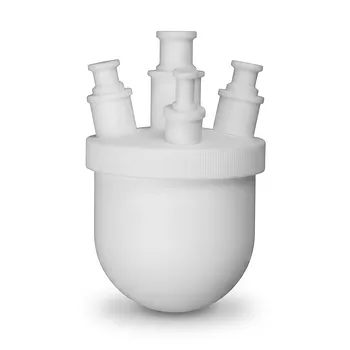
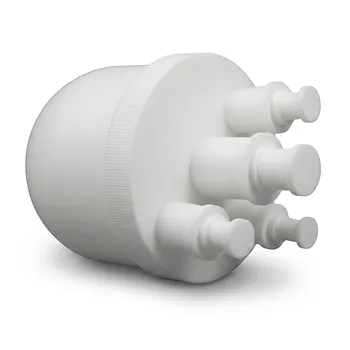
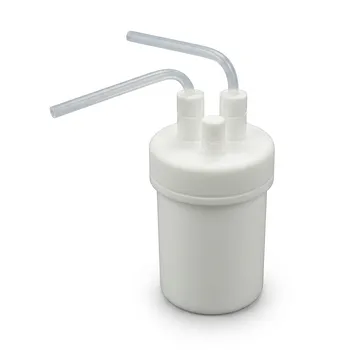
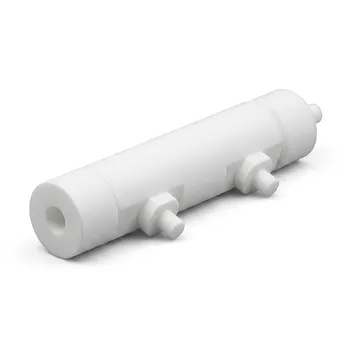
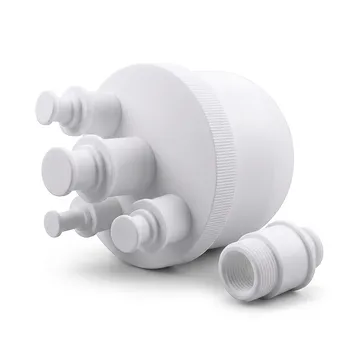
For the ion activation of electrospun anion exchange membranes in strong alkaline environments, reaction vessels must be constructed from high-performance fluoropolymers, specifically Polytetrafluoroethylene (PTFE). This material is required to withstand immersion in harsh solutions, such as 1 M Potassium Hydroxide (KOH), without degrading. Using PTFE ensures the chemical environment remains pure, facilitating the full conversion of anion exchange groups and protecting the membrane's final performance.
The use of PTFE-based reaction vessels is a critical requirement to prevent the leaching of metallic impurities into the alkaline solution. This level of chemical resistance is necessary to ensure the complete conversion of exchange groups and the long-term ionic conductivity of the membrane.
The Role of Material Stability in Ion Activation
Resisting Chemical Attack from Strong Bases
Reaction vessels used for ion activation must be inert to prevent structural failure when exposed to strong alkaline environments. Solutions like 1 M KOH are highly corrosive to standard plastics and certain metals.
Fluoropolymers like PTFE are the industry standard because their carbon-fluorine bonds are exceptionally strong and resistant to chemical cleavage. This stability allows the vessel to maintain its integrity during prolonged immersion cycles.
Preventing the Introduction of Impurities
A major risk during ion activation is the leaching of metallic impurity ions from the vessel material into the treatment bath. If the vessel material reacts with the alkali, it can release contaminants that interfere with the membrane's chemistry.
Utilizing PTFE or fluoropolymer-lined containers acts as a safeguard against this contamination. Maintaining a high-purity environment is essential for achieving the precise chemical signatures required in advanced membrane technology.
Impact on Membrane Performance
Ensuring Complete Chemical Conversion
The primary goal of the activation process is the complete conversion of anion exchange groups within the electrospun fibers. If the solution is contaminated by leaching from an inferior vessel, the chemical reactions may be inhibited or altered.
By using corrosion-resistant vessels, researchers ensure that the stoichiometry of the reaction remains predictable. This leads to a more uniform and reliable membrane structure.
Preserving Ionic Conductivity
The final ionic conductivity of the membrane is highly sensitive to the presence of foreign ions. Metallic impurities can block or degrade the exchange sites, significantly reducing the efficiency of the membrane in fuel cells or electrolyzers.
Choosing the correct vessel material directly translates to better electrical performance. PTFE ensures that the membrane's conductive pathways are formed correctly without interference from the container's chemical makeup.
Understanding the Trade-offs
Cost and Material Availability
While PTFE and PFA offer superior chemical resistance, they are significantly more expensive than standard laboratory plastics like polypropylene. This higher initial investment is often a hurdle for large-scale production or pilot projects.
However, the cost of a failed membrane batch or inconsistent test results usually far outweighs the price of high-quality fluoropolymer equipment.
Thermal and Structural Limitations
Fluoropolymers like PTFE have lower mechanical strength compared to metals and can be prone to "creep" or deformation under heavy loads at high temperatures.
If the ion activation process requires high-pressure heating, fluoropolymer-lined steel vessels are often preferred over solid PTFE. This provides the chemical resistance of the polymer with the structural support of the metal.
How to Apply This to Your Process
When selecting equipment for membrane treatment, your choice should be dictated by the harshness of the chemical environment and your purity requirements.
- If your primary focus is maximum chemical purity: Use solid PTFE or PFA vessels to eliminate any possibility of metallic contamination or liner failure.
- If your primary focus is high-pressure or high-temperature activation: Opt for fluoropolymer-lined stainless steel containers to combine structural integrity with chemical inertness.
- If your primary focus is cost-effective prototyping: Ensure that any alternative plastic used is strictly rated for 1 M KOH exposure, though be prepared for a shorter equipment lifespan and potential impurity issues.
The integrity of your reaction vessel is the foundation upon which the performance and reliability of your anion exchange membrane are built.
Summary Table:
| Feature | PTFE/PFA Vessel Requirement | Benefit for Ion Activation |
|---|---|---|
| Chemical Resistance | Inert to 1 M KOH | Prevents structural degradation in strong bases |
| Purity Level | Zero Metallic Leaching | Protects conductivity by excluding foreign ions |
| Material Stability | Strong C-F Bonds | Ensures predictable stoichiometry for conversion |
| Design Type | Solid or Fluoropolymer-Lined | Balances chemical purity with pressure/temp needs |
Secure Your Membrane Performance with KINTEK’s Fluoropolymer Expertise
Don't let metallic impurities compromise your research. KINTEK specializes in high-performance fluoropolymer solutions tailored for the most demanding alkaline environments. From everyday basic labware—including beakers, crucibles, and reagent bottles—to advanced derivative apparatus like hydrothermal synthesis liners, microwave digestion vessels, and custom electrochemical cells, we provide the purity your membranes deserve.
Our end-to-end custom CNC fabrication allows us to deliver everything from complex non-standard machined parts to high-volume orders of PTFE and PFA components. Whether you need precise fluid transfer tools like tubing and valves or bespoke reaction setups, KINTEK delivers absolute focus on material integrity.
Contact us today to discuss your custom PTFE/PFA requirements and ensure your ion activation process achieves maximum efficiency.
References
- Peng Liu, Yang Peng. Biphasic anion-exchange nanofibers enable bipolar junction engineering for enhanced electrocatalytic CO<sub>2</sub> conversion in acidic media. DOI: 10.1039/d5ey00153f
This article is also based on technical information from Kintek Knowledge Base .
Related Products
- High Purity PTFE Corrosion Resistant Reaction Vessel with Luer Fittings and Caps for Trace Analysis
- PTFE 10L Reaction Vessel with Stirring Paddle Customizable Corrosion Resistant High Temperature Reactor for Biopharmaceutical and Chemical Processing
- High Purity PTFE Reaction Vessel Polyfluortetraethylene Cylindrical Tank Petrochemical Reaction Container
- High Purity PTFE Reaction Vessel with Electric Stirring System and Customizable 5L Tank including Buchner Funnel Filtration Assembly
- High Performance Customizable PTFE Reaction Vessel and Corrosion Resistant Polytetrafluoroethylene Flask for Chemical Laboratory Use
People Also Ask
- Why is a PTFE reaction vessel required for Ti3C2Tx MXene synthesis? Ensure Safe HF Etching & High Purity
- What reaction vessel and fluid handling considerations are necessary for living cationic polymerization of fluorinated monomers involving Lewis acid catalysts? Key design and safety tips
- Why are high-purity PTFE or PFA reaction vessels recommended for the synthesis of PANI-TiC hybrid materials? - Guide
- Why are fluoroplastic (PTFE) reaction vessels recommended for Methylene Blue (MB) adsorption kinetic experiments?
- What are the key steps for structural integrity in molded PTFE lab reaction vessels? Master fine powder processing.