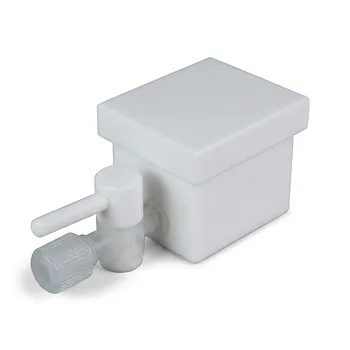
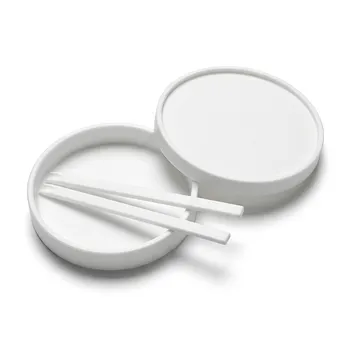
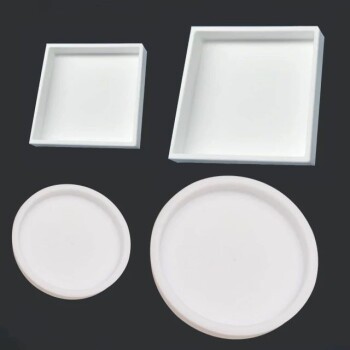
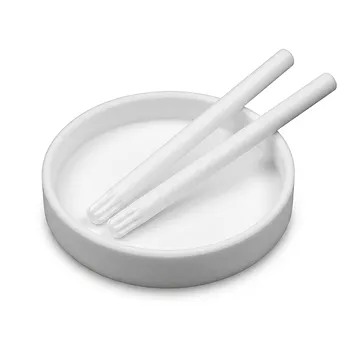
PTFE is preferred when failure, contamination, or chemical attack costs more than the material itself. Compared with HDPE, PTFE provides far greater chemical inertness, thermal stability, and sample purity across demanding laboratory conditions. Its higher price is justified when components must withstand aggressive reagents, elevated temperatures, and prolonged exposure without degrading or contaminating the fluid path.
The value of PTFE is not its low purchase price—it is its ability to preserve integrity under conditions where HDPE may soften, permeate, deform, or chemically degrade. For critical laboratory labware and fluid-transfer components, that reliability often outweighs the initial material premium.
Why PTFE Performs Better in Harsh Laboratory Service
Its chemical resistance is exceptionally broad
PTFE’s carbon backbone is heavily shielded by fluorine atoms, and its strong carbon–fluorine bonds make the material highly resistant to chemical attack.
It is effectively insoluble in common solvents and resists many aggressive acids, bases, and organic reagents that can damage standard plastics. HDPE is chemically resistant in many applications, but its resistance is not as broad under severe chemical or thermal conditions.
It maintains stability at higher temperatures
PTFE has a melting range of approximately 327–342°C and can support continuous use at temperatures around 260°C, depending on the design and service conditions.
HDPE typically has a much lower operating limit, around 120°C. At elevated temperatures, HDPE can soften, deform, lose dimensional accuracy, or experience accelerated chemical permeation.
It resists thermal degradation
PTFE’s higher thermal-degradation resistance helps it retain chemical stability during heating, digestion, sterilization, and other demanding laboratory processes.
This is particularly important for digestion vessels, reaction components, and high-temperature fluid-transfer assemblies where a material must resist both the chemical environment and the heat used to process it.
Why Material Stability Matters in Laboratory Applications
It protects sample integrity
Laboratory components are often part of the measurement system, not merely containers or plumbing. If a material reacts with a sample, releases extractables, or absorbs chemicals, it can alter the result.
PTFE’s low surface energy and chemical inertness reduce the risk of contamination, adsorption, and unintended reactions. This makes it valuable in trace analysis, pharmaceutical work, semiconductor processing, and analytical chemistry.
It prevents chemical degradation of the fluid path
In fittings, valves, tubing, and gaskets, chemical degradation can cause swelling, cracking, embrittlement, leakage, or particle generation.
PTFE remains stable against a much wider range of fluids than HDPE. That stability helps maintain a clean, reliable fluid path and reduces the likelihood that the component itself becomes a source of contamination.
It avoids metal-ion contamination
PTFE components can be especially useful where metal ions would interfere with the process or analysis.
For example, in fuel-cell research, fluoropolymer fluid-path components help prevent metal contamination that could poison catalysts or affect membrane performance. The same principle applies to high-purity chemical handling and trace-level measurements.
The Physical Properties That Add Value
It offers a very low coefficient of friction
PTFE’s low surface energy produces a naturally low-friction surface.
This can reduce sticking, ease fluid handling, and improve the service life of seals, valves, tubing, and moving interfaces. It also makes PTFE useful where smooth release and low maintenance are important.
It provides strong environmental resistance
PTFE resists moisture, many solvents, weathering effects, and temperature variation better than standard thermoplastics.
That broad environmental stability supports long service life in laboratory and process environments where components may be exposed to heat, humidity, corrosive vapors, or repeated chemical cycles.
It provides electrical insulation
PTFE is also an excellent electrical insulator.
This is not the primary reason for choosing it in most laboratory labware, but it can be an additional advantage in electrochemical systems, electronics-related laboratory equipment, and fuel-cell research assemblies.
Why the Higher Cost Can Be Economically Rational
The purchase price is only one part of the cost
HDPE may cost substantially less as a raw material, but the material price does not represent the full operating cost of a component.
A failed or contaminated PTFE substitute can require discarded samples, repeated experiments, equipment cleaning, process interruption, or replacement of damaged parts. In regulated or high-value work, these consequences can exceed the original material savings.
PTFE reduces the risk of failure
A PTFE gasket, vessel, or fitting may cost more initially, but it can prevent leakage, chemical attack, deformation, and contamination.
The economic benefit comes from risk reduction and service reliability, not simply from longer physical life. In critical applications, avoiding one failure can justify the premium for many components.
It supports repeatable results
Consistent analytical or process results depend on controlling variables that may be overlooked, including container chemistry, surface interactions, and fluid-path cleanliness.
PTFE helps reduce material-related variation. This is particularly valuable when samples are scarce, concentrations are extremely low, or testing must be reproducible over many cycles.
Where HDPE Still Makes Sense
HDPE is suitable for less demanding chemical service
HDPE remains a practical choice for general-purpose bottles, containers, and fluid-handling components when temperatures and chemical exposures are moderate.
Its lower cost, easier processing, and useful chemical resistance make it appropriate when the application does not require PTFE’s extreme performance.
Cost-sensitive designs may favor HDPE
For disposable or high-volume laboratory items, the performance margin provided by PTFE may not justify the additional expense.
The correct choice depends on the actual fluid, temperature, exposure time, purity requirement, and consequence of failure—not on the material’s reputation alone.
Understanding the Trade-offs
PTFE is not universally superior
PTFE’s strengths come with limitations. It is relatively soft, can deform under sustained compressive loads through creep, and is more difficult and expensive to process than HDPE.
Component geometry, sealing design, reinforcement, and operating pressure must therefore be evaluated alongside chemical compatibility.
Chemical compatibility still requires verification
PTFE is highly resistant, but “chemically inert” should not be interpreted as immune to every condition.
Certain highly reactive substances, including elemental fluorine and some molten or reactive alkali-metal systems, can attack PTFE, especially at elevated temperatures. Compatibility should be checked for the exact chemical concentration, temperature, pressure, and exposure duration.
PFA may be preferable for some applications
PFA offers fluoropolymer-level chemical and thermal resistance while providing better melt-processability and, in some designs, improved transparency or fabrication flexibility.
The choice between PTFE and PFA depends on component geometry, purity requirements, mechanical demands, and manufacturing method.
Mechanical performance must be considered separately
PTFE’s chemical resistance does not automatically make it the best material for every load-bearing part.
Where stiffness, dimensional stability, or resistance to creep is the dominant requirement, another material—or a composite or reinforced PTFE grade—may be more appropriate.
Making the Right Choice for Your Goal
The best material decision begins with the consequences of degradation, contamination, or failure.
- If your primary focus is chemical resistance: Choose PTFE when the component will contact aggressive acids, solvents, concentrated reagents, or chemically challenging fluids beyond the reliable range of HDPE.
- If your primary focus is high-temperature operation: Choose PTFE when sustained temperatures may approach or exceed HDPE’s practical operating range.
- If your primary focus is sample purity: Choose PTFE for trace analysis, high-purity fluid paths, and applications where extractables or material reactions could compromise results.
- If your primary focus is lowest initial cost: Choose HDPE when chemical exposure, temperature, and purity requirements are moderate and the consequences of replacement or contamination are limited.
- If your primary focus is long-term reliability: Choose PTFE when preventing leaks, degradation, downtime, or failed experiments is more valuable than minimizing the component’s purchase price.
PTFE earns its premium by converting material cost into chemical stability, sample protection, and dependable performance where standard thermoplastics may not be sufficient.
Summary Table:
| Property | PTFE | HDPE |
|---|---|---|
| Chemical Resistance | Excellent, resists most chemicals | Good, but limited with some solvents/acids |
| Continuous Use Temp. | ~260°C | ~120°C |
| Thermal Degradation | High resistance | Moderate resistance |
| Sample Purity | Low extractables, minimal contamination | Higher extractables risk |
| Cost | Higher initial cost | Lower initial cost |
Ensure the highest integrity for your lab results. Choose PTFE labware and fluid systems from KINTEK, exclusively dedicated to high-performance fluoropolymers. From basic beakers to custom machined components, our PTFE and PFA products provide unmatched purity and durability. Contact us today to discuss your requirements and get a quote! Contact us
Related Products
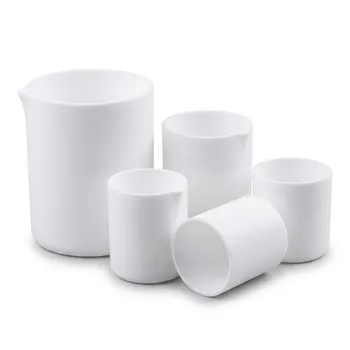
- Large Scale PTFE Beakers and Flasks for High Temperature Corrosion Resistant Laboratory Applications with Custom CNC Fabrication
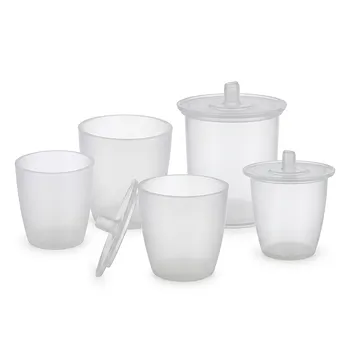
- High Purity PFA Crucible and Corrosion Resistant PTFE Beaker for Trace Analysis and Custom Laboratory Applications
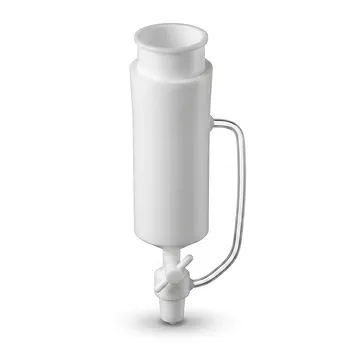
- Custom PTFE Constant Pressure Separatory Funnel Corrosion Resistant Low Background Labware for PFA Flasks
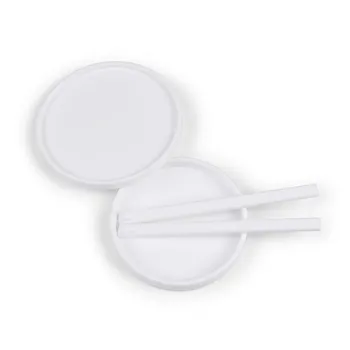
- Custom PTFE Petri Dish 30mm Corrosion Resistant Low Background Non Leaching Laboratory Ware
- Custom PTFE Laboratory Apparatus Corrosion Resistant Low Background Reaction Cells Precision CNC Fabrication
People Also Ask
- Why is the material of the reaction vessel critical for tribocatalytic degradation? Boost Your Catalytic Yield!
- What is the operational temperature range for PTFE laboratoryware? Mastering Thermal Limits from -200°C to +260°C
- What are the main advantages of PTFE as a material for laboratory bottles? Superior Chemical & Thermal Resistance
- Why is PTFE used in laboratory applications? Ensure Chemical Purity and Reliability
- What are the limitations of pure PTFE in high temperature applications? Understanding the 200°C Ceiling