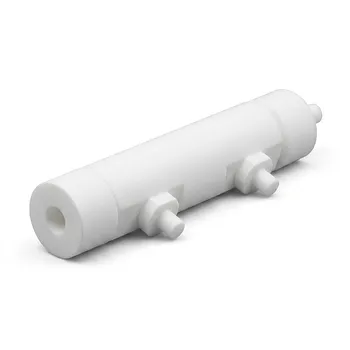
ETFE is preferred when the component must be both chemically resistant and economically injection-moldable. Pure PTFE offers better ultimate chemical inertness, lower friction, and a much higher continuous-use temperature of approximately 260°C, but it cannot be processed through conventional thermoplastic melt techniques. ETFE has lower melt viscosity, higher tensile strength, and greater toughness, allowing manufacturers to injection-mold intricate fittings, connectors, sockets, and valve housings efficiently.
The central advantage of ETFE is manufacturability without sacrificing most of the chemical resistance needed for fluid handling. It occupies the practical middle ground between PTFE’s extreme chemical and thermal performance and the structural demands of complex molded components.
Why Pure PTFE Is Difficult to Injection-Mold
PTFE Does Not Flow Like a Conventional Thermoplastic
Pure PTFE has exceptional chemical and thermal performance, but it does not readily melt and flow during standard injection molding. Instead, it is typically shaped through processes such as compression molding, sintering, or machining from stock material.
This makes complex PTFE parts more difficult and expensive to produce, particularly when they require internal passages, undercuts, threaded connections, sealing features, or integrated mounting geometry.
Complex Geometries Increase Manufacturing Cost
A pipe fitting or valve housing may contain several precise features that are straightforward to form in an injection mold. Producing the same geometry from PTFE often requires additional machining, assembly, or specialized forming operations.
ETFE’s melt-processability allows many of these features to be created in a single molding cycle, reducing part count, machining requirements, and production cost.
How ETFE Enables Complex Fluid Components
Low Melt Viscosity Supports Intricate Molding
ETFE has a relatively low melt viscosity and a broad processing window compared with fully fluorinated polymers such as PTFE. It can fill detailed molds and reproduce the geometry required for connectors, sockets, tubing components, valve bodies, and fittings.
Its low shear sensitivity also supports more predictable processing in precision injection molding.
One-Piece Construction Improves Design Flexibility
Injection molding allows designers to integrate multiple functions into one ETFE component. Ports, bosses, sealing glands, mounting features, and internal flow paths can often be incorporated into the same part.
This can reduce joints and interfaces, which may simplify assembly and reduce potential leak paths.
Molding Makes Repeated Production More Efficient
Once the mold and process are established, injection molding provides consistent, repeatable production for medium- and high-volume applications. The economic advantage becomes more significant when the alternative is machining complex PTFE parts individually.
Why ETFE Performs Well in Service
Higher Mechanical Strength
ETFE generally provides higher tensile strength than pure PTFE. The reference values are approximately 38–42 MPa for ETFE compared with 20–35 MPa for PTFE, although actual values depend on grade, temperature, processing, and test method.
This added strength helps ETFE fittings and housings resist deformation under pressure, assembly loads, and mechanical stress.
Greater Toughness and Impact Resistance
The ethylene component in ETFE’s molecular structure improves toughness, impact strength, cut-through resistance, and abrasion resistance compared with fully fluorinated PTFE.
That makes ETFE useful where components experience vibration, friction, repeated handling, pressure cycling, or mechanical shock.
Strong Chemical Resistance
ETFE retains chemical resistance approaching that of fully fluorinated polymers for many demanding fluid-handling environments. It is therefore suitable for chemical tubing, piping, pump internals, connectors, and valve fittings.
However, its chemical resistance is not identical to PTFE’s. The appropriate material must be selected against the specific chemical, concentration, temperature, and exposure duration.
Electrical Insulation Performance
ETFE has a low dielectric constant of approximately 2.6, which supports applications that combine fluid handling with electrical insulation or electrical isolation requirements.
This can be useful in connectors, sensor housings, and process equipment where electrical properties matter alongside chemical resistance.
Understanding the Trade-offs
ETFE Has a Lower Continuous-Use Temperature
The principal thermal compromise is ETFE’s continuous temperature rating of approximately 150°C, compared with approximately 260°C for pure PTFE.
Some ETFE grades and applications may support higher short-term or specialized operating conditions, but the continuous service limit must be checked against the manufacturer’s data for the selected grade.
PTFE Retains Superior Chemical Inertness
PTFE remains the better choice when the application demands maximum chemical inertness, particularly with highly aggressive solvents, acids, or other media at elevated temperatures.
ETFE’s hydrogen-containing backbone improves mechanical properties but slightly reduces its resistance compared with fully fluorinated PTFE.
ETFE Has More Friction
PTFE has an exceptionally low coefficient of friction. ETFE generally has higher friction, which can increase sliding resistance and may affect valve movement, seal behavior, or fluid-interface performance.
For components where low friction is the dominant requirement, PTFE or PFA may be more appropriate.
Molded Parts Still Require Careful Design
ETFE’s melt-processability does not eliminate design constraints. Wall thickness, shrinkage, weld lines, gate placement, internal stresses, threaded features, and chemical exposure must all be evaluated during component design.
A material that can be molded is not automatically suitable for every molded geometry or service condition.
Choosing ETFE for the Right Application
When Mechanical Durability Matters
ETFE is well suited to fittings, valve housings, pump internals, and connectors exposed to impact, abrasion, cut-through, pressure, or repeated mechanical loading.
Its higher strength and toughness can provide more durable structural performance than pure PTFE.
When Production Efficiency Matters
ETFE is the stronger option when complex parts must be produced repeatedly and cost-effectively. Injection molding can reduce machining, assembly, material waste, and per-part labor.
This is especially valuable for geometrically detailed components produced in consistent volumes.
When Chemical Resistance and Moldability Must Be Balanced
ETFE is a practical choice when the fluid environment is chemically demanding but does not require PTFE’s maximum temperature or inertness. It provides a useful balance of chemical resistance, mechanical performance, and manufacturing flexibility.
When PTFE or PFA Is Still the Better Choice
Pure PTFE or PFA should remain under consideration for extremely aggressive chemicals, continuous temperatures beyond ETFE’s rating, or applications requiring the lowest possible friction.
In those cases, the additional manufacturing difficulty may be justified by the material’s superior chemical and thermal performance.
Making the Right Choice for Your Goal
Select the polymer according to the dominant requirement rather than choosing solely by chemical-resistance ranking.
- If your primary focus is complex, cost-effective production: Choose ETFE when injection molding can consolidate intricate fittings, connectors, or valve housings into repeatable one-piece components.
- If your primary focus is mechanical durability: Choose ETFE when impact, abrasion, cut-through resistance, and structural strength are more important than minimum friction.
- If your primary focus is extreme chemical or thermal exposure: Choose pure PTFE or PFA when the application approaches their superior limits for chemical inertness, low friction, or continuous temperature.
- If your primary focus is balanced performance: Choose ETFE when the service conditions fit its approximately 150°C continuous rating and the design benefits from melt-processable fluoropolymer construction.
ETFE is preferred for complex fluid-transfer components because it delivers the manufacturability and mechanical durability that pure PTFE lacks while retaining strong chemical resistance for demanding service.
Summary Table:
| Property | ETFE | PTFE |
|---|---|---|
| Injection moldability | Excellent (low melt viscosity) | Poor (not melt-processable) |
| Tensile strength | 38-42 MPa | 20-35 MPa |
| Continuous use temperature | ~150°C | ~260°C |
| Chemical resistance | Good (approaching PTFE) | Superior |
| Friction | Higher | Low |
| Typical applications | Fittings, connectors, valve housings | Seals, gaskets, linings |
Need precision ETFE or PTFE components? KINTEK specializes in high-performance fluoropolymers. From injection-molded fittings to custom CNC-machined parts, we deliver durable solutions for your fluid handling needs. Contact us today to discuss your project and get a quote! Contact us.
Related Products
- Corrosion Resistant PFA Tubing 1/4 Inch Custom Molded Welded Fluid Transfer Components
- High Purity PFA Valves and Weldable Corrosion Resistant Transparent Tubing for Semiconductor Sensor Manufacturing Fluid Transfer
- Corrosion Resistant High Purity PFA Valve and Weldable Transparent Tubing for Semiconductor Fluid Transfer
- High Corrosion Resistant PTFE Faucet Polytetrafluoroethylene Valve for Chemical Storage Drums and Fluid Transfer Systems Customizable Industrial Grade
- Custom PTFE Parts Manufacturer for Teflon Containers and Components
People Also Ask
- How do PFA fluid transfer components contribute to chemical research precision? Achieve high-purity results today.
- How do high-precision PFA fluid transfer components, such as tubing and fittings, affect the results of continuous-flow synthesis?
- Why is PFA preferred over FEP for high-temperature, high-purity fluid transfer?
- Why is PFA frequently specified over standard PTFE for custom-machined fluid transfer valves, fittings, and complex laboratory reaction vessels? Discover the key advantages.
- What role do PFA tubing and valves play in high-precision laboratory fluid transfer systems? Ensure Ultra-Pure Results