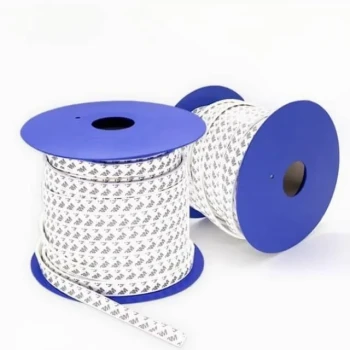
ePTFE is advantageous because it combines exceptional chemical resistance with high conformability and reliable temperature performance. Its expanded porous structure allows gaskets and joint sealants to compress around scratches, uneven flange faces, and other surface imperfections, creating tight seals with relatively low seating stress. At the same time, ePTFE remains stable in contact with many aggressive acids, bases, solvents, and corrosive process fluids, making it well suited to reaction vessels, transfer fittings, heat exchangers, and containment systems.
ePTFE solves two problems simultaneously: it resists chemical attack like conventional PTFE while conforming more effectively to imperfect or delicate sealing surfaces. The result is a clean, durable seal that helps protect against leakage, contamination, and unplanned maintenance.
Why Corrosive Chemical Service Is Difficult
Chemical attack degrades conventional sealing materials
Many rubber elastomers and metals lose sealing performance when exposed to strong acids, bases, solvents, or corrosive gases. They may swell, embrittle, corrode, or react with the process fluid.
PTFE is exceptionally chemically inert and is insoluble in virtually all industrial solvents, strong acids, and strong bases. ePTFE retains this fundamental fluoropolymer resistance, allowing it to remain stable where many conventional gasket materials rapidly deteriorate.
Temperature changes increase sealing demands
Chemical processing equipment may experience cryogenic conditions, elevated temperatures, pressure cycles, and thermal expansion between different components. A gasket must remain sufficiently flexible to maintain contact while retaining its mechanical integrity.
ePTFE provides broad temperature tolerance, commonly covering approximately -268°C to +260°C, with some product specifications extending to about +315°C. The correct operating limit depends on the specific product, pressure, chemical exposure, and manufacturer’s rating.
How ePTFE Improves Sealing Performance
Its expanded structure conforms to uneven surfaces
ePTFE contains a multidirectional fibril and microvoid structure. This makes it soft, highly compressible, and capable of adapting to scratches, pits, waviness, and other imperfections on flange faces.
That conformability is particularly valuable for glass-lined steel, plastic, fiberglass, and damaged or difficult-to-machine flanges. In many cases, the equipment does not need to be re-machined merely to obtain an effective gasket seal.
It seals effectively with lower seating stress
Because ePTFE compresses readily, it can create a tight seal without the high bolt loads required by less conformable materials. This reduces mechanical stress on fragile components such as glass-lined vessels and nonmetallic piping.
Lower seating stress can also simplify installation and reduce the risk of distorting flanges or damaging sensitive equipment.
It supports high-purity fluid paths
ePTFE is non-corrosive and does not readily react with the fluids it contacts. Properly specified products can also meet cleanliness requirements for food, pharmaceutical, laboratory, and other high-purity applications.
This helps reduce the risk of process-fluid contamination caused by gasket degradation, extractables, corrosion products, or chemical reaction.
Where ePTFE Provides the Most Value
Reaction vessels and chemical containment systems
Reaction vessels must prevent aggressive chemicals from escaping while tolerating temperature changes and repeated maintenance. ePTFE sealants and gaskets can accommodate irregular vessel flanges while maintaining chemical compatibility across a wide range of process conditions.
They are especially useful for glass-lined equipment, where excessive bolt loading or flange imperfections can make sealing difficult.
Fluid transfer fittings and piping flanges
Transfer systems often combine dissimilar materials and include flanges that are difficult to align or machine. ePTFE can conform across these interfaces and maintain a continuous barrier against corrosive fluids.
Its broad chemical resistance also reduces the need to match a separate elastomer or gasket material to every individual chemical service, although application-specific compatibility checks remain essential.
Heat exchangers and irregular flange faces
Heat exchangers combine pressure, temperature cycling, and potentially uneven sealing surfaces. ePTFE’s compressibility helps close small surface defects, while its fluoropolymer chemistry protects the seal from many aggressive media.
The material can therefore be useful when both surface adaptation and chemical resistance are more important than maximum mechanical stiffness.
Understanding the Trade-offs
Pure ePTFE can experience creep under sustained load
ePTFE is more conformable than dense PTFE, but that softness means pure ePTFE can undergo creep or cold flow under high pressure, high temperature, or heavy mechanical loading. Loss of gasket thickness can reduce long-term sealing force.
The expanded structure may reduce creep relative to some highly compressible materials, but it does not eliminate the issue. For severe pressure or load conditions, filled PTFE, metal-reinforced PTFE, or another engineered gasket construction may provide better dimensional stability.
Chemical resistance does not guarantee universal suitability
PTFE and ePTFE resist a very broad range of chemicals, but compatibility still depends on concentration, temperature, pressure, exposure time, and the presence of unusual reactive species. Product-specific chemical-resistance data should govern the final selection.
A gasket may also be chemically compatible while being unsuitable because of pressure, flange movement, vacuum conditions, or inadequate installation.
Temperature ratings must be treated as application limits
A published maximum temperature is not a universal operating promise. Pressure, bolt load, thermal cycling, flange design, and the process fluid can reduce the practical service limit.
The gasket manufacturer’s pressure-temperature envelope and installation requirements should be reviewed together rather than evaluating temperature in isolation.
Installation remains important
Even highly conformable ePTFE cannot compensate for incorrect gasket dimensions, inadequate bolt tightening, excessive flange damage, or poor alignment. Proper surface preparation, controlled compression, and appropriate retightening procedures are still necessary where the product design requires them.
Making the Right Choice for Your Goal
Select ePTFE based on the complete service condition, including chemical exposure, temperature, pressure, flange material, surface condition, and required cleanliness.
- If your primary focus is chemical compatibility: Use ePTFE when broad resistance to aggressive acids, bases, solvents, and corrosive gases is required, subject to product-specific compatibility verification.
- If your primary focus is sealing damaged or irregular flanges: Choose a highly conformable ePTFE gasket or sealant that can accommodate scratches, unevenness, and delicate flange surfaces.
- If your primary focus is low mechanical loading: Consider ePTFE for applications where the seal must form effectively without imposing high seating stress on glass-lined, plastic, fiberglass, or other fragile equipment.
- If your primary focus is long-term performance under high pressure: Evaluate filled or metal-reinforced PTFE constructions rather than assuming pure ePTFE will resist creep in every service condition.
- If your primary focus is high-purity processing: Specify a clean, non-reactive ePTFE product with the required regulatory or process approvals and verify that installation materials do not introduce contamination.
The central advantage of ePTFE is its ability to pair fluoropolymer-level chemical resistance with the practical conformability needed to seal real-world chemical processing equipment.
Summary Table:
| Feature | Advantage | Application |
|---|---|---|
| Chemical Resistance | Inert to acids, bases, solvents | Chemical processing, reaction vessels |
| Conformability | Seals uneven or damaged flanges | Glass-lined, plastic, fiberglass equipment |
| Temperature Tolerance | -268°C to +260°C | Cryogenic to high-temperature processes |
| Low Seating Stress | Prevents damage to fragile flanges | Glass-lined vessels, nonmetallic piping |
| High Purity | Non-contaminating | Pharmaceutical, food, lab applications |
Ready to enhance the reliability and safety of your fluid handling systems with high-performance ePTFE gaskets and sealants? At KINTEK, we specialize in PTFE and PFA products, including custom-machined components for demanding applications. Our ePTFE solutions offer excellent chemical resistance, flexibility, and purity, ensuring long-lasting, leak-free performance. Contact us now to discuss your requirements and discover how our expertise can optimize your operations. Get in touch today!
Related Products
- Custom PTFE Insulating Gaskets and Corrosion Resistant Fluoropolymer Seals for Industrial Electrical Applications
- Custom PTFE Insulating Gaskets Corrosion Resistant Teflon Seals Tailored Engineering Plastic Components
- Customizable High Temperature Resistant Anti Static PTFE Insulating Gaskets Flame Retardant Corrosion Proof Industrial Seals
- Custom PTFE Sealing Caps and Corrosion Resistant Low Background Teflon Adapters
- Customizable PTFE Seals Filter Holders for Versatile Applications
People Also Ask
- What are the three primary types of PTFE available for gaskets and seals? Choose the Right Material for Your Application
- Why is PTFE an ideal material choice for sealing gaskets, valves, and fluid transfer tubing exposed to extremely aggressive chemicals? Discover Its Superior Chemical Resistance and Reliability
- How is PTFE utilized in seals and gaskets? Leverage Its Chemical & Temperature Resistance
- What are the key properties of PTFE that make it suitable for seals and gaskets? Unlock Superior Sealing Performance
- How are custom PTFE parts used in the automotive sector? Enhance Vehicle Performance & Durability