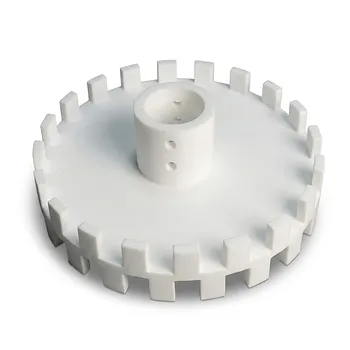
Polytetrafluoroethylene (PTFE) rotors are specified for these high-stakes industries because they provide a chemically inert, non-stick, and non-porous interface that ensures product purity.
By meeting rigorous FDA and USP Class VI regulatory standards, PTFE guarantees that no extractables or leachables will contaminate the media. Furthermore, its unique physical properties allow for rapid Clean-in-Place (CIP) cycles and the safe processing of heat-sensitive biological emulsions.
Core Takeaway: PTFE is the gold standard for rotors because it eliminates the risk of chemical migration and bacterial harboring while simultaneously protecting the integrity of sensitive formulations through its low-friction and non-reactive surface.
Achieving Absolute Material Purity
Chemical Inertness and Regulatory Compliance
PTFE is virtually non-reactive with almost all acids, bases, and organic solvents used in processing. This characteristic ensures that the rotor does not degrade or leach chemicals into the product, which is critical for drug stability and food safety.
By adhering to FDA and USP Class VI standards, PTFE rotors simplify the regulatory approval process for manufacturers. These certifications prove the material is physiologically harmless and will not cause adverse reactions when in contact with consumables.
Prevention of Microbial Growth
Unlike many plastics or metals, virgin PTFE features a non-porous surface that lacks microscopic depressions. These depressions are often where microbes hide and multiply in other materials.
The absence of these "micro-pockets" ensures that bacteria cannot take hold on the rotor surface. This makes PTFE an essential component in maintaining the sterile environments required for biotechnology and pharmaceutical manufacturing.
Streamlining Cleaning and Validation
Efficiency in Clean-in-Place (CIP) Cycles
The non-stick nature of PTFE prevents product residue from adhering to the rotor during operation. This significantly reduces the time and water required for Clean-in-Place (CIP) and Steam-in-Place (SIP) protocols.
Faster cleaning cycles lead to reduced validation time between batches. This efficiency minimizes the risk of cross-contamination and allows for higher equipment throughput in multi-product facilities.
Resistance to Aggressive Cleaning Agents
Pharmaceutical and food processing often involve harsh sterilization chemicals and high-temperature steam. PTFE can withstand these aggressive environments without losing its structural integrity or surface finish.
This durability ensures a long service life even when the equipment is subjected to frequent sterilization cycles. It prevents the material fatigue that often leads to particulate shedding in lesser materials.
Protecting Heat and Shear-Sensitive Media
Low Friction for Thermal Stability
PTFE has one of the lowest coefficients of friction of any solid material. This property is vital for minimizing heat generation during high-speed rotation.
By keeping temperatures low, PTFE rotors protect heat-sensitive biological samples, vitamins, or emulsions from denaturing. This ensures that the final product maintains its intended potency and shelf-life.
Handling Shear-Sensitive Biologics
The smooth, low-friction surface of PTFE supports the gentle flow of shear-sensitive fluids. This is particularly important in biotechnology, where delicate cell structures or proteins can be damaged by turbulence or mechanical stress.
Understanding the Technical Trade-offs
Dimensional Stability and "Cold Flow"
While PTFE is chemically superior, it is susceptible to "cold flow" or creep under heavy mechanical loads. This means that under constant pressure, the material may slowly deform over time.
Engineers must account for this by using reinforced PTFE grades or specific housing designs if the application involves extreme pressures. For standard mixing and pumping, however, the benefits of inertness far outweigh this limitation.
Thermal Expansion Considerations
PTFE has a higher coefficient of thermal expansion than the stainless steel components it often interacts with. In processes with wide temperature swings, clearances must be precisely calculated to prevent binding or leaking.
How to Apply This to Your Process
When selecting or specifying a rotor for a regulated environment, your choice should be driven by the specific sensitivity of your media and your cleaning protocols.
- If your primary focus is Regulatory Compliance: Ensure you specify Virgin PTFE that carries both FDA and USP Class VI documentation to satisfy auditors and safety standards.
- If your primary focus is Operational Efficiency: Leverage PTFE’s non-stick properties to shorten your CIP cycles and reduce the volume of cleaning agents required.
- If your primary focus is Product Integrity: Utilize PTFE’s low friction to handle delicate biological formulations that are prone to heat degradation or shear stress.
By choosing PTFE rotors, you are investing in a material that prioritizes the safety of the consumer and the purity of the science.
Summary Table:
| Key Feature | Benefit | Regulatory/Industry Impact |
|---|---|---|
| Chemical Inertness | Eliminates leaching and product contamination | Ensures drug stability & FDA/USP Class VI compliance |
| Non-Porous Surface | Prevents bacterial and microbial harboring | Essential for maintaining sterile biotech environments |
| Non-Stick Texture | Facilitates rapid Clean-in-Place (CIP) cycles | Reduces downtime and cross-contamination risks |
| Low Friction | Minimizes heat generation during rotation | Protects heat-sensitive biological emulsions |
Precision Fluoropolymer Solutions for Your Critical Lab Processes
In high-stakes pharmaceutical and biotechnology environments, the integrity of your equipment defines the purity of your results. KINTEK is your premier partner for high-performance laboratory supplies, offering an exhaustive catalog of products crafted exclusively from PTFE and PFA.
From everyday essentials like beakers, crucibles, and reagent bottles to advanced tools including hydrothermal synthesis liners, electrochemical cells, and microchannel reactors, we provide materials that withstand the most aggressive chemical environments. Our capabilities extend beyond standard labware to end-to-end custom CNC fabrication, enabling us to deliver complex, non-standard machined parts and bespoke setups tailored to your exact specifications.
Whether you require high-volume consumables or specialized fluid transfer components like precision valves and tubing, KINTEK ensures absolute material purity and performance.
Ready to upgrade your laboratory setup with medical-grade fluoropolymers? Contact our expert team today and let us manufacture the solution you need.
Related Products
- High Purity PTFE Wide Mouth Extraction Bottle Large Capacity Reaction Vessel for Rotary Agitators
- Large Capacity PTFE Reaction Bottle 2L Wide Mouth Fluoropolymer Extraction Vessel Compatible with Rotary Agitators
- Customizable PTFE Rods for Advanced Industrial Applications
- High Corrosion Resistant PTFE Faucet Polytetrafluoroethylene Valve for Chemical Storage Drums and Fluid Transfer Systems Customizable Industrial Grade
- Custom Graphite Filled PTFE Rods for Advanced Industrial Applications
People Also Ask
- What are the temperature limits for the PTFE bottle? Ensure Safety from -200°C to 260°C
- What are the advantages of the PTFE bottle's non-stick surface? Ensure Purity and Efficiency in Your Lab
- What are the key applications of the PTFE bottle? Ensure Chemical Safety and Sample Purity
- What material is the PTFE bottle made from? Discover the Benefits of 100% Virgin PTFE
- What makes the PTFE bottle durable? Unmatched Chemical & Thermal Stability for Demanding Applications