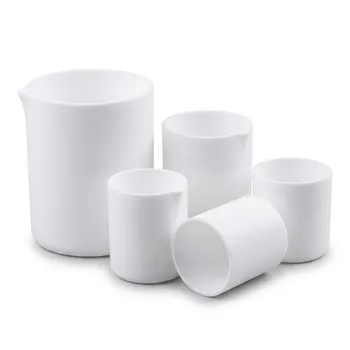
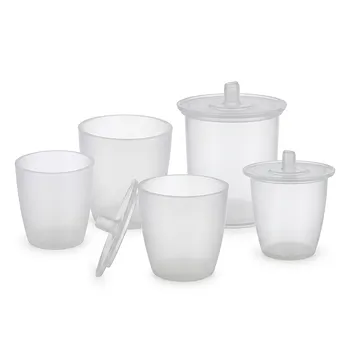
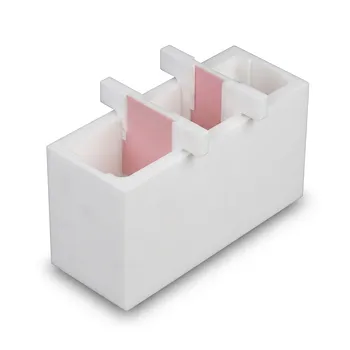
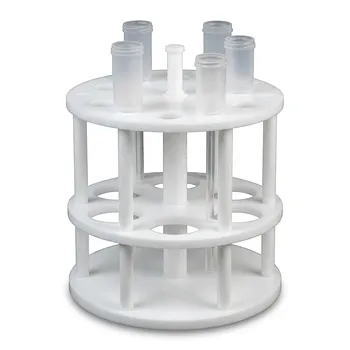
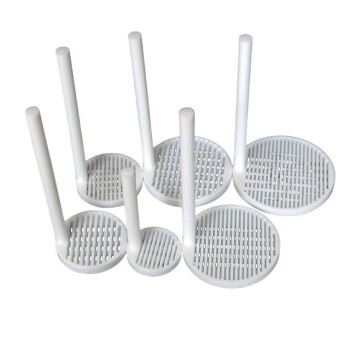
Custom PTFE laboratory components are not injection molded because high-molecular-weight PTFE does not become a freely flowing liquid when heated. Above its melting point, typically around 327 °C, it forms a highly viscous, gel-like phase with negligible flow. Manufacturers therefore compact PTFE resin into a preform, sinter it into a dense solid, and machine that stock into the required geometry.
PTFE’s exceptional molecular weight and chemical resistance make it valuable in laboratories, but those same properties prevent conventional melt processing. Pressing and sintering preserve the material’s performance, while machining provides the dimensional accuracy and complex shapes that molding cannot readily deliver.
Why PTFE Cannot Use Conventional Injection Molding
Its Melt Viscosity Is Extremely High
Most thermoplastics are heated until they become sufficiently fluid to flow through an injection barrel, runner, and mold cavity. High-molecular-weight PTFE behaves differently: even above its melting temperature, its melt viscosity remains extraordinarily high.
PTFE is commonly described as having melt creep viscosity on the order of 10^10 to 10^11 Pa·s under elevated-temperature conditions. It therefore does not flow through conventional injection equipment in the way that lower-viscosity plastics do.
Its Molecular Structure Restricts Flow
PTFE has a very high molecular weight, a largely linear molecular structure, and high crystallinity. Its carbon backbone is strongly shielded by fluorine atoms, which contributes to its chemical inertness and low friction but also limits molecular mobility.
The result is a material that softens and undergoes a transition above its melting point without becoming a practical, pumpable molding liquid.
Conventional Injection Molding Depends on Flow
Injection molding requires the polymer melt to fill a mold rapidly, reproduce thin sections, and pack against the mold walls before solidifying. PTFE cannot reliably perform these functions under conventional processing conditions.
Increasing temperature is not a simple solution. Excessive heating can degrade the polymer, while the material still does not develop the flow behavior required for standard injection molding.
How Pressing and Sintering Form PTFE Stock
Granular Resin Is Compacted Into a Preform
Manufacturing begins with PTFE resin in granular or powdered form. The resin is compressed at room temperature into a high-density preform, such as a billet, rod, tube, sheet, or near-net-shape blank.
This step shapes the loose particles without requiring the polymer to flow as a melt.
Sintering Fuses the Particles
The compacted preform is heated above PTFE’s melting point under controlled conditions. The particles coalesce and fuse into a continuous, dense solid.
Sintering is therefore different from conventional melt molding. The material is heated enough to develop molecular contact and consolidate the structure, but it is not injected as a low-viscosity liquid into a mold.
The Process Preserves PTFE’s Performance
Carefully controlled pressing and sintering help retain the properties that make PTFE suitable for demanding laboratory service. These include high chemical resistance, thermal endurance, low friction, electrical insulation, and material purity.
The process also avoids introducing the additives or processing conditions that could compromise performance in chemically aggressive or contamination-sensitive environments.
Why Machining Is Used for Custom Components
Machining Provides Geometric Freedom
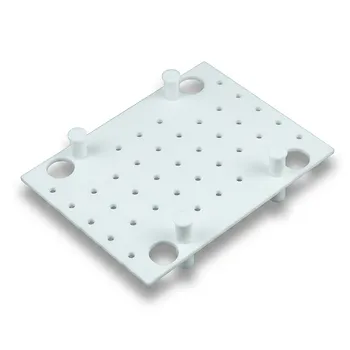
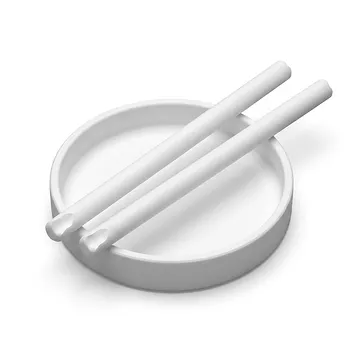
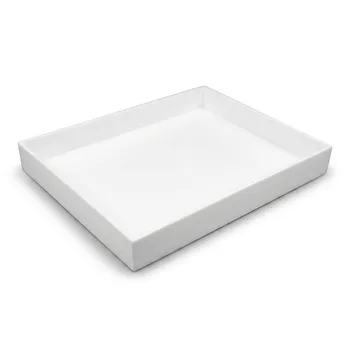
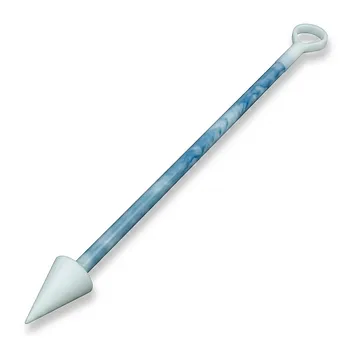
Once a sintered billet or other stock shape has been produced, it can be turned, milled, drilled, bored, or routed into the final component. CNC machining can create internal channels, threaded connections, sealing surfaces, vessel cavities, and other features that would be difficult to form through compression alone.
This is particularly important for custom reaction vessels, electrochemical cells, fluid-transfer fittings, valves, liners, and non-standard laboratory fixtures.
It Supports Tight Dimensional Control
Machining removes material until the component reaches its specified dimensions. This allows manufacturers to control critical features such as wall thickness, bore diameter, flatness, thread geometry, and mating surfaces.
For laboratory equipment, those details can determine whether a part seals correctly, fits existing apparatus, or delivers a predictable fluid path.
Custom Volumes Do Not Justify Dedicated Tooling
Injection molding is most economical when many identical parts can amortize the cost of specialized molds and processing equipment. Custom laboratory components are often produced in low quantities and may be revised for a particular experiment or instrument.
Machining from standard PTFE stock avoids the need to design and manufacture a dedicated mold for every unusual geometry.
Why This Route Matters in Laboratory Applications
Chemical Compatibility Is the Primary Requirement
Many laboratory components contact strong acids, bases, solvents, oxidizing chemicals, or reactive samples. PTFE is selected because it provides broad chemical resistance in situations where metals, glass, elastomers, or other plastics may be unsuitable.
The manufacturing route is valuable because it produces components from the same high-performance PTFE material rather than requiring a more easily processed polymer with lower chemical resistance.
Purity and Reliability Matter
Laboratory hardware can affect sample integrity, reaction results, and analytical measurements. A chemically resistant component is not sufficient if it sheds contaminants, degrades at operating temperature, or fails under repeated use.
Dense sintered PTFE stock, followed by controlled machining and appropriate cleaning, supports reliable service in demanding laboratory environments.
The Material Is Built Around Its Properties
PTFE’s processing difficulty is closely related to its useful performance. The molecular characteristics that prevent easy melt flow also contribute to its low surface energy, low friction, thermal stability, and chemical inertness.
Manufacturers accept the specialized fabrication route because the resulting properties are often more important than the convenience of low-cost molding.
Understanding the Trade-offs
Machining Can Produce Significant Waste
Machining a custom component from a billet removes material that may not become part of the finished product. For complex vessels or heavily hollowed geometries, the resulting scrap can be substantial.
This increases material consumption and production cost compared with a well-designed near-net-shape molding process.
Production Is Slower Than High-Volume Molding
Pressing, sintering, setup, machining, inspection, and finishing generally require more individual operations than conventional injection molding. Lead times and unit costs can therefore be higher, especially for one-off parts or small production runs.
The trade-off is justified when the required geometry, material performance, or quantity makes conventional molding impractical.
PTFE Requires Careful Dimensional Control
PTFE can deform under sustained load and can exhibit thermal expansion and dimensional changes related to its processing history. Designers and machinists must account for tolerances, shrinkage during sintering, operating temperature, and long-term mechanical loading.
A machined part is precise at inspection, but its design must still reflect PTFE’s mechanical behavior in service.
Not Every Fluoropolymer Has the Same Limitation
The explanation applies primarily to high-molecular-weight, unfilled or standard PTFE. Some modified fluoropolymers and lower-viscosity fluoroplastic grades are melt-processable and may be injection molded or extruded.
The correct manufacturing method therefore depends on the specific polymer grade, filler system, geometry, tolerance requirements, and application conditions.
Making the Right Choice for Your Goal
The appropriate process follows from the part’s performance requirements, quantity, and geometry.
- If your primary focus is chemical resistance and purity: Use sintered high-performance PTFE stock and specify machining and cleaning controls appropriate for contamination-sensitive laboratory service.
- If your primary focus is complex custom geometry: Use precision CNC machining after pressing and sintering, particularly for internal cavities, channels, threads, and non-standard interfaces.
- If your primary focus is low-volume production: Prefer machining from pre-formed PTFE billets because dedicated injection-molding tooling is unlikely to be economical.
- If your primary focus is high-volume production: Evaluate near-net-shape compression molding or a different melt-processable fluoropolymer, provided its chemical, thermal, and purity characteristics meet the application.
- If your primary focus is dimensional stability: Include sintering behavior, thermal expansion, creep, and sustained loading in the design and tolerance analysis.
The pressing, sintering, and machining route is not a workaround for PTFE’s limitations; it is the established method that converts its exceptional material properties into dependable custom laboratory components.
Summary Table:
| Aspect | Pressing & Sintering + Machining | Conventional Melt-Injection Molding |
|---|---|---|
| Melt flow | Not required; powder compacted and fused | Requires low-viscosity melt flow |
| Material suitability | High-molecular-weight PTFE | Not suitable for standard PTFE |
| Geometry complexity | High (via CNC machining) | Limited by mold design |
| Production volume | Low to medium (custom) | High (mass production) |
| Tooling cost | Low (no molds) | High (dedicated molds) |
| Chemical resistance | Preserved (pure PTFE) | May be compromised by additives |
| Dimensional accuracy | High (controlled machining) | Good but limited by shrinkage |
| Waste material | Higher (machining waste) | Lower (near-net shape) |
Looking for custom PTFE lab components that meet the highest standards of chemical resistance and precision? At KINTEK, we specialize in manufacturing laboratory supplies from PTFE and PFA through pressing, sintering, and advanced CNC machining. Whether you need standard beakers, custom electrochemical cells, or complex fluid handling components, our expertise ensures superior performance and reliability. Contact us today to discuss your requirements and discover how our solutions can enhance your lab's efficiency and accuracy. Get in touch with us for a personalized consultation.
Related Products
- Custom PTFE Parts Manufacturer for Teflon Containers and Components
- Custom PTFE Laboratory Apparatus Corrosion Resistant Low Background Reaction Cells Precision CNC Fabrication
- Custom Machined Molded PTFE Teflon Parts Manufacturer for Laboratory ITO FTO Conductive Glass Cleaning Flower Basket
- Corrosion Resistant PTFE Dispersing Disc and High Temperature Propeller Stirring Paddle for Laboratory Chemical Mixing
- Large Scale PTFE Beakers and Flasks for High Temperature Corrosion Resistant Laboratory Applications with Custom CNC Fabrication
People Also Ask
- What design considerations are important for custom PTFE parts? Design for Performance & Reliability
- What industries use custom PTFE parts and for what purposes? Solve Critical Challenges with High-Performance Materials
- What advantages do custom PTFE parts offer for industrial efficiency? Boost Uptime & Cut Costs
- What industries benefit most from custom PTFE parts? Solve Extreme Environment Challenges
- What are the main advantages of using PTFE for custom parts? Solve Complex Engineering Challenges